

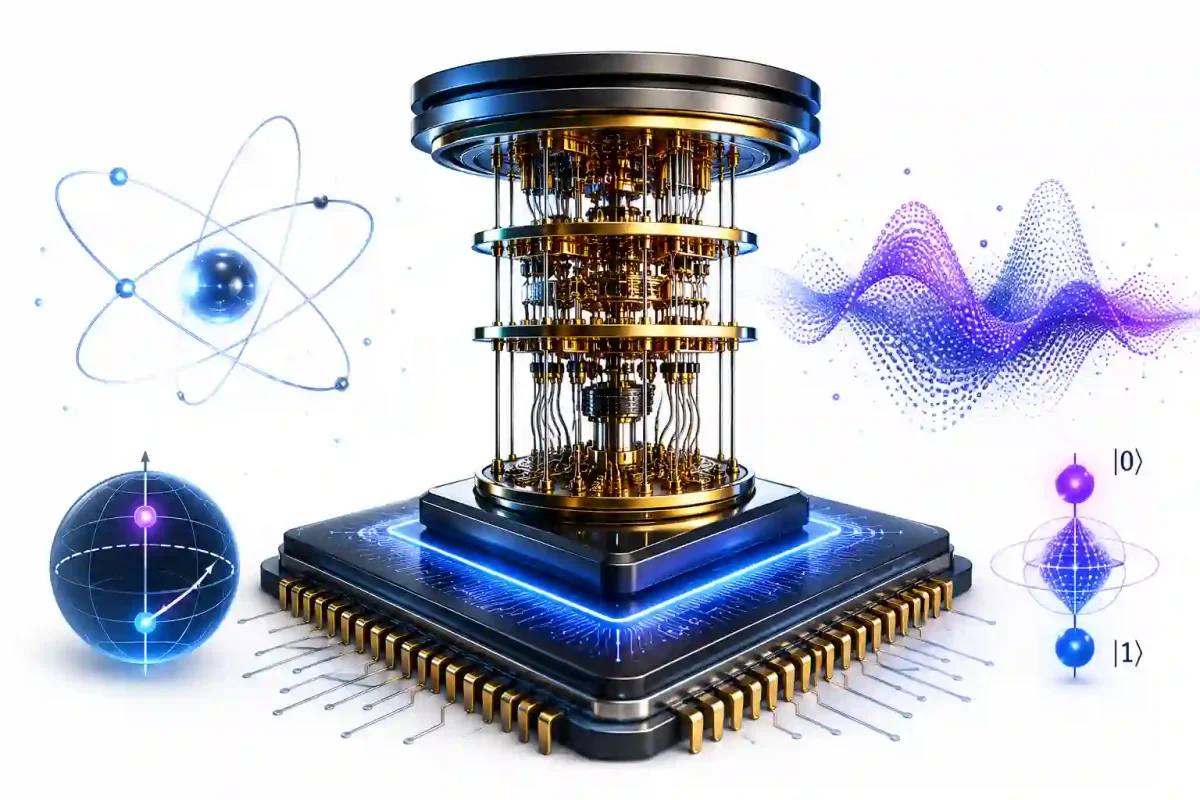
Modern computers have transformed nearly every aspect of our lives. Whether you’re browsing the web, streaming videos, using artificial intelligence, or sending emails, every digital task relies on classical computers processing billions of calculations every second. Over the past several decades, classical computing has become faster, smaller, and more efficient, enabling innovations that once seemed impossible.
However, some of today’s most complex scientific and engineering problems remain beyond the capabilities of even the world’s fastest supercomputers. Simulating molecules, designing advanced medicines, optimizing global supply chains, and breaking certain mathematical problems can require an impractical amount of computing power and time.
To overcome these limitations, researchers have developed an entirely new approach to computing known as quantum computing.
Unlike traditional computers that process information using bits with values of either 0 or 1, quantum computers use quantum bits (qubits) that follow the laws of quantum mechanics. These unique properties allow quantum computers to explore multiple possibilities simultaneously, making them exceptionally powerful for solving specific classes of problems.
Although quantum computing is still an emerging technology, it is already transforming fields such as cryptography, artificial intelligence, finance, healthcare, chemistry, and materials science. Major technology companies including IBM, Google, Microsoft, Amazon, and Intel are investing billions of dollars to build practical quantum computers.
In this comprehensive beginner’s guide, you’ll learn:
- What quantum computing is
- How quantum computers work
- What qubits, superposition, and entanglement mean
- The different types of quantum computers
- Popular quantum algorithms
- Real-world applications
- Challenges facing quantum computing
- Career opportunities in the quantum industry
- The future of quantum technology
Whether you’re a student, developer, cybersecurity enthusiast, or simply curious about future technologies, this guide will help you understand quantum computing from the ground up.
What Is Quantum Computing?
Quantum computing is a revolutionary type of computing that uses the principles of quantum mechanics to process information in ways that are fundamentally different from classical computers.
Traditional computers represent information using bits, where each bit can only store one of two possible values:
- 0
- 1
Quantum computers instead use quantum bits, commonly called qubits.
Unlike classical bits, qubits can exist in multiple states at the same time because of the unique laws of quantum physics. This enables quantum computers to perform many calculations simultaneously for specific problems, making them dramatically faster than classical computers in certain situations.
It’s important to understand that quantum computers are not designed to replace your laptop or smartphone. Instead, they are specialized machines built to solve problems that would take classical computers years—or even millions of years—to complete.
Today, quantum computing is one of the fastest-growing areas of computer science and is expected to play an important role in future technologies.
Understanding Classical Computing
Before learning how quantum computers work, it’s useful to understand the foundation of traditional computing.
Every modern digital device—including smartphones, laptops, desktop computers, gaming consoles, servers, and cloud data centers—uses classical computing.
Classical computers process information using binary digits, commonly known as bits.
A bit has only two possible values.
| Bit Value | Represents |
|---|---|
| 0 | Off |
| 1 | On |
Although this system appears simple, combining billions of bits enables computers to perform highly sophisticated tasks.
Modern processors contain billions of microscopic transistors that continuously switch between these two states while executing instructions.
Examples of tasks performed by classical computers include:
- Opening applications
- Playing games
- Editing videos
- Running operating systems
- Browsing websites
- Training many artificial intelligence models
- Processing financial transactions
Despite their incredible performance, classical computers have practical limitations.
As transistor sizes continue shrinking toward atomic scales, engineers face increasing challenges related to:
- Heat generation
- Energy consumption
- Manufacturing complexity
- Physical size limitations
Additionally, some computational problems grow exponentially more difficult as the amount of data increases.
For example, simulating complex molecular interactions or solving large optimization problems may require computational resources beyond the capabilities of today’s most powerful supercomputers.
This is one of the primary reasons why researchers began exploring quantum computing.
The Birth of Quantum Computing
The concept of quantum computing originated during the early 1980s when scientists realized that classical computers struggled to accurately simulate quantum systems.
In 1981, Nobel Prize-winning physicist Richard Feynman proposed an innovative idea.
Instead of trying to simulate quantum mechanics using classical computers, why not build computers that themselves operate according to the laws of quantum mechanics?
This groundbreaking concept laid the foundation for quantum computing.
A few years later, physicist David Deutsch introduced the idea of a universal quantum computer, providing a theoretical framework for performing general-purpose quantum computations.
During the 1990s, researchers developed powerful quantum algorithms that demonstrated quantum computing’s enormous potential.
Some of the most influential contributors include:
| Scientist | Major Contribution |
|---|---|
| Richard Feynman | Proposed quantum simulation |
| David Deutsch | Universal quantum computer |
| Peter Shor | Integer factorization algorithm |
| Lov Grover | Quantum search algorithm |
These discoveries transformed quantum computing from a theoretical curiosity into one of the world’s most active research fields.
Today, governments, universities, and technology companies collectively invest billions of dollars every year into quantum research.
What Is a Qubit?
A qubit, short for quantum bit, is the basic unit of information in a quantum computer.
Just as classical computers use bits, quantum computers use qubits.
However, the behavior of a qubit is fundamentally different.
A classical bit can exist in only one state at a time.
0or
1A qubit, however, can exist in a combination of both states simultaneously until it is measured.
Mathematically, a qubit is represented as:
|ψ⟩ = α|0⟩ + β|1⟩Where:
- α represents the probability amplitude of state 0
- β represents the probability amplitude of state 1
- The probabilities always satisfy:
|α|² + |β|² = 1Although the mathematics may seem intimidating, the key idea is simple:
A qubit can represent multiple possibilities at the same time, giving quantum computers extraordinary computational power for specific tasks.
Researchers create physical qubits using several different technologies, including:
- Superconducting circuits
- Trapped ions
- Photons
- Neutral atoms
- Semiconductor quantum dots
Each technology has its own advantages and engineering challenges, which we’ll explore later in this guide.
Superposition Explained
One of the most fascinating principles of quantum computing is superposition. It allows a qubit to exist in more than one state at the same time until it is measured.
To understand superposition, imagine flipping a coin into the air. While it’s spinning, you don’t consider it purely heads or tails. It has the potential to become either outcome when it lands.
A qubit behaves somewhat similarly. Instead of storing only 0 or 1, it can represent a combination of both states simultaneously.
Unlike a classical computer, which must evaluate one possibility after another, a quantum computer can evaluate many possibilities at the same time. This ability is one of the key reasons quantum computers can outperform classical computers for certain computational problems.
It is important to remember that superposition does not mean a quantum computer instantly knows every answer. Instead, it explores multiple computational paths simultaneously and uses quantum algorithms to increase the probability of obtaining the correct result.
Why Is Superposition Powerful?
The computational power of a quantum computer grows exponentially as more qubits are added.
| Number of Qubits | Possible Quantum States |
|---|---|
| 1 | 2 |
| 2 | 4 |
| 3 | 8 |
| 5 | 32 |
| 10 | 1,024 |
| 20 | 1,048,576 |
| 50 | Over 1 quadrillion |
This exponential growth is what makes quantum computing so promising for solving highly complex optimization, simulation, and cryptographic problems.
Quantum Entanglement
Another remarkable property of quantum mechanics is entanglement.
When two or more qubits become entangled, their quantum states become linked. Measuring one qubit immediately influences the state of the other, regardless of the physical distance separating them.
Albert Einstein famously referred to this phenomenon as:
“Spooky action at a distance.”
Although the phrase sounds mysterious, entanglement has been repeatedly confirmed through scientific experiments.
Entanglement enables quantum computers to coordinate multiple qubits in ways that are impossible for classical computers. It also plays a vital role in quantum communication, quantum cryptography, and many quantum algorithms.
Without entanglement, most modern quantum computing techniques would not be possible.
Quantum Interference
Another important principle behind quantum computing is quantum interference.
Quantum interference allows a quantum computer to manipulate probability amplitudes.
Instead of treating every possible solution equally, interference helps:
- Increase the probability of correct answers
- Reduce the probability of incorrect answers
Think of it like multiple water waves interacting.
When two waves combine, they can:
- Strengthen each other (constructive interference)
- Cancel each other out (destructive interference)
Quantum algorithms use the same principle to amplify desirable computational paths while suppressing incorrect ones.
This process greatly improves the chances of obtaining the correct answer after measuring the qubits.
Quantum Gates
Classical computers perform calculations using logic gates such as:
- AND
- OR
- XOR
- NOT
Quantum computers instead use quantum gates, which manipulate qubits according to the principles of quantum mechanics.
Unlike classical logic gates, quantum gates operate on probability amplitudes rather than simple binary values.
Some of the most common quantum gates include:
| Quantum Gate | Purpose |
|---|---|
| X Gate | Flips a qubit (Quantum NOT) |
| H Gate (Hadamard) | Creates superposition |
| Z Gate | Changes the phase of a qubit |
| Y Gate | Rotates the qubit state |
| CNOT Gate | Creates entanglement between two qubits |
| SWAP Gate | Exchanges the states of two qubits |
Quantum gates are the fundamental building blocks of every quantum algorithm.
Quantum Circuits
A quantum circuit is a sequence of quantum operations performed on qubits.
Just as classical programs consist of CPU instructions, quantum programs consist of quantum circuits.
A typical quantum circuit includes:
- Initializing qubits
- Applying quantum gates
- Creating superposition
- Generating entanglement
- Measuring the final quantum state
A simplified quantum circuit looks like this:
Qubit
  │
  ▼
Hadamard Gate
  │
  ▼
CNOT Gate
  │
  ▼
Measurement
The order of these operations determines how information is processed.
Modern quantum programming frameworks such as Qiskit, Cirq, and PennyLane allow developers to build these circuits using programming languages like Python.
How Quantum Computers Work
Although quantum computers are built using highly advanced hardware, their basic workflow can be understood through a series of steps.
Step 1: Initialize Qubits
The quantum processor prepares all qubits in a known initial state.
Step 2: Create Superposition
Hadamard gates place selected qubits into superposition so they can represent multiple possibilities simultaneously.
Step 3: Apply Quantum Gates
Quantum gates manipulate the qubits according to the algorithm being executed.
Step 4: Generate Entanglement
Specific gates create entanglement between qubits, allowing them to work together during computation.
Step 5: Use Quantum Interference
The algorithm amplifies correct computational paths while reducing incorrect ones using interference.
Step 6: Measure the Qubits
After computation is complete, the qubits are measured.
Measurement causes the quantum state to collapse into classical binary values.
Step 7: Obtain the Final Result
The measured values are interpreted as the solution produced by the quantum algorithm.
Because quantum systems are probabilistic, many algorithms must be executed multiple times to achieve highly accurate results.
Types of Quantum Computers
Researchers are developing quantum computers using several different hardware technologies.
Each approach has unique strengths and engineering challenges.
Superconducting Qubits
Superconducting quantum computers use tiny electrical circuits cooled to temperatures close to absolute zero.
Major companies using this technology include:
- IBM
- Rigetti Computing
Advantages
- Fast quantum gate operations
- Mature manufacturing techniques
- Strong industry support
Disadvantages
- Extremely sensitive to environmental noise
- Requires complex cryogenic cooling systems
Trapped Ion Quantum Computers
This approach stores qubits using electrically charged atoms called ions.
Powerful lasers manipulate the ions to perform quantum computations.
Organizations working with trapped-ion technology include:
- IonQ
- Quantinuum
Advantages
- High computational accuracy
- Long coherence times
- Excellent qubit stability
Disadvantages
- Slower gate operations
- Difficult to scale to very large systems
Photonic Quantum Computers
Photonic quantum computers use particles of light, known as photons, to carry quantum information.
Unlike many other quantum technologies, photons can often operate at or near room temperature.
Advantages
- Reduced environmental interference
- Easier long-distance quantum communication
- Room-temperature operation
Disadvantages
- Challenging hardware design
- Difficult photon synchronization
Topological Quantum Computers
Topological quantum computing is still largely experimental.
Instead of relying on traditional qubits, it aims to encode information in special quantum states that are naturally resistant to errors.
Microsoft has invested heavily in this research area.
Potential Advantages
- Improved error resistance
- Greater stability
- Better scalability for future quantum computers
Although practical topological quantum computers have not yet been built, they represent one of the most exciting long-term directions in quantum research.
Quantum Algorithms
The true power of quantum computing comes from quantum algorithms. These algorithms are specifically designed to leverage quantum mechanical principles such as superposition, entanglement, and interference to solve problems more efficiently than classical algorithms.
Unlike traditional algorithms that process data sequentially, quantum algorithms manipulate qubits through quantum gates to explore multiple computational paths simultaneously.
While quantum computers are not universally faster than classical computers, they can provide significant speed advantages for certain types of problems, including integer factorization, database searching, optimization, and molecular simulation.
Some of the most famous quantum algorithms include:
- Shor’s Algorithm
- Grover’s Algorithm
- Quantum Phase Estimation
- Quantum Fourier Transform
- Variational Quantum Eigensolver (VQE)
- Quantum Approximate Optimization Algorithm (QAOA)
Let’s explore the two most well-known algorithms.
Shor’s Algorithm
Introduced by mathematician Peter Shor in 1994, Shor’s Algorithm demonstrated that quantum computers could solve a problem previously believed to be computationally infeasible for classical computers.
The algorithm efficiently factors very large integers into their prime factors.
For example:
15 = 3 × 5Factoring small numbers is easy, but factoring numbers hundreds or thousands of digits long becomes extraordinarily difficult for classical computers.
This difficulty forms the security foundation of encryption systems such as:
- RSA
- Rivest–Shamir–Adleman Cryptography
A sufficiently powerful quantum computer running Shor’s Algorithm could factor these large numbers much faster than any known classical algorithm.
Why Is Shor’s Algorithm Important?
Potential benefits include:
- Faster mathematical computations
- Advances in scientific research
- New cryptographic techniques
Potential concerns include:
- Breaking today’s public-key encryption
- Requiring new quantum-resistant security standards
This is one of the primary reasons researchers are developing post-quantum cryptography.
Grover’s Algorithm
Another groundbreaking quantum algorithm is Grover’s Algorithm, developed by Lov Grover in 1996.
It provides a faster method for searching an unsorted database.
Suppose you have one million records and need to find a specific item.
A classical computer may need to examine every entry.
Average complexity:
O(N)Grover’s Algorithm reduces this to approximately:
O(√N)Although this is not an exponential improvement like Shor’s Algorithm, it still represents a substantial speedup for many search-related problems.
Potential applications include:
- Database searching
- Optimization
- Artificial intelligence
- Machine learning
- Cybersecurity
- Pattern recognition
Quantum Simulation
One of the earliest motivations for building quantum computers was the simulation of quantum systems.
Nature itself behaves according to quantum mechanics.
Unfortunately, accurately simulating molecules and atoms becomes incredibly difficult for classical computers as the system grows larger.
Quantum computers are naturally suited to these problems.
Applications of quantum simulation include:
- Drug discovery
- Protein folding analysis
- Material science
- Chemical engineering
- Battery development
- Semiconductor research
For example, pharmaceutical researchers may use quantum simulations to understand how molecules interact with diseases, potentially reducing the time required to develop new medicines.
Similarly, engineers can design stronger materials and more efficient batteries using quantum simulations that would be impractical on classical systems.
Quantum Supremacy
Quantum supremacy refers to the point at which a quantum computer performs a computational task that would be practically impossible for the world’s most powerful classical supercomputers.
In 2019, Google announced that its Sycamore quantum processor completed a specialized calculation in approximately 200 seconds.
Google estimated that the same task would require a classical supercomputer thousands of years to complete.
Although researchers debated the exact comparison, the achievement represented a major milestone in quantum computing history.
It demonstrated that quantum hardware had reached a level where it could outperform classical computers on certain carefully designed problems.
However, it is important to understand that quantum supremacy does not mean quantum computers outperform classical computers for every task.
Today’s quantum computers remain highly specialized and are still considered experimental.
Real-World Applications
Although practical large-scale quantum computers are still under development, organizations worldwide are already exploring how quantum computing can solve real-world problems.
Several industries are expected to benefit significantly over the coming decades.
Healthcare
Healthcare is one of the most promising fields for quantum computing.
Researchers hope quantum computers will dramatically accelerate medical discoveries.
Potential applications include:
- Drug discovery
- Personalized medicine
- Protein folding analysis
- DNA research
- Medical imaging optimization
Instead of testing millions of possible drug combinations through lengthy laboratory experiments, scientists may eventually use quantum simulations to predict molecular behavior much faster.
This could significantly reduce the cost and development time of life-saving medicines.
Finance
Financial institutions process enormous amounts of data every day.
Quantum computing may improve:
- Portfolio optimization
- Risk analysis
- Fraud detection
- Market prediction
- Option pricing
Banks and investment firms are actively researching quantum algorithms that could improve decision-making and financial modeling.
Artificial Intelligence
Artificial intelligence often requires processing massive datasets and solving complex optimization problems.
Quantum computing has the potential to accelerate several AI-related tasks, including:
- Machine learning
- Neural network optimization
- Data classification
- Pattern recognition
- Natural language processing
Although quantum AI remains an emerging research area, many experts believe it could become one of the most transformative applications of quantum computing.
Cybersecurity
Quantum computing presents both opportunities and challenges for cybersecurity.
Potential benefits include:
- Stronger encryption methods
- Quantum key distribution
- Secure communications
- Advanced security analysis
Potential risks include:
- Breaking existing RSA encryption
- Weakening ECC-based cryptography
- Requiring migration to post-quantum cryptography
Governments and technology companies worldwide are already preparing for the transition to quantum-resistant security standards.
Logistics
Modern logistics involves solving complex optimization problems.
Quantum computers may improve:
- Delivery route planning
- Traffic optimization
- Warehouse management
- Supply chain optimization
- Fleet scheduling
Even small improvements in logistics efficiency could save companies millions of dollars each year.
Climate Science
Climate systems involve enormous numbers of interacting variables.
Quantum computing may help scientists:
- Improve climate prediction models
- Design efficient solar panels
- Develop better batteries
- Discover cleaner energy technologies
- Optimize carbon capture systems
By enabling more accurate simulations, quantum computers could contribute to solving some of humanity’s greatest environmental challenges.
Quantum Computing and Cryptography
Modern internet security depends heavily on cryptography. Every time you log in to a website, make an online payment, send an encrypted email, or access cloud storage, cryptographic algorithms protect your data from unauthorized access.
Today’s most widely used public-key encryption algorithms include:
- RSA
- Elliptic Curve Cryptography (ECC)
- Diffie-Hellman Key Exchange
These algorithms rely on mathematical problems that are extremely difficult for classical computers to solve within a practical timeframe.
However, large-scale fault-tolerant quantum computers could solve some of these mathematical problems much more efficiently using Shor’s Algorithm.
As a result, cybersecurity experts around the world are preparing for a future where current encryption standards may no longer provide sufficient protection.
Fortunately, researchers are also developing new cryptographic techniques designed to remain secure even against quantum attacks.
Post-Quantum Cryptography
Post-Quantum Cryptography (PQC) refers to cryptographic algorithms specifically designed to resist attacks from both classical and quantum computers.
Unlike quantum cryptography, which often requires specialized hardware, post-quantum cryptography can generally be implemented using existing computers and communication networks.
Several promising post-quantum algorithms are based on mathematical problems such as:
- Lattice-based cryptography
- Hash-based cryptography
- Code-based cryptography
- Multivariate cryptography
- Isogeny-based cryptography
Many governments and organizations are already preparing to migrate toward these new standards.
Benefits of post-quantum cryptography include:
- Protection against future quantum attacks
- Compatibility with existing internet infrastructure
- Long-term data security
- Safer digital communications
The transition to quantum-resistant encryption is expected to take many years, making early preparation essential.
Major Companies Working on Quantum Computing
Quantum computing has become one of the world’s fastest-growing technology sectors. Governments, universities, and private companies are investing billions of dollars into research and development.
Here are some of the leading organizations driving innovation.
IBM
IBM is one of the pioneers in quantum computing.
The company provides cloud-based quantum computers through IBM Quantum, allowing researchers, students, and developers worldwide to experiment with real quantum hardware.
IBM has also developed the open-source Qiskit framework, one of the most popular software development kits for quantum programming.
IBM’s long-term goal is to build large-scale, fault-tolerant quantum computers capable of solving practical business and scientific problems.
Google’s Quantum AI division focuses on developing superconducting quantum processors.
In 2019, Google announced that its Sycamore processor achieved quantum supremacy by solving a specialized computational task significantly faster than a classical supercomputer.
Google continues researching:
- Quantum hardware
- Quantum error correction
- Scalable quantum processors
- Quantum algorithms
The company aims to develop practical quantum systems capable of solving real-world scientific challenges.
Microsoft
Microsoft approaches quantum computing through both hardware and software innovation.
The company has developed the Azure Quantum platform, enabling researchers and developers to access various quantum computing technologies through the cloud.
Microsoft also created Q# (Q Sharp), a programming language specifically designed for quantum application development.
Additionally, Microsoft is investing heavily in topological quantum computing, which could potentially produce more stable and reliable qubits.
Amazon
Amazon entered the quantum computing industry through Amazon Braket, a cloud service that provides access to multiple quantum hardware providers.
Developers can write quantum programs, test algorithms, and compare different quantum technologies without purchasing expensive hardware.
Amazon Braket supports research in:
- Quantum machine learning
- Optimization
- Simulation
- Algorithm development
Intel
Intel is applying decades of semiconductor manufacturing expertise to quantum computing.
The company is researching silicon-based quantum processors that may eventually integrate with existing semiconductor manufacturing techniques.
Intel’s primary research areas include:
- Spin qubits
- Cryogenic control systems
- Scalable chip manufacturing
- Quantum hardware reliability
IonQ
IonQ specializes in trapped-ion quantum computers, one of the most accurate quantum computing technologies available today.
Its systems are accessible through major cloud providers, enabling businesses and researchers to explore practical quantum applications.
IonQ focuses on:
- High-fidelity quantum operations
- Long coherence times
- Commercial quantum computing services
Challenges Facing Quantum Computing
Although quantum computing has enormous potential, researchers must overcome several significant engineering and scientific challenges before it becomes widely adopted.
Quantum Decoherence
One of the biggest challenges is quantum decoherence.
Qubits are extremely sensitive to their environment.
Even tiny disturbances such as:
- Heat
- Electromagnetic radiation
- Vibrations
- Electrical noise
can destroy fragile quantum states.
When decoherence occurs, quantum information is lost, causing computational errors.
Researchers continue developing new materials and hardware designs to extend qubit coherence times.
Error Rates
Unlike classical computers, quantum computers experience relatively high error rates.
Every quantum operation introduces a small probability of error.
As quantum programs become more complex, these errors accumulate and reduce computational accuracy.
Reducing error rates remains one of the highest priorities in quantum computing research.
Scalability
Building a quantum computer with just a few dozen qubits is already a remarkable engineering achievement.
However, practical quantum applications may require:
- Hundreds of thousands of logical qubits
- Millions of physical qubits
- Highly reliable quantum hardware
- Advanced cooling systems
Scaling quantum computers while maintaining stability remains one of the industry’s greatest technical challenges.
Cost
Quantum computers are among the most sophisticated machines ever built.
Many current systems require:
- Temperatures close to absolute zero
- Precision laser systems
- Vacuum chambers
- Specialized control electronics
- Complex cryogenic infrastructure
These requirements make quantum computers extremely expensive to build, operate, and maintain.
As technology advances, researchers hope manufacturing costs will gradually decrease.
Quantum Error Correction
Because quantum information is extremely fragile, quantum error correction (QEC) is essential for building reliable quantum computers.
Unlike classical error correction, where data can simply be copied, quantum mechanics introduces a unique challenge known as the no-cloning theorem, which states that an unknown quantum state cannot be copied exactly.
To overcome this limitation, quantum error correction distributes information across multiple physical qubits to create a more reliable logical qubit.
A typical quantum error correction system can:
- Detect errors without directly measuring quantum information
- Correct bit-flip errors
- Correct phase-flip errors
- Preserve quantum coherence
- Improve computational reliability
Popular quantum error correction codes include:
- Surface Code
- Shor Code
- Steane Code
- Bacon-Shor Code
Although quantum error correction requires many additional qubits, it is considered one of the most important technologies needed for practical, fault-tolerant quantum computing.
Researchers expect future quantum computers to rely heavily on advanced error correction techniques to perform long and complex computations reliably.
Quantum Computing vs Classical Computing
Although both classical and quantum computers process information, they are fundamentally different in how they store, manipulate, and compute data.
The following table highlights the major differences between the two technologies.
| Feature | Classical Computer | Quantum Computer |
|---|---|---|
| Data Unit | Bit | Qubit |
| Possible States | 0 or 1 | 0, 1, or a superposition of both |
| Processing Style | Sequential | Parallel through quantum states |
| Core Principles | Binary Logic | Quantum Mechanics |
| Speed | Excellent for everyday computing | Exceptional for specific computational problems |
| Error Rate | Very Low | Relatively High |
| Scalability | Mature Technology | Still Developing |
| Typical Uses | Web browsing, gaming, office work, programming | Drug discovery, optimization, cryptography, scientific simulation |
Classical computers remain the best choice for everyday computing tasks such as browsing the internet, editing documents, watching videos, or running business applications.
Quantum computers, on the other hand, are designed to solve specialized computational problems that would take classical computers an impractical amount of time.
Instead of replacing classical computers, quantum computers are expected to work alongside them.
Will Quantum Computers Replace Traditional Computers?
This is one of the most frequently asked questions about quantum computing.
The short answer is No.
Quantum computers are not designed to replace laptops, smartphones, gaming consoles, or desktop computers.
Instead, they are specialized machines built to solve highly complex computational problems.
For example, you would still use a classical computer for:
- Browsing the web
- Watching YouTube
- Playing games
- Writing documents
- Software development
- Graphic design
A quantum computer would be used for tasks such as:
- Simulating molecules
- Optimizing transportation networks
- Breaking or strengthening cryptographic systems
- Solving advanced mathematical problems
- Training certain AI models
- Discovering new materials
In the future, many organizations may use hybrid computing, where classical and quantum computers work together to solve problems more efficiently.
Careers in Quantum Computing
Quantum computing is creating exciting career opportunities across multiple disciplines.
As governments and technology companies continue investing in quantum research, demand for skilled professionals is expected to increase significantly over the next decade.
Career Opportunities
Popular job roles include:
- Quantum Software Engineer
- Quantum Hardware Engineer
- Quantum Research Scientist
- Quantum Algorithm Developer
- Quantum Machine Learning Engineer
- Quantum Security Specialist
- Quantum Physicist
- Quantum Systems Architect
- Research Assistant
- Quantum Cloud Developer
Professionals in these roles often work for technology companies, universities, research laboratories, healthcare organizations, financial institutions, and government agencies.
Essential Skills
Building a career in quantum computing requires knowledge from multiple disciplines.
Mathematics
Important mathematical topics include:
- Linear Algebra
- Probability
- Complex Numbers
- Calculus
- Matrix Operations
Physics
Understanding basic quantum mechanics is essential.
Recommended topics include:
- Wave Functions
- Superposition
- Entanglement
- Probability Amplitudes
- Quantum Measurement
Programming
Python is currently the most popular programming language for quantum computing.
Useful programming languages include:
- Python
- C++
- Rust
- Julia
Quantum Frameworks
Several excellent software development frameworks are available for learning quantum programming.
Popular choices include:
- Qiskit
- Cirq
- PennyLane
- Q#
- Ocean SDK
Learning these frameworks allows beginners to experiment with real quantum algorithms using cloud-based quantum computers.
How to Learn Quantum Computing
Getting started with quantum computing may seem overwhelming, but following a structured learning path makes the journey much easier.
A recommended roadmap is:
Step 1: Learn Programming
Start with Python because it is the most widely used language for quantum programming.
Topics to master include:
- Variables
- Functions
- Loops
- Object-Oriented Programming
- NumPy
Step 2: Study Mathematics
Focus on:
- Linear Algebra
- Matrices
- Probability
- Complex Numbers
Step 3: Learn Basic Quantum Mechanics
Understand concepts such as:
- Qubits
- Superposition
- Entanglement
- Measurement
- Interference
Step 4: Explore Quantum Programming
Practice building simple quantum circuits using frameworks like:
- IBM Qiskit
- Google Cirq
- PennyLane
- Microsoft Q#
Step 5: Build Projects
Apply your knowledge by creating small projects such as:
- Quantum Random Number Generator
- Quantum Coin Flip Simulator
- Bell State Generator
- Grover Search Demo
- Quantum Teleportation Simulation
Hands-on practice is one of the best ways to strengthen your understanding of quantum computing.
The Future of Quantum Computing
Quantum computing is still in its early stages, but its future looks incredibly promising.
Researchers are working toward building fault-tolerant quantum computers capable of solving practical problems that are impossible for today’s classical computers.
Over the next decade, we can expect significant advancements in:
- Drug discovery
- Artificial intelligence
- Climate modeling
- Financial optimization
- Cybersecurity
- Space exploration
- Materials science
- Energy storage
- Logistics
- Manufacturing
Although challenges such as error correction, scalability, and hardware reliability remain, continuous investment from governments, universities, and private companies is accelerating progress.
As quantum technology matures, it is likely to become one of the most influential innovations of the 21st century.
Frequently Asked Questions
Is quantum computing better than classical computing?
Not necessarily. Classical computers remain the best choice for everyday computing tasks, while quantum computers excel at solving certain highly specialized computational problems.
What is a qubit?
A qubit is the fundamental unit of information in a quantum computer. Unlike a classical bit, a qubit can exist in multiple states simultaneously through superposition.
Can quantum computers break encryption?
Large-scale fault-tolerant quantum computers could potentially break encryption algorithms such as RSA and ECC. This is why researchers are developing post-quantum cryptography.
Is quantum computing available today?
Yes. Several companies provide cloud access to real quantum computers for research, education, and experimentation. However, current systems are still experimental and have limited capabilities.
Which programming language is used for quantum computing?
Python is the most widely used language because it supports popular frameworks such as Qiskit, Cirq, and PennyLane.
Is quantum computing difficult to learn?
It can be challenging because it combines mathematics, physics, and computer science. However, beginners with a solid understanding of Python and basic linear algebra can gradually learn the concepts.
What industries will benefit most from quantum computing?
Industries expected to benefit include healthcare, finance, cybersecurity, logistics, manufacturing, artificial intelligence, chemistry, and materials science.
Can I learn quantum computing without a physics degree?
Yes. Many developers begin with programming and gradually learn the necessary quantum mechanics concepts through online courses, books, and hands-on projects.
How long will it take for quantum computers to become mainstream?
Experts believe practical large-scale quantum computers are still several years away. Significant progress is being made, but widespread commercial adoption will take time.
Should students learn quantum computing now?
Absolutely. Quantum computing is an emerging field with growing demand for skilled professionals. Learning the fundamentals today can provide valuable career opportunities in the future.
Conclusion
Quantum computing represents one of the most exciting technological advancements of our time. By harnessing the principles of quantum mechanics, quantum computers offer a fundamentally new way of processing information that could revolutionize industries ranging from healthcare and finance to artificial intelligence and cybersecurity.
Although the technology is still evolving, researchers have already demonstrated remarkable progress. Major companies such as IBM, Google, Microsoft, Amazon, Intel, and IonQ continue investing heavily in quantum hardware, software, and research, bringing us closer to practical, large-scale quantum computers.
For students, developers, researchers, and technology enthusiasts, now is an excellent time to begin learning about quantum computing. Building a strong foundation in mathematics, programming, and quantum concepts today will prepare you for the innovations and career opportunities of tomorrow.
While classical computers will continue to power everyday digital life, quantum computers are expected to become powerful companions that solve some of humanity’s most complex scientific and computational challenges.
The quantum revolution has only just begun, and understanding its foundations today will help you stay ahead in the rapidly evolving world of technology.

Discussion
Loading comments...