

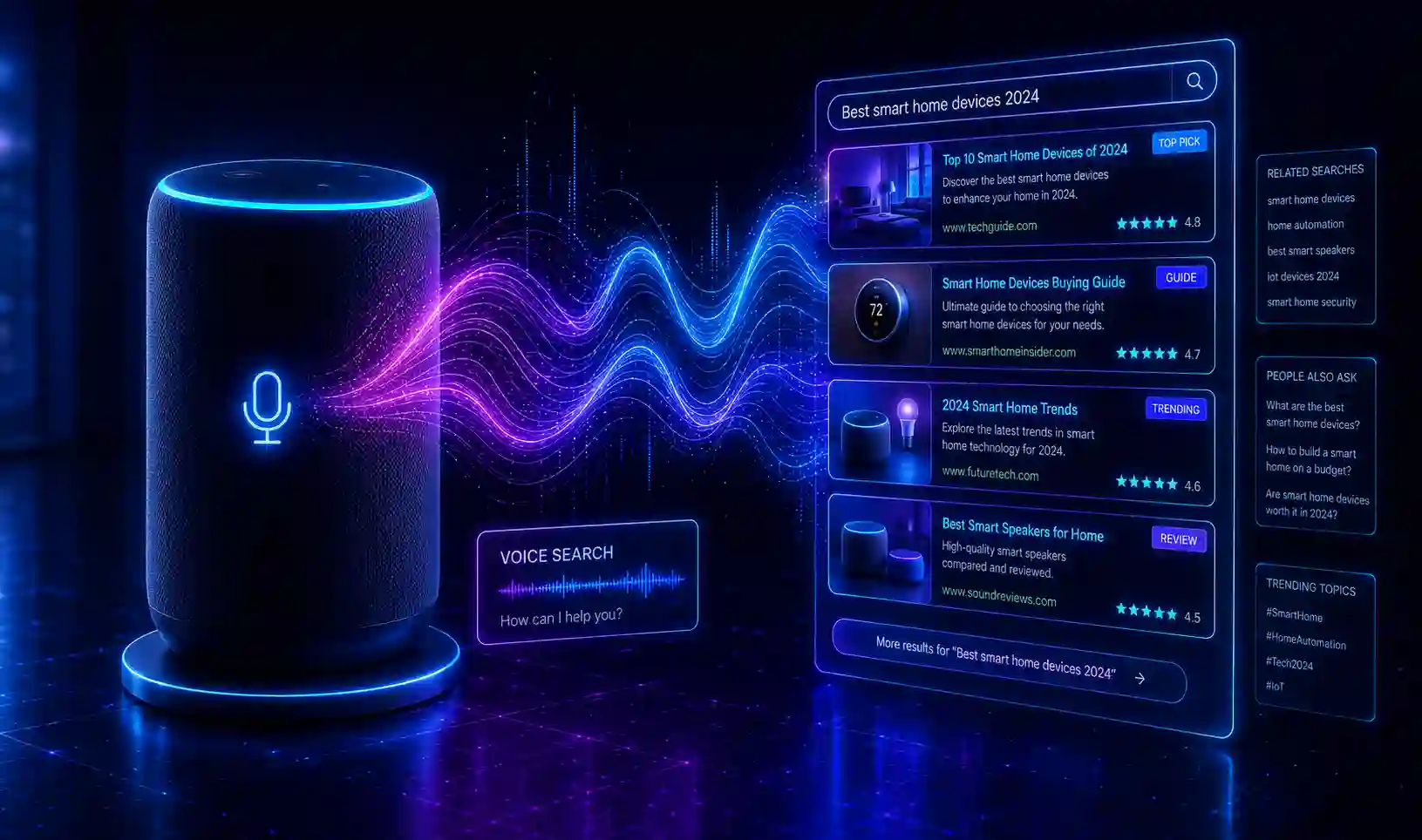
In 2010, searching the internet required sitting down at a keyboard and typing fragmented keywords like “weather Chicago weekend.”
Today, you are more likely to stand in your kitchen, chopping vegetables, and ask the empty room: “Hey Alexa, what’s the weather going to be like in Chicago this weekend?”
The adoption of smart speakers (Amazon Echo, Google Home) and virtual assistants (Siri, Google Assistant) has fundamentally altered human-computer interaction. In 2026, nearly half of all internet searches are initiated by voice.
However, Voice Search Optimization (VSO) is completely different from traditional Search Engine Optimization (SEO). When a user types a query into Google, they are given 10 blue links to choose from. When a user asks Siri a question, Siri gives them one single answer.
If you are not the #1 answer, you do not exist.
In this comprehensive masterclass, we will explore the psychology of conversational search, how to structure your content to capture the elusive “Position Zero,” and why Local SEO is the backbone of voice marketing.
1. How Voice Search Differs from Text Search
To optimize for voice, you must understand how human behavior changes when we speak versus when we type.
- Length: Typed searches are short (1-3 words) because typing is tedious. Voice searches are long (5-8 words) because speaking is fast.
- Tone: Typed searches are robotic (“best running shoes flat feet”). Voice searches are conversational (“What are the best running shoes for someone with flat feet?”).
- Intent: Voice searches are overwhelmingly driven by immediate, local intent. People use voice when their hands are full (driving, cooking) and they need an answer right now.
2. The Psychology of Conversational Queries
When optimizing for text SEO, marketers historically obsessed over exact-match keywords. This strategy fails in voice search.
Google’s AI (specifically the BERT and MUM algorithm updates) is now incredibly advanced at understanding Natural Language Processing (NLP). It understands the context of a sentence, not just individual words.
Your content must answer the “Who, What, Where, When, Why, and How.” If you sell coffee beans, ranking for the word “Coffee” is irrelevant for voice search. You want to rank for the query: “How do I brew the perfect cup of French Press coffee at home?“
3. Position Zero: The Holy Grail of Voice Search
When you ask a smart speaker a question, where does it get the answer?
It almost exclusively reads from Featured Snippets (also known as “Position Zero”). A Featured Snippet is the highlighted box of text that appears at the very top of a Google search results page, above the standard #1 ranking.
If you capture the Featured Snippet on desktop, you will be the only answer read aloud by Google Assistant.
How to Optimize for Featured Snippets
- The Question Header: Use an
<h2>or<h3>HTML tag that asks the exact question the user is speaking. (e.g.,<h2>How much does a new roof cost?</h2>). - The 45-Word Answer: Immediately below that header, answer the question clearly and directly in a single paragraph. Data shows the optimal length for a voice search answer is between 40 and 50 words.
- The Deep Dive: After the concise 45-word answer, spend the rest of the article explaining the topic in deep detail to satisfy standard SEO ranking factors.
4. Long-Tail Keywords and Question Phrases
Because voice searches are conversational, they heavily rely on Long-Tail Keywords. These are highly specific search phrases that have lower search volume, but incredibly high conversion intent.
How to find Voice Search Keywords: Use tools like AnswerThePublic or the Google “People Also Ask” box. If you are a plumber, do not optimize for “Chicago Plumber.” Optimize for:
- “Why is my kitchen sink draining so slowly?”
- “How do I fix a running toilet?”
- “Who is the cheapest emergency plumber in Chicago?”
Write an individual blog post or an FAQ section dedicated to answering each one of those specific conversational questions.
5. Local SEO: The Engine of Mobile Voice Search
Over 50% of all voice searches have Local Intent. People are driving in their cars, asking their phones for directions, business hours, and nearby services.
The “Near Me” Phenomenon
Searches containing the phrase “near me” have grown exponentially over the last decade. If a user asks, “Where is a good Italian restaurant near me?” Google Assistant does not read them a blog post. It reads them a listing from Google Business Profile.
To dominate Local Voice Search, you must:
- Claim and meticulously optimize your Google Business Profile.
- Ensure your Name, Address, and Phone Number (NAP) are 100% consistent across Yelp, Apple Maps, and your website.
- Generate a massive volume of 5-star Google Reviews. Siri and Google Assistant will often filter results by saying, “Here are the top-rated Italian restaurants near you.” If you are rated 3.5 stars, you will not be mentioned.
6. Website Speed and Mobile Optimization
As discussed in our Mobile Marketing Guide, Google heavily prioritizes mobile-friendly websites.
For voice search, Page Speed is critical. When a user asks a smart speaker a question, they expect an answer instantly. The average voice search results page loads in 4.6 seconds—which is 52% faster than the average webpage.
If your website takes 10 seconds to load because of massive, uncompressed images and bloated JavaScript, Google will refuse to use your content for a voice answer, because it would create a bad user experience.
7. Schema Markup (Structured Data) for Voice
Search engines are smart, but they are still machines. They need help understanding the context of your data.
Schema Markup is a specialized code you add to your website’s HTML that translates your content into a language search engines natively understand.
If you publish a recipe for chocolate chip cookies, you shouldn’t just format it as regular text. You should use Recipe Schema Markup. This tells Google exactly which part of the text is the “Prep Time,” which part is the “Ingredients,” and which part is the “Instructions.”
When a user says, “Hey Google, walk me through the recipe for chocolate chip cookies,” Google Assistant relies entirely on Schema Markup to read the instructions step-by-step.
(Specifically, look into Speakable Schema, which tells Google exactly which paragraphs of text are designed to be read aloud).
8. Creating FAQ Pages for Voice Dominance
The absolute fastest way to start ranking for voice search is to build a massive, highly structured FAQ (Frequently Asked Questions) page on your website.
The Strategy:
- Talk to your Sales and Customer Support teams. Ask them: “What are the 20 questions customers ask you on the phone every single day?”
- Write those exact 20 questions as
<h2>headers on your FAQ page. - Answer each question directly in a 40-50 word paragraph.
- Apply
FAQPageSchema Markup to the entire page.
This creates a dense cluster of natural language Q&A data that Google’s voice algorithm loves to index and read aloud.
9. The Future of Voice Commerce (V-Commerce)
Voice search is evolving from pure information retrieval to actual transactions. This is known as Voice Commerce.
Consumers are already comfortable saying, “Alexa, reorder paper towels.” But as AI assistants become more advanced, complex transactions are occurring. “Siri, book me a window seat on the cheapest flight to Denver next Friday.”
To prepare for V-Commerce, e-commerce brands must optimize product descriptions to be conversational. Instead of listing technical specs, product pages must answer questions like, “Is this vacuum cleaner good for pet hair?“
10. Frequently Asked Questions (FAQ)
Q: Do I need a different SEO strategy for Alexa, Siri, and Google Assistant? A: Largely, no. While Alexa relies heavily on Bing, and Siri pulls from Apple Maps and various sources, Google Assistant has the lion’s share of the market. If you optimize for Google’s Featured Snippets and Local SEO, you will generally perform well across all three assistants.
Q: Does voice search use different keywords than text search? A: The topics are the same, but the phrasing is different. A text search keyword is “SEO tools.” The equivalent voice search keyword is “What are the best SEO tools for small businesses?”
Q: How do I track Voice Search traffic in Google Analytics? A: Currently, this is incredibly difficult. Google Analytics does not separate voice search traffic from standard organic search traffic. You can only infer voice traffic by looking at your Google Search Console data and filtering for search queries that begin with “Who,” “What,” “Where,” “Why,” and “How.”
11. Conclusion & Next Steps
Voice Search Optimization is not a fad; it is the inevitable result of humans seeking the path of least resistance. Typing is friction. Speaking is frictionless.
By shifting your content strategy from robotic keyword stuffing to answering real human questions with clear, concise, and structured data, you will not only dominate smart speakers but significantly improve your overall SEO rankings.
Ready to explore the final frontier of Digital Marketing? Dive into our last masterclass in this 20-part series:
Discussion
Loading comments...