

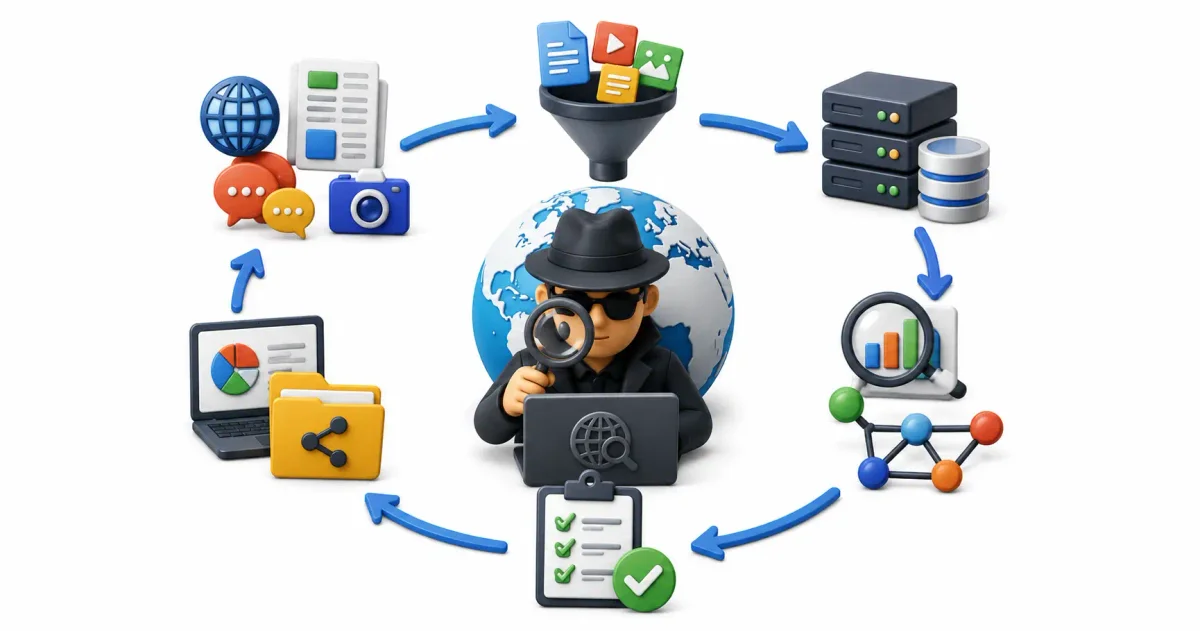
In recent years, the term “Open Source Intelligence” (OSINT) has expanded beyond the confines of federal intelligence agencies and entered mainstream culture. Today, major international news agencies use OSINT to track troop movements via commercial satellite imagery, true-crime podcast communities use it to solve cold cases, and cybersecurity professionals use it daily to map the infrastructure of state-sponsored ransomware syndicates.
However, despite its growing popularity, a misconception persists among beginners: the belief that OSINT is simply the act of “advanced Googling.”
Typing a target’s name into a search engine, scrolling through their public Twitter feed, and downloading their LinkedIn profile picture is not intelligence. That is raw data gathering—a process referred to within the professional intelligence community as OSINF (Open Source Information).
True, actionable intelligence is a refined and structured product. It is raw data that has been filtered, verified against independent sources, and analyzed to answer a specific question.
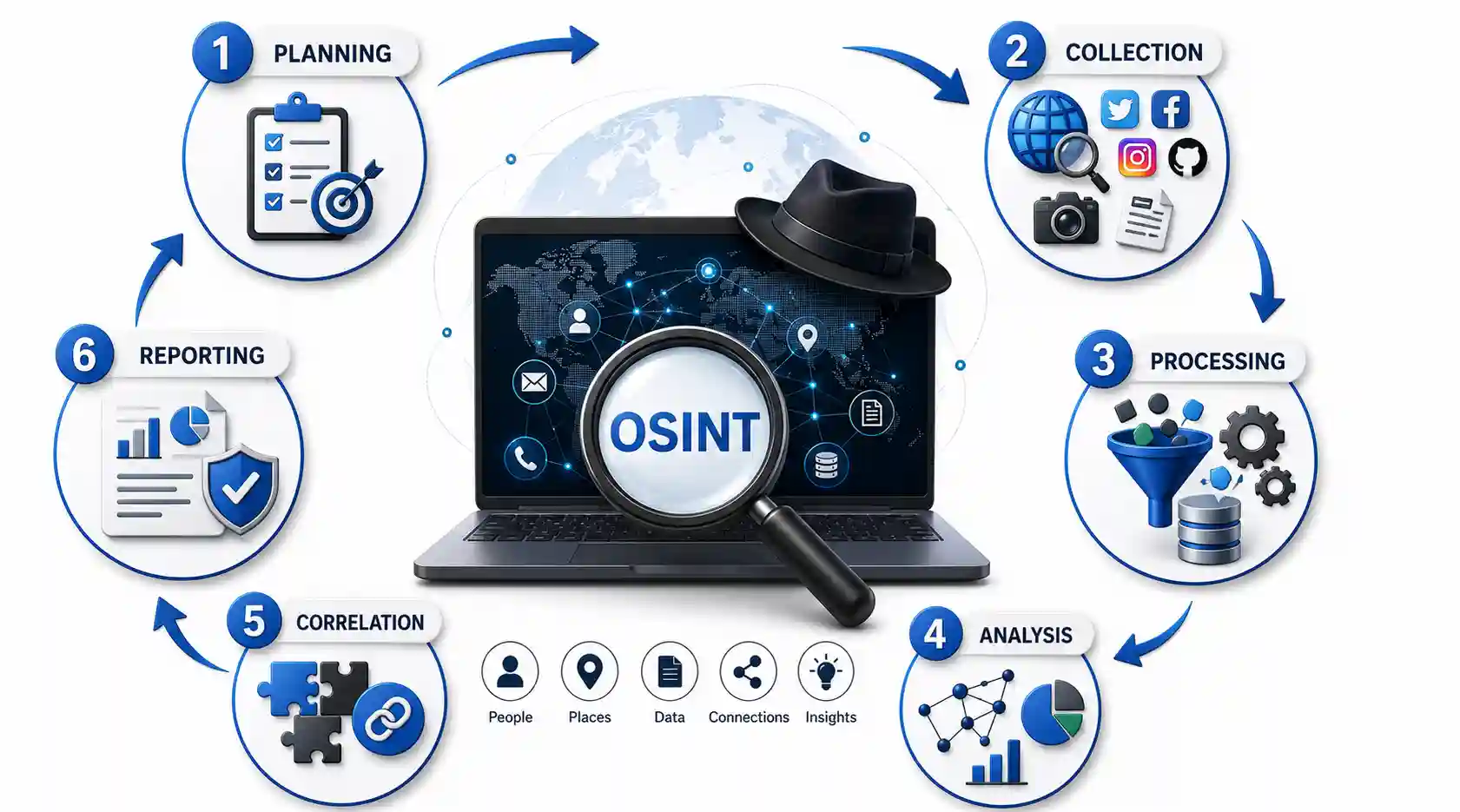
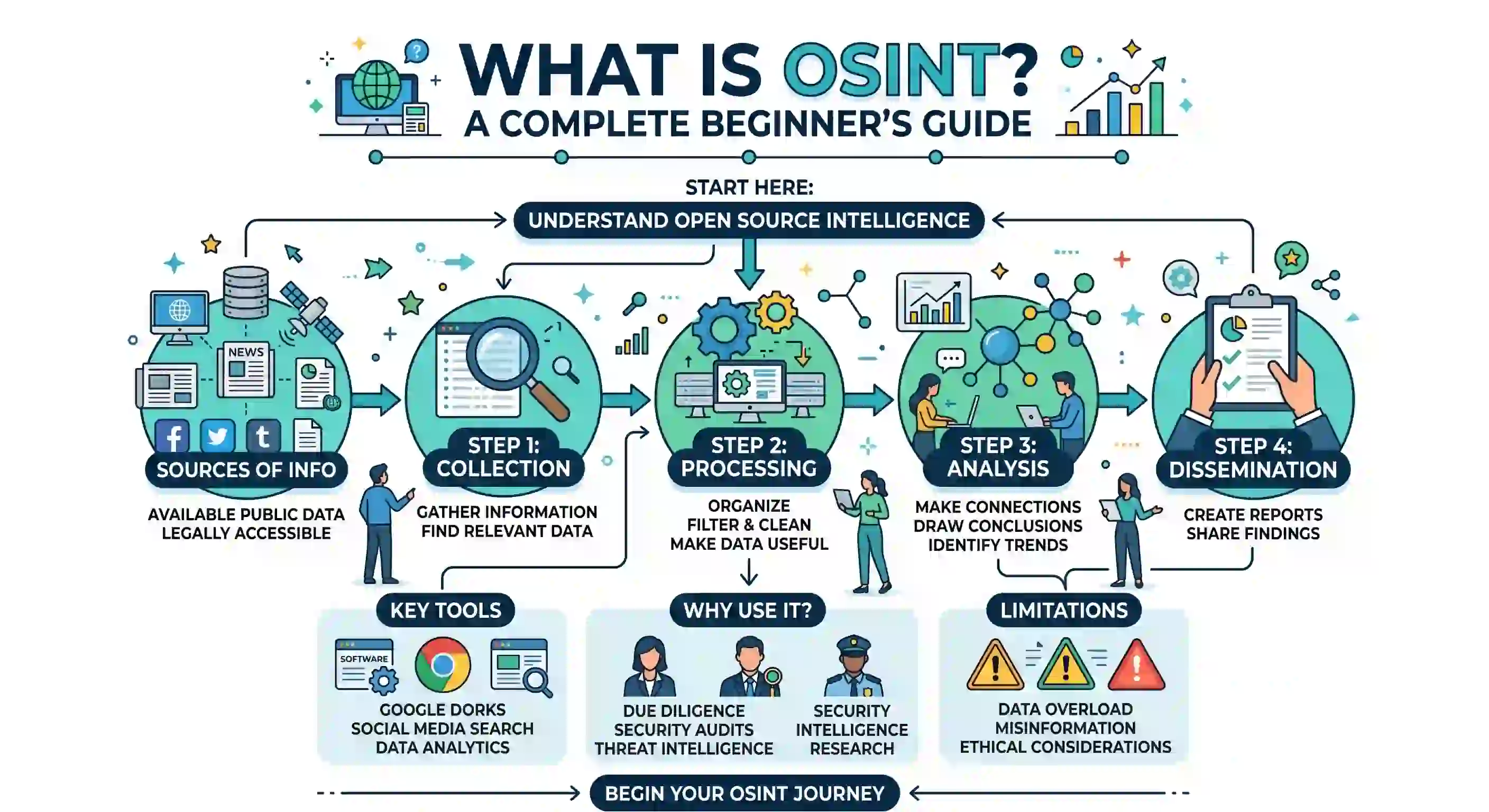
To transform raw internet data into effective, legally defensible intelligence, professional analysts rely on a globally recognized, five-step framework known as the Intelligence Cycle. Without adhering to this framework, an investigator will inevitably succumb to information overload, get lost in irrelevant digital rabbit holes, or worse, alert the target that they are under investigation.
In this guide, we will break down the mechanics of open source intelligence by walking through the five distinct, cyclical phases of a professional OSINT investigation.
1. Phase 1: Planning and Direction (The Bedrock Foundation)
Every successful military operation, business venture, and intelligence investigation requires a clearly defined objective before any action is taken. The Planning and Direction phase is a critical step of the Intelligence Cycle. If you fail to plan here, your investigation will likely fail.
Defining the Priority Intelligence Requirement (PIR)
The Priority Intelligence Requirement (PIR) is the specific question that the investigation is designed to answer. It defines the finish line.
- A Poorly Defined PIR (The Amateur Approach): “Find out everything you can find on the internet about the Russian hacker group APT29.” This lacks direction. It is far too broad. You could spend years gathering terabytes of data on APT29 and still never deliver a useful, concise report to your client.
- A Professionally Defined PIR (The Elite Approach): “Identify the IPv4 addresses, the physical hosting providers, and the active domain names of the Command and Control (C2) servers currently being used by APT29 to target the European financial sector this quarter.” This is laser-focused, achievable, and actionable.
Establishing the Scope and Rules of Engagement (RoE)
Before touching a keyboard, the lead analyst must define the boundaries of the investigation.
- Time Constraints: “The executive board needs this finalized report in 48 hours.” This strict deadline forces the analyst to prioritize fast, high-yield data collection methods over time-consuming forensic analysis.
- Legal and Ethical Boundaries: Are you allowed to create fake accounts (sock puppets) to view a target’s locked social media profile? Are you permitted to execute active network port scans against their corporate infrastructure, or must the collection remain passive? Violating these RoE can lead to criminal charges.
Threat Modeling and OPSEC
Finally, the analyst must threat-model the investigation. If the target is a sophisticated cybercriminal, the analyst must assume the target is monitoring their own infrastructure. Before starting, the analyst must configure an isolated Linux Virtual Machine, establish a VPN tunnel, disable browser telemetry, and prepare their anonymous sock puppet accounts to ensure operational security.
2. Phase 2: Collection (The Data Gathering Engine)
With the PIR defined and the OPSEC environment secured, the analyst begins the Collection phase. This involves utilizing an array of software tools and techniques to scrape public data from the internet.
The most critical distinction an analyst makes in this phase is understanding the difference between Passive and Active collection methods.
Passive Collection (The Gold Standard)
In traditional OSINT, data collection should mostly be passive. Passive collection means gathering data without interacting directly with the target’s systems. The target has no server logs of your activity because you are querying independent, third-party databases.
- Search Engine Dorking: Using boolean operators in Google or Bing (e.g.,
site:targetcompany.com ext:sql "password") to compel search engines to reveal indexed files the target thought were hidden. - Historical WHOIS and DNS Records: Querying the global ICANN registries and historical DNS servers (like SecurityTrails) to see who registered a domain name, and where their corporate email servers (MX records) are located.
- The Internet Archive (Wayback Machine): Using digital archives to view historical, cached versions of a website that the target deleted or altered to hide evidence.
- Public Data Breach Repositories: Querying aggregate databases like DeHashed to see if the target’s corporate email addresses and plaintext passwords were exposed in data breaches.
Semi-Active Collection (The Gray Area)
This involves interacting directly with the target’s server, but doing so in a way that generates normal web traffic that blends in with other users.
- SSL Certificate Grabbing: Connecting to a target’s HTTPS web server to download its SSL certificate. The certificate often contains the “Subject Alternative Name” (SAN) field, which leaks a list of internal subdomains owned by the target company.
Active Collection (The Boundary Line)
Active collection involves aggressive actions that will be logged by the target’s Intrusion Detection Systems (IDS) and firewalls.
- Network Port Scanning: Running tools like Nmap to probe a target’s IP address and see which ports are open and vulnerable.
- Crucial Note: In professional intelligence frameworks, Active Collection crosses the line from OSINT into Active Reconnaissance and is generally forbidden unless explicitly authorized in writing by the client.
Cryptographic Evidence Preservation
During the collection phase, data must be securely preserved. A target could delete an incriminating tweet halfway through your investigation. Professional analysts use tools like Hunchly to archive a full HTML copy of every webpage they view, generating cryptographic hashes to ensure the digital evidence is admissible in a court of law.
3. Phase 3: Processing and Collation (Finding the Signal)
The Collection phase often generates a mountain of raw data. A thorough analyst might have downloaded PDF documents, scraped lines of historical DNS records, and saved screenshots.
The Processing and Collation phase is the necessary step where this raw noise is structured into a usable, searchable format.
Data Cleaning and Deduplication
If you utilized an automated OSINT tool like Spiderfoot to scrape employee email addresses related to a corporation, the raw output will likely contain duplication and false positives. The analyst must write and run scripts (often in Python, Go, or Bash) to deduplicate the lists, remove invalid entries, and format the raw data into clean CSV files or structured SQL databases.
Translation, Transcription, and Localization
If the target is a foreign entity, the analyst must translate intercepted dark-web forum posts, leaked audio files, or propaganda video transcripts into the native language of the investigation. In 2026, AI-driven transcription tools are utilized in this step to rapidly process hours of raw video footage.
Metadata Extraction (EXIF Analysis)
This is arguably one of the most vital steps in OSINT processing. When a target uploads a photograph to a blog or publishes a PDF document, the file often contains hidden EXIF (Exchangeable Image File Format) metadata.
The analyst uses command-line tools like exiftool to strip this hidden data out of the files. The metadata often reveals the GPS coordinates of where a photograph was taken, the make and model of the smartphone used, and the internal corporate username of the employee who originally created the document.
4. Phase 4: Analysis and Production (The Human Element)
The raw data has been collected, cleaned, and organized. Now, the human intelligence work begins. The Analysis phase requires the investigator to connect the disparate dots, identify patterns, and draw conclusions that answer the original Priority Intelligence Requirement (PIR).
Link Analysis
Link analysis is the process of visually mapping the relationships between seemingly disparate entities. Analysts use graph-database visualization tools, such as Maltego, Gephi, or Obsidian, to draw these maps.
- The Workflow: The analyst plots an anonymous forum username as Node A on the screen. Through OSINT, they discover that username is linked to a ProtonMail email address (Node B). They then discover that email address was previously used to register a cryptocurrency wallet address (Node C) found in a breach database. They visually connect these nodes, proving that the anonymous user controls that crypto wallet.
Timeline Analysis (Establishing the Pattern of Life)
An analyst extracts every timestamp gathered during the processing phase (the time of a dark-web forum post, the creation date of a malicious domain, the EXIF timestamp on a photo) and carefully plots them on a chronological timeline. This allows the analyst to deduce the target’s “Pattern of Life.” If a target exclusively posts on an English-language hacker forum between 03:00 UTC and 11:00 UTC, and is silent for the next 8 hours every day, the analyst can deduce the target’s sleep schedule, indicating the target resides in an Eastern European or Asian timezone, undermining their claim to be an American citizen.
Geospatial Intelligence (GEOINT)
If the investigation involves locating a facility, a hostage, or a missing person, the analyst examines collected photographs and satellite imagery. By analyzing the angle of shadows cast by the sun at a time of day, the architecture of background buildings, local street signs, and the species of local flora visible in the frame, an analyst can often pinpoint the street corner where a photo was taken.
Mitigating Cognitive Bias
During analysis, the investigator must actively fight their own psychological biases. They use structured analytical frameworks like the CIA-developed Analysis of Competing Hypotheses (ACH). This framework ensures the analyst is not merely cherry-picking data to support their predetermined conclusion, but is scientifically trying to disprove their own working theories.
5. Phase 5: Dissemination (Delivering the Product)
The final phase of the Intelligence Cycle is Dissemination. The analyst has solved the puzzle; now they must communicate the findings to the stakeholder (the corporate executive client, the law enforcement agency, or the incident response team).
The Intelligence Report (BLUF Methodology)
Professional intelligence reports are not written like academic essays or mystery novels. They are written using the BLUF (Bottom Line Up Front) methodology. The executive summary must explicitly answer the Priority Intelligence Requirement in the first paragraph. Corporate executives and military commanders do not have the time to read a chronological narrative of how the analyst found the data; they need the actionable conclusion immediately.
Establishing Confidence Levels
Professional analysts rarely present intelligence as undeniable fact. Findings are delivered with an attached Confidence Level, based on the reliability of the sources and the strength of the corroborating evidence:
- High Confidence: The conclusion is supported by multiple, independent, reliable sources.
- Moderate Confidence: The conclusion is logical and supported by data, but relies on a few unverified assumptions or a single source.
- Low Confidence: The conclusion is a working theory based on fragmented or questionable information.
The Endless Cycle Restarts
In the world of professional OSINT, intelligence is rarely “finished.” The successful dissemination of the final report almost always triggers new questions from the stakeholder. (“Excellent work, you found the hacker’s IP address. Now, can you find out who is paying them in Bitcoin?”) These new questions become the new Priority Intelligence Requirements, and the OSINT Intelligence Cycle begins again at Phase 1.
By adhering to this cycle, investigators elevate their work from amateur internet searching to professional, legally defensible intelligence analysis.
Frequently Asked Questions (FAQ)
What does OSINT stand for?
OSINT stands for Open Source Intelligence. It is the practice of collecting and analyzing information from publicly available sources such as websites, social media, public records, and news articles to produce actionable intelligence.
What are the five phases of the OSINT intelligence cycle?
The five phases are: Planning and Direction (defining objectives), Collection (gathering data), Processing (organizing raw data), Analysis (interpreting findings), and Dissemination (delivering the final intelligence report to stakeholders).
Is OSINT the same as hacking?
No. OSINT strictly involves collecting publicly available information without bypassing any security measures. Hacking involves unauthorized access to private systems, which is illegal. OSINT is a legal and widely used practice in law enforcement, journalism, and corporate security.
What skills do I need to learn OSINT?
You need strong analytical thinking, attention to detail, familiarity with search engines and social media platforms, and a basic understanding of networking concepts like IP addresses and DNS. Programming knowledge in Python is helpful but not required for beginners.
Who uses OSINT professionally?
OSINT is used by law enforcement agencies, military intelligence units, corporate security teams, journalists, private investigators, and cybersecurity professionals. It is also increasingly used by HR departments for background checks and due diligence.
Discussion
Loading comments...