

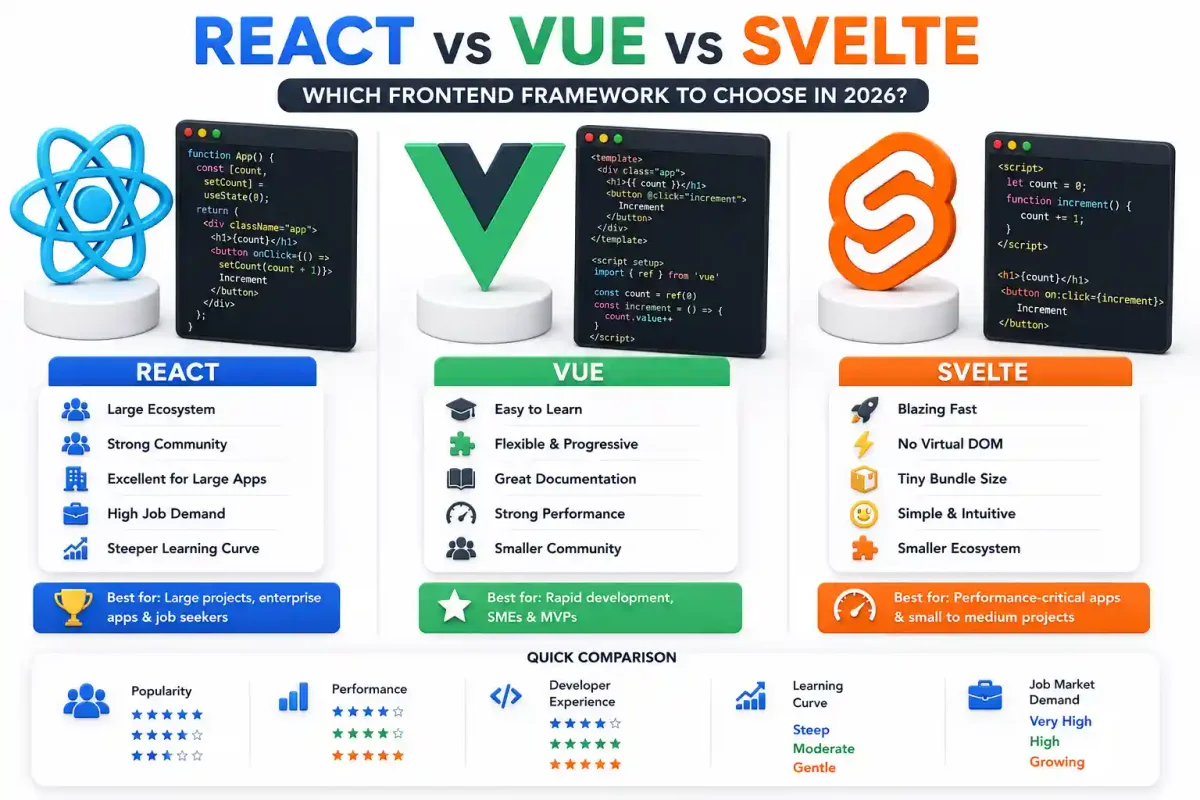
If you spend enough time managing infrastructure and deploying applications to production Ubuntu VPS environments, you quickly realize that the choice of frontend framework directly impacts your backend architecture.
A bloated frontend requires more aggressive CDN caching with Cloudflare, heavier Node.js server-side rendering (SSR) footprints, and more complex Docker multi-stage builds. In 2026, the dominant triopoly of JavaScript frameworks consists of React, Vue, and Svelte.
While bootcamp graduates often argue about which framework has the “cleanest syntax,” infrastructure engineers evaluate them differently. We care about build times in GitHub Actions, runtime memory footprint, how cleanly they compile via Vite or Webpack, and how securely they handle REST API communication.
In this deep-dive comparison, we will evaluate React, Vue, and Svelte not just as UI libraries, but as architectural components of a modern, containerized stack.
React: The Enterprise Behemoth
Created by Meta, React remains the undisputed heavyweight champion of the frontend ecosystem. It relies on a Virtual DOM and heavily promotes functional programming paradigms through Hooks.
The Architecture
React itself is just a UI library. In 2026, almost nobody ships raw React; they ship Next.js. Next.js forces a specific server-client architecture utilizing React Server Components (RSC). This blurs the line between frontend and backend, allowing developers to query databases like PostgreSQL or MongoDB directly from a server component before streaming HTML to the client.
State management in React often requires external tooling. While Context API works for small apps, enterprise teams usually rely on Redux Toolkit, Zustand, or Jotai.
Infrastructure & Deployment
Deploying modern React (specifically Next.js) requires a Node.js runtime. You cannot simply drop the build output into a static Nginx container.
A standard deployment involves:
- Containerizing the app with a multi-stage
Dockerfile. (See our guide on installing Docker on Ubuntu). - Managing dependencies with pnpm or npm.
- Exposing the Node server via Nginx Proxy Manager or Traefik.
- Running the Node process with a process manager like PM2 inside the container.
Because Next.js caches aggressive amounts of route data, you also need to manage Linux memory limits carefully to prevent Out Of Memory (OOM) crashes in production.
When to Choose React
- You are building massive enterprise applications with large engineering teams.
- You need seamless integration with a massive ecosystem of libraries (e.g., Tailwind UI, Radix).
- You want to share code with a React Native mobile application.
- You are deploying to PaaS platforms like Vercel or self-hosting via Coolify.
Vue 3: The Pragmatic Middle Ground
Vue 3 (specifically using the Composition API) offers a highly pragmatic, incrementally adoptable approach. Created by Evan You, it strikes a balance between React’s JavaScript-heavy JSX and traditional HTML templates.
The Architecture
Vue uses a Virtual DOM but pairs it with a highly optimized, proxy-based reactivity system. When a reactive variable changes, Vue knows exactly which components depend on it without requiring the developer to memorize complex dependency arrays (a common pain point with React’s useEffect and useMemo).
The standard meta-framework for Vue is Nuxt.js, which provides exceptional Server-Side Rendering (SSR) and Static Site Generation (SSG). State management is officially handled by Pinia, which is significantly lighter and more intuitive than Redux.
Infrastructure & Deployment
Vue applications are incredibly flexible to deploy. If you are building a pure Single Page Application (SPA), Vue compiles down to static HTML/CSS/JS files via Vite.
You can securely serve these static files using a minimal Nginx or Caddy container, which requires almost zero CPU overhead and can easily be secured with Fail2ban and Let’s Encrypt certificates.
If you are using Nuxt.js for SSR, you will deploy it similarly to Next.js using a Node.js runtime, often orchestrated via Portainer or DokPloy.
When to Choose Vue
- You have a team transitioning from traditional backend templating (like Laravel Blade or Django templates).
- You want high performance without the steep learning curve of React Hooks.
- You need to inject a modern frontend into a legacy application incrementally.
- You prefer the clean separation of HTML, CSS, and JS within Single File Components (SFCs).
Svelte (and SvelteKit): The Compile-Time Innovator
Svelte radically breaks away from the Virtual DOM entirely. Instead of doing the heavy lifting in the browser at runtime, Svelte acts as a compiler. It parses your components during the build step and outputs highly optimized, vanilla JavaScript that surgically updates the DOM.
The Architecture
With the release of Svelte 5 and its “Runes” system, Svelte’s reactivity is universally accessible outside of .svelte files. The meta-framework, SvelteKit, handles routing, SSR, and API endpoints.
Because there is no Virtual DOM engine shipped to the client, Svelte applications have dramatically smaller bundle sizes. This makes it an exceptional choice for edge computing or applications running on low-powered devices.
Infrastructure & Deployment
SvelteKit relies on “Adapters” for deployment. When you run your build pipeline via GitLab CI or GitHub Actions, you choose an adapter that targets your infrastructure.
adapter-node: Outputs a standalone Node.js server. (Perfect for deploying on a Linux VPS).adapter-static: Pre-renders the entire site as static files. (Ideal for deploying behind UFW firewalls on a raw Nginx block).adapter-cloudflare: Compiles the app to run natively on Cloudflare Workers.
Because Svelte’s footprint is so small, you can pack multiple Svelte containers densely into a Proxmox VE homelab without triggering CPU alerts in Uptime Kuma.
When to Choose Svelte
- Bundle size and raw performance (First Contentful Paint, Time to Interactive) are your highest priorities.
- You are building highly interactive data visualizations or dashboards.
- You want the absolute best Developer Experience (DX) with minimal boilerplate.
- You are deploying to edge networks (Cloudflare Workers, Deno Deploy).
Technical Comparison (2026 Real-World Metrics)
While synthetic benchmarks rarely reflect production realities, understanding the baseline footprint of each framework helps when planning Docker container security and resource limits.
| Metric | React (Next.js) | Vue (Nuxt) | Svelte (SvelteKit) |
|---|---|---|---|
| Architecture | Runtime Virtual DOM | Runtime Virtual DOM (Proxy) | Compile-time (No VDOM) |
| Typical JS Bundle Size | ~130KB | ~85KB | ~15KB |
| Reactivity Paradigm | Pull-based (State hooks) | Push-based (Proxies) | Push-based (Runes/Signals) |
| Build Tooling | Webpack / Turbopack | Vite | Vite |
| TypeScript Integration | Excellent | Excellent | Excellent |
| State Management | Zustand / Redux | Pinia | Built-in Stores / Runes |
Securing Your Frontend
Regardless of which framework you choose, the frontend is inherently insecure because all code executes on the user’s device. From a DevOps perspective, you must secure the boundary between your frontend and backend.
- Never ship secrets: Never hardcode API keys or database credentials in your frontend code. Inject them as environment variables in your backend containers and use a self-hosted Vaultwarden instance for team secret management.
- Container Scanning: When building your frontend Docker images, scan them for vulnerabilities using tools like Trivy or Snyk.
- Network Isolation: Ensure your frontend containers communicate with your backend APIs over an internal Docker network, not over the public internet. Protect internal services using a Tailscale or WireGuard VPN.
- CORS and Rate Limiting: Configure your Nginx reverse proxy to enforce strict Cross-Origin Resource Sharing (CORS) policies and apply rate limiting to prevent DDoS attacks. (See our top 20 Linux security commands for host-level hardening).
Conclusion
Choosing between React, Vue, and Svelte in 2026 is less about which framework is “better” and more about aligning the tool with your engineering team’s strengths and your infrastructure constraints.
- Choose React if you are building a massive enterprise system and need to leverage the largest hiring pool and ecosystem in the industry.
- Choose Vue if you want an incredibly stable, highly performant framework that integrates smoothly with traditional backend systems and offers fantastic developer ergonomics.
- Choose Svelte if you prioritize shipping the absolute smallest, fastest application possible and prefer a compiler-driven approach.
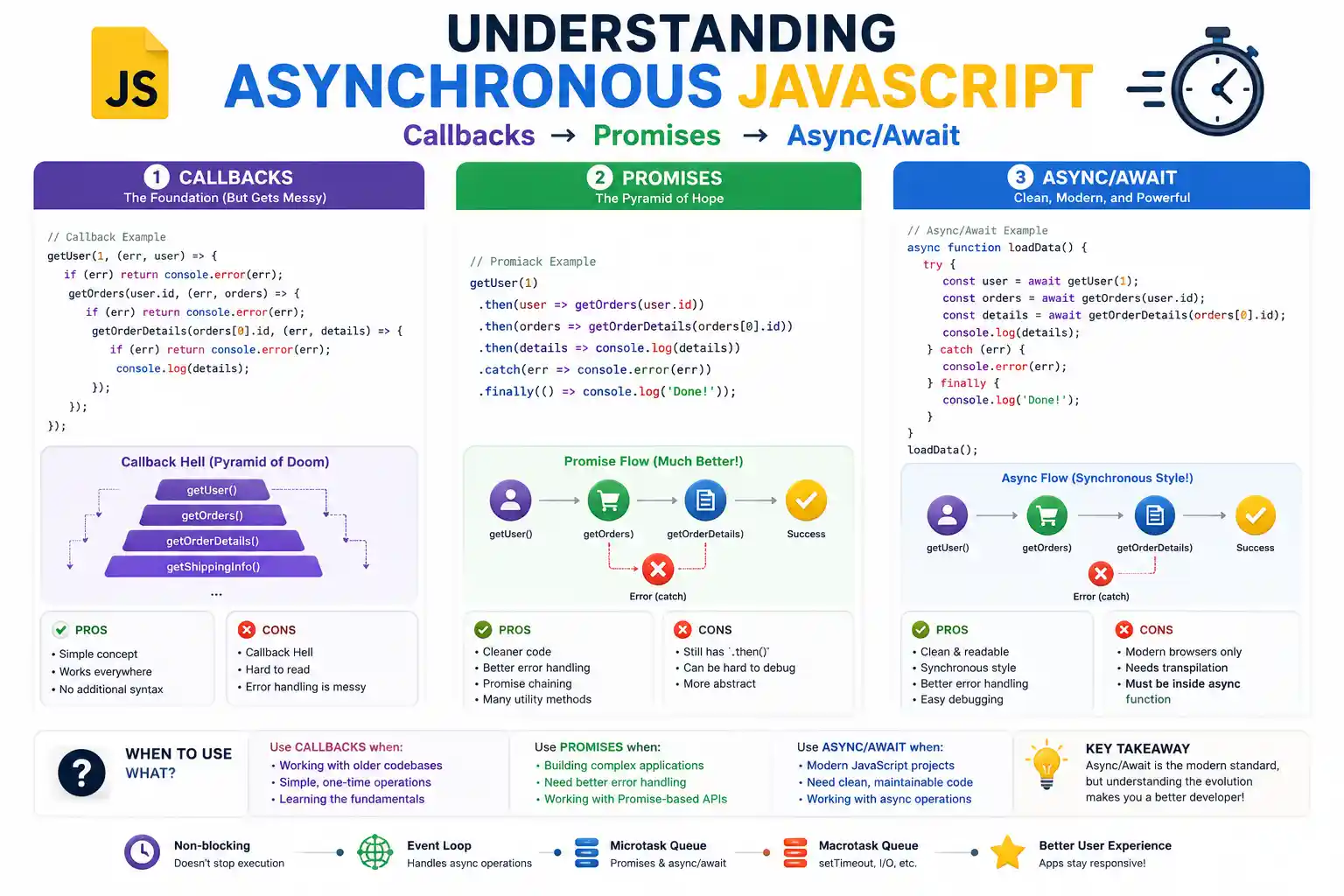
Before you start writing components, ensure you understand how your application will communicate with the backend. Read our guide on understanding asynchronous JavaScript and how to build a REST API with Node.js to round out your full-stack knowledge.
Official Documentation
For deep technical insights into these frameworks, API references, and deployment guides, refer to their official sources:
- React Official Documentation: https://react.dev/
- Vue.js Official Documentation: https://vuejs.org/
- Svelte Official Documentation: https://svelte.dev/
- Next.js Documentation: https://nextjs.org/
- Vite Build Tool: https://vitejs.dev/
Frequently Asked Questions (FAQ)
Which frontend framework has the best performance?
At a purely architectural level, Svelte generally offers the best runtime performance and the smallest bundle sizes because it compiles away the framework entirely, eliminating the need for a Virtual DOM. However, a highly optimized React app will still outperform a poorly written Svelte app.
Do I need to learn Docker to deploy these frameworks?
While you can deploy static sites using traditional web hosting, containerizing your applications with Docker is the industry standard in 2026. It ensures your app runs identically on your local machine, your staging server, and your production VPS. Read our guide on installing Docker on Ubuntu to get started.
Can I build mobile apps with these frameworks?
Yes. React offers React Native, which is heavily used in the enterprise for cross-platform mobile development. Vue developers can use Capacitor or NativeScript. Svelte can also be bundled for mobile using Capacitor, though its native mobile ecosystem is less mature than React’s.
Should I use TypeScript with React, Vue, or Svelte?
Absolutely. In 2026, writing enterprise frontend code in raw JavaScript is highly discouraged. All three frameworks have first-class, built-in support for TypeScript, which dramatically reduces runtime errors and improves developer tooling and autocomplete.
What is Server-Side Rendering (SSR)?
SSR is the process where a Node.js server executes your framework code, generates the complete HTML, and sends it to the browser. This improves SEO and initial page load speeds compared to a standard Single Page Application (SPA) where the browser must download a large JavaScript bundle before rendering anything.
Why do I need Nginx if I am using Node.js?
Node.js is excellent at running application logic, but it is not optimized for serving static files (images, CSS), handling TLS/SSL encryption, or managing load balancing. Nginx sits in front of your Node.js application as a reverse proxy to handle these tasks efficiently and securely.
What is the difference between Vite and Webpack?
Webpack is an older, highly configurable bundler that rebuilds your entire application when you make a change, which can be slow on large projects. Vite (used by default in Vue and Svelte) uses native ES modules to instantly update only the files you change, resulting in lightning-fast development server speeds.
How do I handle state management in these frameworks?
React typically uses Context API for small apps and Zustand or Redux for large apps. Vue uses Pinia, which is officially supported and highly integrated. Svelte uses built-in writable stores and Runes, requiring zero third-party libraries for robust state management.
Is it hard to migrate from React to Svelte?
Yes. Because the reactivity paradigms are completely different (Virtual DOM vs Compile-time), you cannot easily translate components 1-to-1. Migrating a large application usually requires a complete rewrite. Teams often migrate by rewriting small micro-frontends incrementally rather than attempting a monolithic switch.
How do I automate deployments for these frameworks?
You should use a CI/CD pipeline like GitHub Actions or GitLab CI. When you push code, the pipeline runs your tests (using Jest or Cypress), builds the production assets, packages them into a Docker container, and pushes the container to your server or a registry like Docker Hub.


Discussion
Loading comments...