

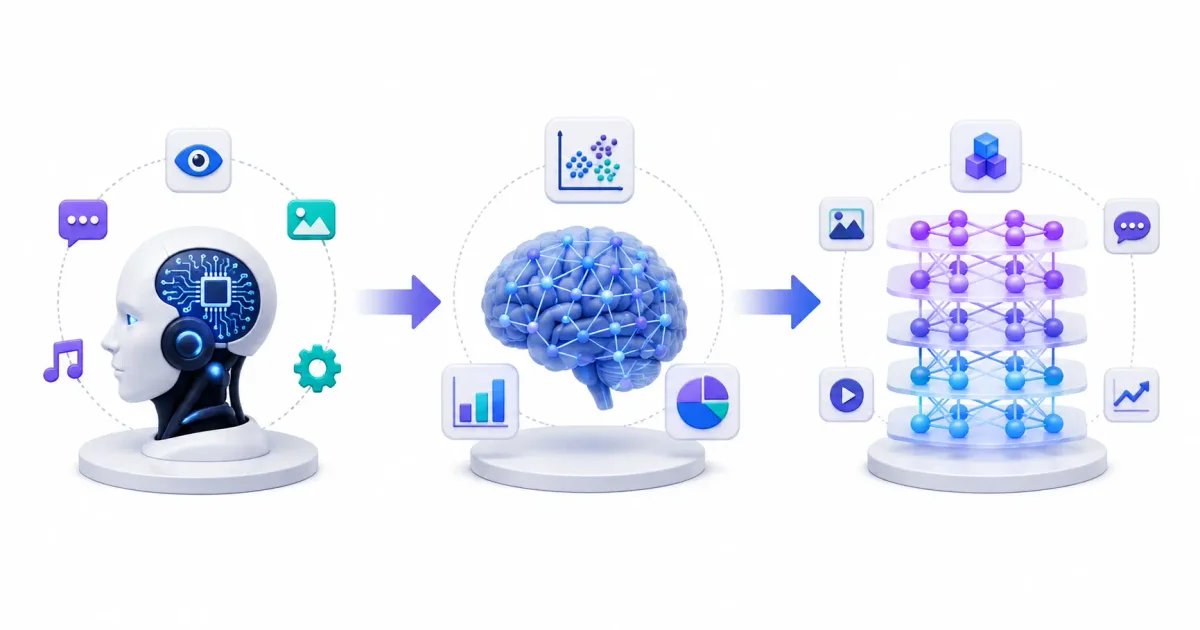
The technology landscape is increasingly dominated by terms like Artificial Intelligence (AI), Machine Learning (ML), and Deep Learning (DL). For many developers, sysadmins, and DevOps engineers, untangling these overlapping concepts is just the first step. The more significant challenge lies in understanding how to deploy, manage, monitor, and secure these distinct workloads in production environments or home labs.
If you are planning to build AI infrastructure, whether you’re deploying a custom model on Hetzner Cloud or running open-source language models on your local Proxmox VE server, understanding the boundaries between these concepts is critical. This comprehensive guide will break down the differences between AI, ML, and DL, covering their historical evolution, hardware requirements, deployment strategies, and security implications.
1. The Big Picture: AI, ML, and DL Definitions
To understand the relationship between these three terms, visualize them as concentric circles. Artificial Intelligence is the broadest category. Inside AI sits Machine Learning, a specific subset of AI techniques. Inside Machine Learning sits Deep Learning, an even more specialized subset.
Artificial Intelligence (AI)
Artificial Intelligence refers to any technique that enables computers to mimic human intelligence, logic, or behavior. It is an umbrella term encompassing both simple rules-based systems and complex neural networks. When an application can interpret context and take action—even if that action is driven by a thousand hard-coded if-then statements—it falls under the AI umbrella. Early AI coding assistants were often heavily rules-based before the advent of modern language models. If you examine the rules in a typical firewall, you might see simple logic that some marketing teams once called “AI”.
Machine Learning (ML)
Machine Learning is a subset of AI that uses statistical methods to enable machines to improve at tasks with experience. Instead of explicitly programming the rules, engineers provide the ML algorithm with large datasets and let the model “learn” the patterns. Classical ML algorithms—such as Random Forests, Support Vector Machines (SVMs), and Linear Regression—excel at tabular data processing and are still widely used in modern production environments. You might use classical ML to analyze Linux logs for anomaly detection without needing massive computing clusters.
Deep Learning (DL)
Deep Learning is a subset of Machine Learning based on artificial neural networks with multiple layers (hence “deep”). These algorithms attempt to simulate the behavior of the human brain to learn from large amounts of unstructured data like text, images, and audio. Deep Learning powers modern generative AI, including tools built on the MCP protocol and conversational models that offer advanced ChatGPT tips. When we discuss the future of AI jobs, we are primarily talking about the impact of Deep Learning.
2. Historical Context and Evolution
Understanding how we arrived at modern Deep Learning requires looking at the history of computing. You cannot simply jump into deploying complex models without understanding why these architectures were built in the first place.
The Symbolic AI Era
In the mid-20th century, early AI researchers focused on symbolic AI, also known as Good Old-Fashioned AI (GOFAI). These systems relied on explicit, human-readable representations of knowledge and logic. If you were building a medical diagnosis system in the 1980s, you would write thousands of rules defining symptom combinations. These systems were rigid and failed to handle uncertainty or incomplete data effectively. Managing this logic required meticulous care over the software development life cycle.
The Rise of Machine Learning
As storage became cheaper and datasets grew larger, researchers shifted toward statistical models. In the 1990s and 2000s, Machine Learning algorithms gained prominence. E-commerce platforms used Collaborative Filtering to recommend products, while email providers used Naive Bayes classifiers to filter spam. During this era, feature engineering—the process of manually extracting relevant signals from raw data—was the most critical skill for data scientists. For instance, before feeding data into a model to predict network bandwidth usage, an engineer had to manually calculate rolling averages and peak time indicators.
The Deep Learning Boom
Around 2012, Deep Learning experienced a massive breakthrough, catalyzed by the availability of large labeled datasets (like ImageNet) and the utilization of GPUs for parallel processing. Researchers realized that deep neural networks, originally conceptualized decades earlier, could automatically extract features from raw data if given enough compute power and data. Today, this shift has created an entirely new ecosystem of MLOps tools. If you look at the top 50 AI websites today, nearly all of them rely heavily on Deep Learning under the hood.
3. Core Differences: A Technical Comparison
To deploy these technologies effectively, infrastructure engineers must understand how they differ in practice.
Feature Engineering
- Machine Learning: Requires significant manual feature engineering. Engineers must clean, structure, and transform data before feeding it to the algorithm. This is typically done using tools like Apache Spark or stored directly in a PostgreSQL database.
- Deep Learning: Learns features automatically. You feed raw data (like raw pixels or unformatted text) into the model, and the neural network’s hidden layers identify the relevant patterns.
Hardware Dependencies
- Machine Learning: Most classical ML models can be trained and executed efficiently on standard CPUs. A simple VPS is often sufficient for ML workloads. You can even run ML inferences on edge devices like Raspberry Pis.
- Deep Learning: Requires massive parallel processing power. Training and running inference for DL models generally requires powerful GPUs with high VRAM. If you are deploying a Node.js app that interacts with a DL model, the model itself will likely sit on a dedicated GPU instance or be accessed via API.
Data Requirements
- Machine Learning: Performs well on smaller, structured datasets. Classical algorithms can generalize effectively with just thousands of examples.
- Deep Learning: Data-hungry. These models require millions or billions of examples to achieve state-of-the-art performance. The storage requirements for DL training datasets are immense, often utilizing high-throughput networked storage or object storage like MinIO or AWS S3. Choosing the right filesystem, such as in a Btrfs vs ext4 comparison, becomes crucial for data integrity.
Interpretability
- Machine Learning: Highly interpretable. When a Decision Tree makes a prediction, you can trace the exact logical path it followed. This is critical in highly regulated industries.
- Deep Learning: Often treated as a “black box.” Understanding exactly why a Deep Learning model made a specific prediction is an ongoing area of research.
4. Practical Applications and Workloads
Let’s look at how these technologies are applied in real-world scenarios, particularly from a self-hosting and DevOps perspective.
Machine Learning in Production
Classical ML is ubiquitous in backend infrastructure.
- Anomaly Detection: Monitoring tools often use ML to establish baselines and detect anomalies in CPU usage or memory management.
- Fraud Detection: Payment gateways use gradient boosting algorithms to score transactions in milliseconds.
- Recommendation Systems: Traditional collaborative filtering powers recommendations on platforms similar to Jellyfin or [Plex].
To host classical ML models, you can easily containerize them. Since CPU inference is cheap, orchestrating these containers with Docker Compose or Kubernetes is straightforward and cost-effective. You can serve them via a REST API built with Python’s FastAPI or Node.js.
Deep Learning in Production
Deep Learning powers the applications that capture public attention.
- Computer Vision: Object detection, facial recognition, and automated tagging in tools like Immich.
- Natural Language Processing: Large Language Models (LLMs), machine translation, and text summarization used in document management systems like Paperless-ngx.
- Audio Processing: Speech-to-text and voice generation.
Running DL in production requires robust infrastructure. You might use Ollama to manage local models or vLLM for high-throughput serving. Managing GPU resources, handling massive model weights, and ensuring low-latency inference require careful capacity planning. This debate is at the heart of the local vs cloud AI discussion.
5. Infrastructure and Hosting Considerations
When moving AI, ML, or DL workloads from a Jupyter notebook to a production server, your infrastructure choices will dictate your success.
Containerization and Orchestration
Packaging models as containers is standard practice. For ML, standard Docker images work perfectly. For DL workloads requiring GPU passthrough, you must configure the NVIDIA Container Toolkit. When choosing a container runtime, comparing Docker vs Podman reveals that both can handle GPU passthrough, though Docker remains the industry standard. Our guide to installing Docker on Ubuntu covers the basics.
For orchestration, while Kubernetes and k3s are enterprise choices, many smaller deployments and home labs utilize easier management platforms. Coolify and DokPloy have emerged as excellent self-hosted PaaS alternatives that simplify deployment pipelines, often leveraging Nixpacks or Heroku buildpacks. For managing standalone Docker nodes, Portainer offers a visual interface for managing your AI model containers. For automated image updates, Watchtower is an indispensable tool.
Networking and Reverse Proxies
AI inference APIs need reliable routing. A reverse proxy sits in front of your model servers, handling SSL termination and load balancing.
- Nginx Proxy Manager: Excellent for visual configuration and automatic Let’s Encrypt certificates. It’s a popular choice for securing internal APIs. See our NPM security guide for hardening tips.
- Traefik and Caddy: These modern proxies offer dynamic configuration and excellent integration with Docker, making them ideal for dynamic AI workloads.
- Cloudflare: Using Cloudflare tunnels can securely expose your locally hosted Open WebUI without opening firewall ports.
Understanding what is DNS and how search engines index websites is vital if you are exposing your AI services publicly or building AI-driven SEO tools.
Storage Solutions
Model weights are large files. An LLM might be 40GB, requiring fast storage for quick loading.
- Relational Databases: Metadata and user state are typically stored in robust relational databases like PostgreSQL, MySQL, or MariaDB. PostgreSQL’s
pgvectorextension makes it the dominant choice for AI embeddings. - NoSQL & Key-Value: Redis and MongoDB are frequently used for caching model outputs to reduce GPU load. Supabase offers a hosted Postgres solution with vector support built-in.
- Object Storage: MinIO is a popular self-hosted S3-compatible object store used for holding model weights and training datasets.
- Vector Databases: ChromaDB, Meilisearch, and Milvus are essential for Retrieval-Augmented Generation (RAG) pipelines, storing high-dimensional vectors for semantic search.
6. Security Hardening for AI Infrastructure
Exposing AI APIs without proper security is a recipe for disaster. Model theft, prompt injection, and denial-of-service (DoS) attacks are real threats.
System-Level Security
Begin by securing the host operating system. A great start is reviewing the best Linux distros for beginners to select a stable OS like Debian or Ubuntu LTS.
- Implement a robust firewall. The UFW firewall is the standard on Ubuntu for restricting access to specific ports.
- Secure SSH access. Disable password authentication, use Ed25519 keys, and change default ports. Review our guide to secure SSH on Ubuntu.
- Use Fail2ban or CrowdSec to ban IPs that repeatedly fail authentication attempts. Our CrowdSec beginner guide explains how this collaborative IPS works.
- Keep your systems audited using tools like Lynis. Read our Lynis security audit guide to learn how to scan for vulnerabilities.
- For virus scanning of user uploads before they reach your ML models, implement ClamAV and detect rootkits regularly. You can also explore Kali Linux to penetration-test your infrastructure.
Container and Network Security
When running AI models in Docker, follow principles to secure Docker containers, such as dropping unnecessary privileges and scanning images with Trivy or Snyk. Consider using Semgrep or Gitleaks in your CI pipelines to prevent secret leaks.
To secure communication between nodes (e.g., between your web server and your GPU worker node), utilize a VPN or mesh network. Comparing Tailscale vs WireGuard or understanding VPNs generally will help you create a secure private network for your infrastructure, ensuring model data is transmitted using modern encryption tools.
It is also important to understand the difference between IDS vs IPS to properly monitor network traffic anomalies targeting your AI APIs.
Access Control and Secrets
Never hardcode API keys. Use environment variables and robust secrets management. For managing your administrative passwords, consider self-hosting a password manager like Vaultwarden or comparing the best password managers. Identity providers like Authelia or Keycloak can add an authentication layer in front of your internal tools. Ensure your file permissions are strictly set so that only the service user can read sensitive configuration files.
7. Monitoring and Operations
Operating ML and DL infrastructure requires robust observability to detect model drift and resource exhaustion.
Resource Monitoring
GPU memory leaks or runaway processes will crash your services.
- Glances and Netdata: These tools offer real-time, low-latency insights into system performance.
- Prometheus and Grafana: The industry standard for scraping metrics and visualizing them. You can export GPU metrics using the NVIDIA DCGM exporter. OpenTelemetry is becoming the standard for tracing inference requests across microservices. Log aggregation with Loki or Vector provides visibility into API errors.
- Uptime Kuma: For external availability monitoring, Uptime Kuma is exceptional. Check out our Uptime Kuma self-hosted guide.
- Web Analytics: For tracking API usage or AI dashboard views, privacy-friendly analytics tools like Plausible, Umami, or Matomo are excellent choices.
Understanding the Linux boot process and how systemd manages service lifecycles is critical for ensuring your AI applications automatically recover from crashes.
Automation and Backups
Infrastructure as Code (IaC) tools like Ansible and Terraform ensure your deployments are reproducible. If a node fails, you can redeploy it instantly. For CI/CD, consider self-hosting GitLab, Gitea, or Forgejo. Use tools like Renovate to automate dependency updates.
Backups are non-negotiable. Whether you use Restic, BorgBackup, Duplicati, or Kopia, implementing reliable backup strategies ensures you don’t lose custom fine-tuned weights or valuable vector databases. File synchronization tools like Syncthing can also be used to mirror configuration files via rsync or scp across cluster nodes.
8. Building AI Applications: The Software Stack
When building an application that leverages AI, your choice of software stack is as important as your infrastructure.
Programming Languages
Python is the undisputed king of AI, ML, and DL due to its massive ecosystem. However, Rust is gaining traction for high-performance data processing pipelines. Reviewing the Python vs Rust debate highlights the trade-offs between development speed and execution performance.
For the frontend, modern JavaScript frameworks are typically used. Comparing React vs Vue vs Svelte helps developers pick the right tool for creating responsive AI chat interfaces. Understanding async JavaScript is crucial for handling long-polling or Server-Sent Events (SSE) from slow AI inference APIs. Furthermore, knowing what happens when you type a URL helps debug network latency in AI applications. If you plan to build backend logic, knowing how to build a REST API with Node.js is invaluable.
Middleware and Workflows
Managing complex AI agent workflows often requires orchestration tools like n8n. Our guide on how to install n8n via Docker Compose explains how to automate API interactions. For unifying API access across different LLM providers, tools like LiteLLM offer a standardized interface. If you’re building document generation tools, integrating Stirling-PDF into your workflow can automate report creation based on AI outputs. Understanding JSON is a hard requirement, as almost all AI APIs communicate using this format.
For search integration, self-hosting [SearXNG] (a privacy-respecting metasearch engine) can provide your local AI agents with web-browsing capabilities. And if you are building privacy-focused solutions, exploring open source alternatives and the best open source software for Linux ensures you aren’t locked into proprietary vendors.
9. Learning and Future Trends
The AI field moves at a blistering pace. For students and junior developers, identifying the right projects is vital. Exploring AI projects for CS students and utilizing free AI tools for students provides practical experience. There are also many hidden AI tools and top AI websites that can boost productivity.
As the debate between local vs cloud AI continues, understanding both environments is crucial. Cloud platforms like AWS and Azure dominate enterprise AI, so grasping what is cloud computing and how to deploy Azure Static Web Apps for AI frontends remains highly relevant. Knowing how to host a website for free can help you launch your AI portfolio quickly.
Ultimately, mastering the Software Development Life Cycle (SDLC) and knowing how to install software on Linux correctly are foundational skills that will outlast any specific AI framework. If you’re managing mobile endpoints or testing AI integrations, knowing the best open source Android apps might also be useful. And for those studying networking fundamentals in AI clusters, exploring the IPv4 vs IPv6 transition is highly recommended.
For those producing AI-generated content, understanding content marketing strategy and the beginners guide to SEO will ensure your applications actually reach users. And if you need to troubleshoot system interactions, review the top 20 Linux security commands.
When you need utility generators during development, leverage tools like our JSON formatter, Docker Compose generator, password generator, hash generator, Regex tester, Linux command explorer, Linux permission calculator, Cron expression generator, Gitignore generator, UUID generator, Nginx config generator, and Schema markup generator. Setting up your own network-wide adblocker using Pi-hole can also reduce noise and tracking during development.
10. Official Documentation
- Scikit-Learn Documentation: https://scikit-learn.org
- PyTorch Official Site: https://pytorch.org
- TensorFlow Documentation: https://www.tensorflow.org
- Hugging Face Documentation: https://huggingface.co/docs
- Ollama GitHub Repository: https://github.com/ollama/ollama
- vLLM Documentation: https://docs.vllm.ai
- Docker Documentation: https://docs.docker.com
11. Frequently Asked Questions
What is the primary difference between Machine Learning and Deep Learning?
Machine Learning relies on statistical algorithms that require manual feature engineering on structured data. Deep Learning uses multi-layered artificial neural networks to automatically extract feature representations directly from raw, unstructured data such as images, video, audio, or text.
Can a system use Artificial Intelligence without using Machine Learning?
Yes. Rule-Based AI systems follow hardcoded decision logic written explicitly by programmers using conditional statements. These systems do not require training data and do not adapt or learn from new experience without manual updates to their code.
Do I need GPUs to run classical Machine Learning algorithms?
No. Classical ML algorithms such as Linear Regression, Decision Trees, Support Vector Machines, and Random Forests run fast and efficiently on multi-core CPUs without requiring GPUs. GPUs are primarily required for Deep Learning model training and large-scale parallel inference tasks.
Is Deep Learning always better than Machine Learning?
No. Classical Machine Learning frequently outperforms Deep Learning on small, structured tabular datasets because it trains significantly faster, requires far less computing power, and produces highly interpretable models that are easier to audit.
What hardware is required to run local Deep Learning models?
Running local Deep Learning models or Large Language Models effectively requires a modern GPU with dedicated VRAM. Typically, at least 8GB to 24GB of VRAM is needed for small to medium models, or an Apple Silicon Mac utilizing unified memory architecture.
How do hosting costs compare between ML and Deep Learning?
Classical ML models can often run on low-cost CPU cloud instances ranging from $10 to $30 per month. Deep Learning models typically require dedicated GPU instances that can cost anywhere from $150 to $500+ per month, making local self-hosting or API pay-per-token options appealing alternatives.
Why are Transformer models considered Deep Learning?
Transformers rely on multi-head self-attention mechanisms embedded within deep, multi-layered artificial neural networks. They process sequential inputs in parallel to capture complex contextual relationships across large datasets, making them highly advanced Deep Learning architectures.
What security precautions are needed for ML production servers?
You should secure internal ports using firewalls like UFW, isolate endpoints inside encrypted VPN networks such as Tailscale, route external traffic through reverse proxies with SSL certificates, implement fail2ban, and audit your container images for vulnerabilities.
What is feature engineering?
Feature engineering is the manual process of using domain knowledge to create informative input variables from raw data for classical Machine Learning algorithms. Deep Learning automates this process through its deep neural network layers, extracting features directly from the raw data.
Is PyTorch or TensorFlow better for beginners?
PyTorch is currently considered the industry standard for research, LLMs, and new machine learning projects due to its intuitive Pythonic syntax, dynamic computation graphs, and massive adoption across open-source communities like Hugging Face.


Discussion
Loading comments...