

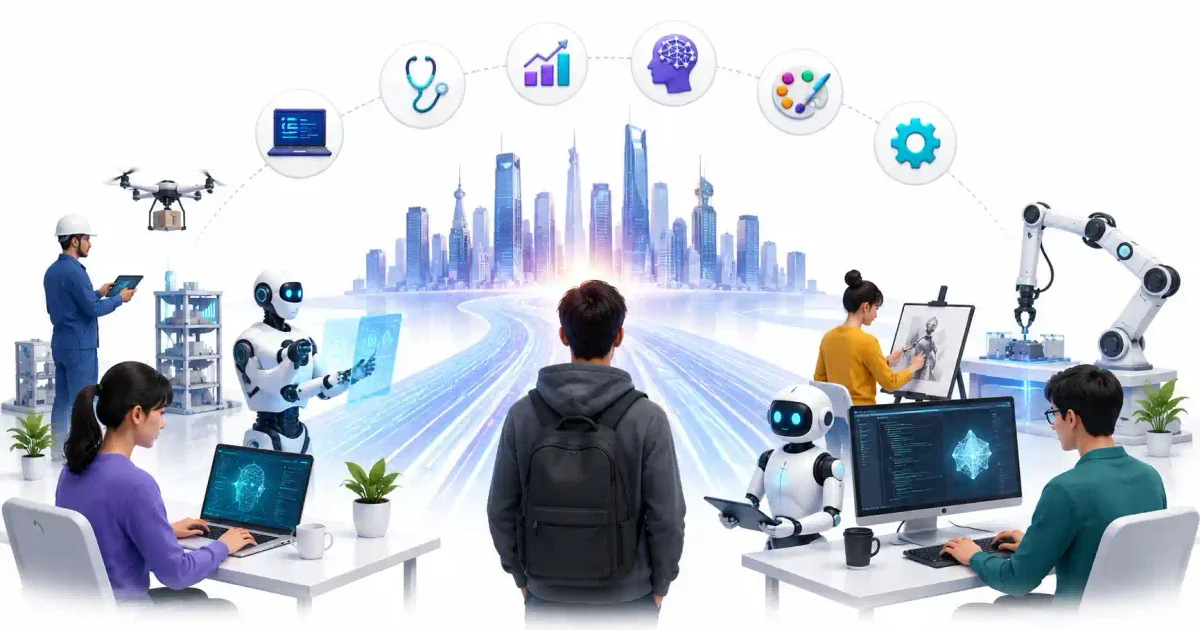
Artificial Intelligence has transformed from an experimental research field into a primary engine of global economic infrastructure. As we navigate 2026 and look toward the decade ahead (2026–2036), the core question facing software engineers, systems administrators, computer science students, and technology leaders is no longer whether AI will automate labor, but how humans collaborating with AI systems will redefine software architecture, organizational structures, and career trajectories. The transition is massive, and engineering careers are undergoing a dramatic rewrite.
The shift is unprecedented. Research from the World Economic Forum, Gartner, and leading technology institutions indicates that while roughly 85 million routine cognitive roles may be automated or restructured by machine learning models, over 110 million new specialized roles are emerging. Success in this new paradigm requires moving beyond basic coding syntax toward system architecture, prompt engineering, vector retrieval pipelines, MLOps deployment, and human-in-the-loop security oversight. We are witnessing the death of the “syntax monkey” and the rise of the high-level system architect.
This comprehensive architectural career guide provides an operational analysis of the AI workforce transformation. We will contrast high-risk versus high-growth career vectors, profile top emergent AI engineering roles, and outline a step-by-step framework to future-proof your career. Whether you are building self-hosted home labs or scaling enterprise platforms, this guide will map out the precise skills, tools, and mindsets you need to remain indispensable in the AI era.
Quick Answer: How to Future-Proof Your Tech Career
If you need a fast takeaway on how to secure your position in the upcoming tech landscape, focus on these fundamental shifts:
- Shift from Syntax to Architecture: Stop focusing solely on typing repetitive code block by block. AI handles the boilerplate. Master system design, security boundaries, asynchronous processing, and API integration. Understanding what happens when you type a URL end-to-end is far more valuable than memorizing syntax.
- Learn MLOps Infrastructure: Master local model hosting with Ollama and vLLM, vector indexing with ChromaDB and pgvector, and container orchestration with Docker and Kubernetes. Knowing how to self-host models is your competitive edge. Read our Ollama Linux installation guide to get started.
- Adopt Agentic Protocols: Master modern integration protocols like the Model Context Protocol (MCP) to connect AI models safely to enterprise backend databases and Linux systems. Check out our guide on the MCP protocol.
- Prioritize Security & Compliance: Focus on red teaming, container security scanning with Trivy and Semgrep, and zero-trust networking with Tailscale. The biggest barrier to enterprise AI adoption is security, making it the most lucrative specialization. Start by learning how to secure Docker containers.
The Cognitive Automation Wave: Structural Industry Shift
Understanding how cognitive automation impacts employment requires analyzing where Large Language Models (LLMs) and neural networks excel versus where they encounter hard algorithmic limitations. AI does not replace humans; it replaces specific deterministic tasks. The engineers who wire together the AI models, databases, and network interfaces will be the ones creating the automation.
Automation Risk Profile by Task Category
| Task Category | Primary Characteristics | AI Automation Capability | Human Value Premium | Examples |
|---|---|---|---|---|
| Routine Rule-Based | Deterministic logic, repetitive patterns, structured text | Extreme (90% - 99%) | Minimal | Data entry, L1 support, manual test execution, basic copy |
| Synthetic Synthesis | Code translation, log parsing, documentation summarizing | High (70% - 85%) | Moderate (Review) | Writing boilerplate code, summarizing logs, drafting tests |
| Architectural Design | System boundary design, failover planning, trade-off decisions | Moderate (30% - 50%) | High | Multi-region clusters, threat modeling, capacity planning |
| High-EQ & Governance | Ethical evaluation, legal accountability, client negotiation | Low (5% - 15%) | Maximum | Executive leadership, incident command, security auditing |
When evaluating AI vs Machine Learning vs Deep Learning, we see that generative AI models are aggressively attacking the “Synthetic Synthesis” layer. If your job revolves around translating requirements into basic CRUD code, your role is heavily exposed. If your job involves designing scalable microservices, securing APIs, or managing distributed clusters, your value is skyrocketing.
Algorithmic Capabilities vs Hard Engineering Limitations
To navigate the job market, you must deeply understand where AI systems fail.
What Artificial Intelligence Excels At
- Pattern Recognition at Scale: Ingesting millions of syslog entries or source code files to identify anomalies using robust search platforms like Meilisearch or OpenSearch.
- Boilerplate Code Generation: Producing initial scaffolding for APIs using Python, Node.js, Go, or Rust via coding assistants like GitHub Copilot and Cursor. Explore the best AI coding assistants to see these capabilities.
- Contextual Retrieval: Indexing massive troves of enterprise documentation into vector databases to query private knowledge bases efficiently.
- Log & Metric Summarization: Parsing real-time server output streams to highlight systemic failure points rapidly.
Hard Machine Learning Limitations
- Out-of-Distribution Generalization: Deep neural networks predict outcomes based on historical training distributions. When encountering rare “black swan” system outages, they struggle to extrapolate correctly without human guidance.
- Lack of Accountability & Liability: An algorithm cannot be sued, audited for legal compliance, or held criminally responsible for data breaches. Legal and operational liability must reside with human engineers. This is why OSINT methodologies and human-led security auditing remain irreplaceable.
- Moravec’s Paradox in Systems Operations: Automating physical infrastructure tasks—such as diagnosing hardware failures in a bare-metal hypervisor cluster—remains difficult for automated robotics. Building a Proxmox home lab gives you the hands-on hardware intuition that AI lacks.
- Context Window Truncation & Hallucinations: Even advanced models suffer from context degradation and hallucinations when reasoning across massive multi-gigabyte code monorepos. Human software architects must review, validate, and orchestrate these AI-generated pull requests.
High-Risk vs High-Growth Career Sectors (2026–2036)
The AI transformation is not reducing overall employment across software engineering; rather, it is shifting demand toward higher-value infrastructure, security, and integration roles.
High-Risk Roles (Facing Automation Pressure)
- Tier-1 Helpdesk & Support Engineers: Traditional script-following support queues are rapidly being replaced by conversational AI agents integrated with organizational vector bases.
- Entry-Level Web Copywriters: Generic marketing copy generation is heavily automated by LLM pipelines using advanced ChatGPT prompt techniques. However, high-end content marketing strategy remains human-led.
- Manual Software Testers: Writing repetitive manual test scripts is automated by autonomous agentic runners executing headless browser tests.
- Basic Data Entry & Bookkeeping: Standard ledger transactions are processed automatically by intelligent data extraction models like Paperless-ngx. To see how this works, check our Paperless-ngx self-hosting guide.
High-Growth Roles (Experiencing Massive Demand Surge)
- AI Infrastructure & MLOps Engineers: Systems engineers who deploy, containerize, scale, and monitor open-weight models using Ollama, vLLM, and Docker. Compare container tech in our Docker vs Podman benchmark.
- AI Security Analysts (Red Teaming): Security experts focused on protecting LLMs from prompt injection attacks, model inversion, training data poisoning, and unauthorized API data extraction.
- Context & Vector Database Engineers: Data specialists who design high-performance semantic search pipelines using vector indices and hybrid search architectures. Understanding relational vs vector data is crucial; start with our PostgreSQL vs MySQL comparison.
- Autonomous Agent Integration Specialists: Engineers who connect AI reasoning engines to enterprise infrastructure using protocols like MCP and workflow engines like n8n. Learn to install n8n via Docker Compose.
Deep Dive: Top High-Growth Careers in the AI Era
Let’s break down the precise tech stacks and focus areas for the highest-growth roles in the upcoming decade. These are the positions commanding massive salary premiums.
| Career Role | Focus Area | Required Tech Stack | Estimated Salary Bracket |
|---|---|---|---|
| MLOps Infrastructure Engineer | Serving & scaling open-weight LLMs | vLLM, Ollama, Docker, Kubernetes | $140,000 – $220,000 / year |
| RAG & Vector Search Architect | High-speed semantic search & indexing | ChromaDB, pgvector, Meilisearch, Redis | $130,000 – $200,000 / year |
| AI Security Red Teamer | Adversarial prompt testing & security | Kali Linux, Semgrep, Gitleaks, Trivy | $150,000 – $230,000 / year |
| Agentic Workflow Developer | Connecting LLMs to host tool APIs | MCP, Python, Node.js, n8n | $125,000 – $195,000 / year |
| AI Observability Lead | Tracking GPU/CPU latency & token telemetry | Prometheus, Grafana, Loki, Vector | $135,000 – $210,000 / year |
For computer science students looking to break into these brackets, the best path is practical execution. Check our curated list of AI projects for CS students to build your portfolio.
Operational MLOps Deployment Infrastructure Stack
To qualify for these high-paying AI engineering roles, candidates must understand how to construct production-ready AI infrastructure from bare metal to the application layer. This requires strong Linux administration skills.
1. Hardware & Host OS
You cannot deploy massive AI models without understanding the underlying host operating system. The foundational layer consists of Linux servers (typically Ubuntu 24.04 LTS, Debian, or Rocky Linux) deployed on bare metal, hypervisors like Proxmox VE, or cloud providers such as Hetzner Cloud or Microsoft Azure. Understanding Linux memory management and the Linux filesystem hierarchy is mandatory when you are configuring GPU drivers and hugepages for model inference.
2. Containerization & Orchestration
Modern AI apps are rarely installed directly on the host OS; they are containerized. You must be able to package inference engines and vector databases using Docker, Docker Compose, or Podman. If you haven’t mastered container basics, read how to install Docker on Ubuntu.
At scale, orchestration is handled by Kubernetes or its lightweight alternative k3s. For simpler single-node deployments, engineers use management panels like Portainer, DokPloy, or Coolify. We strongly recommend our Coolify self-hosting guide to understand modern PaaS deployment.
3. Model Serving & Routing
Serving open-source models (like Llama 3 or Mistral) locally requires inference engines. Ollama is standard for ease of use, while vLLM provides massive throughput for enterprise setups. Between your application and the models, you will often need an AI gateway like LiteLLM to standardize API calls, track token usage, and implement rate limiting across multiple backend models. This entire stack is discussed in detail in our local vs cloud AI guide.
Advanced AI Infrastructure Networking & Security
Network routing and security form the critical barrier protecting your AI workloads from external manipulation and data exfiltration.
Reverse Proxies and Ingress
In a production environment, AI APIs are never exposed directly to the public internet. All traffic must route through a robust reverse proxy. Standard choices include Nginx Proxy Manager, Traefik, or Caddy, which automatically handle SSL termination via Let’s Encrypt. Check out our Nginx Proxy Manager security guide for best practices.
Zero-Trust Networking and Mesh VPNs
To lock down administrative interfaces and private API endpoints, engineers utilize mesh VPN technologies. By putting your Prometheus metrics and Docker management APIs behind Tailscale or WireGuard, you eliminate the need for open firewall ports. We compare these tools extensively in our Tailscale vs WireGuard guide. Additionally, understanding how a VPN works is fundamental to network security.
Intrusion Prevention and Web Application Firewalls (WAF)
Protecting public endpoints requires active defense mechanisms. You should configure Cloudflare for DDoS protection and WAF rules. On the server side, implement Fail2ban to block brute-force attempts or upgrade to CrowdSec for collaborative IP blocklists. Follow our Fail2ban guide and CrowdSec beginner guide to lock down your network. At the OS level, always configure UFW (Uncomplicated Firewall); read our UFW firewall guide for rulesets.
Data Storage, Vector Databases, and Backups for AI
An AI model without memory is useless. Retrieval-Augmented Generation (RAG) pipelines require sophisticated data storage mechanisms.
Relational and Vector Data Stores
Primary application state and structured metadata are stored in standard relational databases like PostgreSQL or MySQL. However, storing the high-dimensional embeddings generated by AI models requires vector capabilities. While dedicated vector databases like ChromaDB are popular, the industry is increasingly moving toward using pgvector, an extension that brings vector search directly into PostgreSQL. High-speed caching for these queries is typically handled by Redis.
Object Storage and Media Management
When dealing with multimodal AI (processing images and video), you need robust S3-compatible object storage. MinIO is the standard for on-premises self-hosted environments. For user-facing file sync, organizations often deploy Nextcloud. Learn how to set this up in our Nextcloud complete setup guide. For photo and image management with AI capabilities built-in, Immich is spectacular; see our Immich self-hosted guide.
Backup and Disaster Recovery
AI infrastructure contains highly sensitive proprietary embeddings and training data. Implementing immutable backups is non-negotiable. Leading tools include Restic, BorgBackup, and Duplicati. Ensure you have a tested disaster recovery plan. For a comprehensive deep dive, read our guide on backup strategies for self-hosted servers.
AI Observability, Monitoring, and Logging
You cannot optimize what you cannot measure. AI inference is highly resource-intensive, often maxing out VRAM and CPU threads. When an AI pipeline fails, the logs are the only way to diagnose the issue. Understanding Linux logs is a prerequisite.
Metrics and Dashboards
To monitor GPU utilization, token generation speed, and API latency, the standard stack is Prometheus for metrics collection and Grafana for dashboard visualization. For simpler, lightweight health checking and uptime monitoring, Uptime Kuma is an excellent choice. Check out our Uptime Kuma self-hosted monitoring guide.
Centralized Logging and Telemetry
Logs from containerized AI models should be aggregated centrally using Loki or Vector. This allows you to query massive volumes of inference logs to detect anomalies or prompt injection attempts rapidly. These observability pipelines are essential for any serious MLOps engineer.
Security Hardening & Zero Trust
Security is the fastest-growing sector within the AI field. As LLMs are given access to databases and external APIs, the risk of disastrous data leaks increases exponentially.
Red Teaming and Vulnerability Scanning
Red teamers utilize operating systems like Kali Linux to simulate attacks on AI infrastructure. Read our Kali Linux beginner’s guide to understand the attacker’s mindset. To prevent shipping insecure code, CI/CD pipelines must integrate static code analysis and container vulnerability scanning using tools like Trivy, Snyk, Semgrep, and Gitleaks.
Secret Management and Hardening
Never hardcode API keys or database passwords in your Python scripts. All secrets must be injected via environment variables and stored in secure vaults like Vaultwarden. See our Vaultwarden self-hosted guide. Furthermore, SSH access to the underlying servers must be locked down using key-based authentication. Review our secure SSH on Ubuntu guide and learn the top 20 Linux security commands. To automate compliance checks, utilize the Lynis security auditing tool; we explain how in our Lynis security audit guide.
Automation, CI/CD, and Development Tools
AI engineers rely on rigorous version control and automation to manage complex infrastructure as code (IaC).
Version Control and GitOps
Git remains the foundation of all software engineering. Code is stored and collaborated on via platforms like GitHub, GitLab, or self-hosted alternatives like Gitea. If you need to brush up on basics, read our Git & GitHub guide.
Infrastructure as Code
Deploying AI servers manually is a recipe for configuration drift. Professionals use Ansible for configuration management and Terraform for provisioning cloud resources. This allows you to spin up identical GPU instances on Azure or AWS predictably. You can compare cloud environments in our AWS vs Azure vs Google Cloud guide.
Development Environments
For editing code, configuring JSON or YAML pipelines, and tweaking systemd service files, engineers often rely on powerful terminal editors like Neovim. See why it’s popular in our Neovim modern editor guide. Understanding file structures is critical, so ensure you comprehend Linux file permissions.
Real-World AI Integrations
To tie this all together, consider a modern AI agent workflow: A user uploads a PDF. The document is processed by Stirling-PDF (see our Stirling-PDF self-hosted guide), its text extracted and chunked via a Python script (read about understanding async JavaScript and Python equivalents for data processing), and the embeddings are pushed to pgvector. A localized chat interface running Open WebUI (read our Open WebUI setup guide) interfaces with Ollama, allowing the user to query the document privately. Simultaneously, SearXNG can be integrated to allow the LLM to search the web securely without tracking. Explore hidden AI tools for more novel integrations.
Troubleshooting Career Transition & Skill Gaps
Many engineers struggle to pivot into AI roles because their resumes emphasize outdated manual processes rather than modern automated architecture.
| Symptom | Likely Cause | What to Check | Fix |
|---|---|---|---|
| Resume Rejected for AI Roles | Listing outdated manual tools without MLOps context | Review project portfolio section on resume | Add containerized AI deployment projects showcasing local model hosting, vector DBs, and Docker. |
| High Latency in Portfolio Demos | Running unquantized models on insufficient CPU hardware | Check CPU/GPU utilization during demo queries | Use 4-bit quantized GGUF models via Ollama or deploy on a VPS. |
| Security Audit Failure in Apps | Hardcoded API keys or unencrypted local vector storage | Run static scanners like Gitleaks and Trivy | Move credentials to environment variables, use Vaultwarden, and restrict internal access via Tailscale. |
| Difficulty Understanding LLM Code | Over-reliance on AI code generators without syntax knowledge | Review underlying language fundamentals | Study REST API concepts, JSON formatting, and core system architecture principles manually. |
| Failing System Design Interviews | Lack of understanding of scale and load balancing | Review cloud architecture basics | Study what is cloud computing and how reverse proxies route multi-node traffic. |
Official Documentation and Resources
When upskilling for the future of AI jobs, always rely on authoritative sources:
- World Economic Forum Future of Jobs Report: Provides macro-level economic data on role transitions. https://www.weforum.org/reports/the-future-of-jobs-report-2023
- Model Context Protocol (MCP) Docs: Essential reading for agentic tool integration. https://modelcontextprotocol.io
- Ollama Infrastructure Project: The standard for local LLM deployment. https://github.com/ollama/ollama
- vLLM High-Performance Engine: Documentation for scaling enterprise inference. https://docs.vllm.ai
- Linux Foundation AI & Data: Excellent resource for open-source AI standards. https://lfaidata.foundation
Frequently Asked Questions
Will AI completely replace software engineers by 2036?
No. AI is automating routine boilerplate code generation, basic test script creation, and generic data manipulation, but it cannot replace human software architects. Engineers are shifting into high-level “Code Architects” who design system topologies, enforce security standards, evaluate operational trade-offs, and manage complex AI infrastructure pipelines. The role changes, but the human necessity remains.
What is the single most important skill to learn for the future AI job market?
The most valuable skill is AI Infrastructure & System Integration—the ability to connect open-weight AI models, vector databases, and agent protocols securely to private enterprise infrastructure using Docker, Python, Linux, and modern MLOps tooling. Knowing how to deploy and secure a system provides far more value than simply knowing how to write prompt templates.
Do I need a Ph.D. in Data Science to work in the AI industry?
No. While research scientists creating foundational algorithms often hold advanced degrees, the vast majority of new, highly paid roles are in AI Systems Engineering & MLOps. These roles require practical, hands-on skills in containerization, API development, Linux server administration, and network security rather than deep theoretical mathematics.
How can computer science students prepare for the AI-driven job market?
Students must move beyond basic academic assignments. They should build and host real-world AI projects—such as local RAG search tools, automated security log analyzers, or multi-agent automation pipelines—and deploy them publicly using Docker and VPS providers. Practical portfolio projects prove operational competency to employers.
What are the highest-paying AI careers in 2026?
According to industry trends, the top-paying roles are specialized technical positions. These include AI Security Red Teamers ($150k–$230k), MLOps Infrastructure Engineers ($140k–$220k), AI Observability Leads ($135k–$210k), and RAG Vector Search Architects ($130k–$200k). High pay correlates directly with managing complexity and risk.
What is the Model Context Protocol (MCP)?
MCP is an open standard that allows LLMs and AI assistants to interact safely with local databases, development tools, and file systems through structured JSON-RPC interfaces. It provides a secure, standardized way to give AI models access to external tools without permitting unconstrained arbitrary code execution.
How is AI changing remote work and DevOps opportunities?
AI enables remote engineers to operate at a much higher level of leverage. Small, distributed engineering teams can now manage massive infrastructure footprints that previously required large dedicated IT departments, thanks to AI-assisted automation tools, advanced log analysis, and intelligent CI/CD pipelines.
What is prompt injection in AI security?
Prompt injection is a critical adversarial attack vector where malicious input intentionally tricks an LLM into ignoring its original instructions. This can result in the model leaking private system prompts, executing unauthorized actions, or exposing sensitive enterprise data to unauthorized users.
Which programming languages are most valuable for AI careers?
Python remains absolutely essential as the glue for AI pipelines, machine learning frameworks, and basic agentic scripts. However, for high-performance model serving engines and system-level backend development, compiled languages like Go, C++, and Rust are in massive demand due to their speed and memory safety.
How do I transition from traditional sysadmin to an MLOps engineer?
Start by learning container orchestration deeply with Docker and Kubernetes. Then, practice local LLM hosting using tools like Ollama or vLLM. Next, learn vector database administration (pgvector, ChromaDB). Finally, master GPU metric monitoring using Prometheus and Grafana, and ensure you understand modern API security principles.

Discussion
Loading comments...