

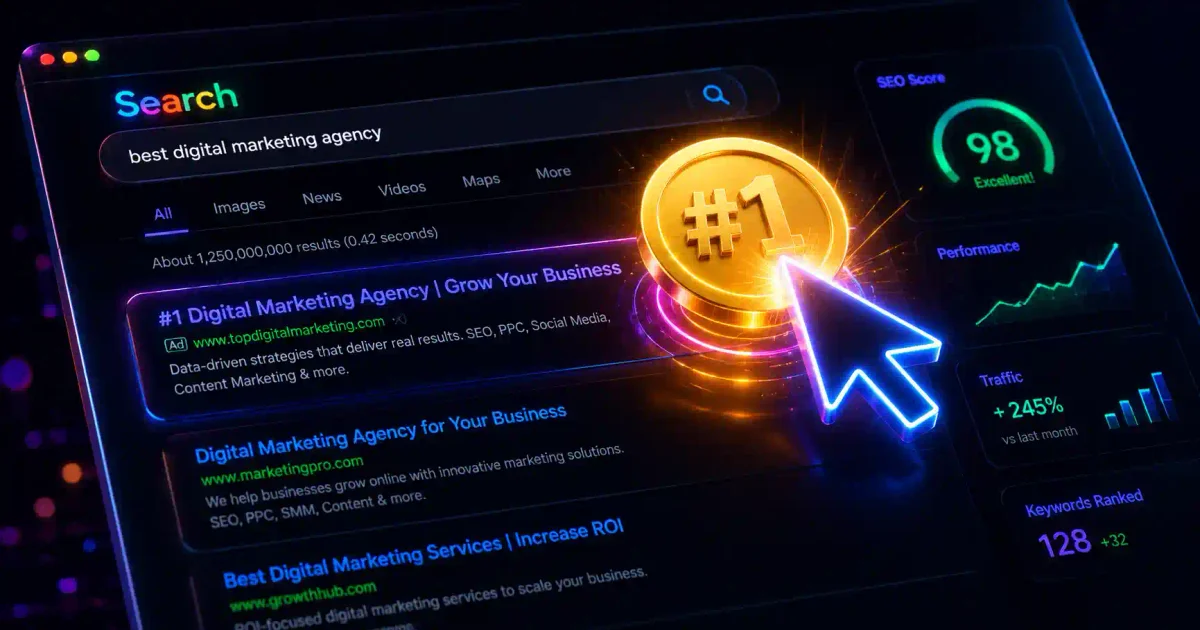
If Search Engine Optimization (SEO) is the slow, grueling, multi-year process of laying bricks to build a permanent skyscraper, Search Engine Marketing (SEM) is the process of renting a helicopter, flying directly to the top of that skyscraper, and instantly planting your flag on the roof.
In the fast-paced, ruthless world of digital commerce, time is often the most expensive currency a business possesses. You might have the best product in your industry, but if you are a brand new startup, you simply do not have 6 to 12 months to wait for an organic SEO strategy to bear fruit and slowly move your website from Page 10 of Google to Page 1.
If you are launching a new product line next week, running a seasonal Black Friday sale, or trying to aggressively capture market share from an entrenched competitor, you do not need theoretical future traffic; you need eyeballs on your website today, with their credit cards out.
That is the raw, unadulterated power of Search Engine Marketing.
In this guide, we will break down what SEM is, how the complex, real-time algorithmic bidding auctions work behind the scenes, how to manipulate the “Quality Score” algorithm to pay less money than your competitors, and how you can architect highly structured, profitable campaigns that turn expensive clicks into predictable cash.
1. What is Search Engine Marketing (SEM)?
Historically, in the early 2000s, “Search Engine Marketing” was used as a broad umbrella term that encompassed everything related to search engines—both paid search (ads) and organic search (SEO). However, as the digital marketing industry matured and specialized, the terminology shifted permanently.
Today, the term SEM refers exclusively to paid search advertising.
When you type a commercial query into Google (e.g., “best project management software”) and you see four results at the very top of the page with a bold “Sponsored” or “Ad” tag immediately next to the URL—that is SEM in action.
Advertisers actively bid money on specific words or phrases (keywords). When a human user searches for that keyword, the search engine runs a highly complex, lightning-fast algorithmic auction (taking less than 0.2 seconds) to decide which advertisers’ ads to display, and in what specific vertical order. The advertiser then pays the search engine a predetermined fee only when the user physically clicks on their ad, effectively buying a targeted visitor. (This is why SEM is often used interchangeably with PPC, or Pay-Per-Click).
The Golden Rule of SEM: Paying for Intent
In traditional advertising (like TV commercials or highway billboards), you are paying for impressions. You pay to put your message in front of a million people, hoping that a percentage of them happen to need your product. In SEM, you are not paying for impressions. You are paying exclusively for Intent.
If you buy a billboard on a busy highway, 100,000 people might drive past it every day, but only 5 of them are actively looking to hire a divorce lawyer right now. The rest of your money is wasted. If you bid $20 on the SEM keyword “hire divorce lawyer near me”, 100% of the people who see and click your ad are actively seeking your service, at that moment, with high urgency. That concentrated, explicit intent is what makes SEM so valuable, and inherently expensive.
2. SEO vs. SEM: The Great Debate and the Hybrid Strategy
One of the most common, fundamental questions from new business owners and junior marketers is: “Should I invest my limited marketing budget into SEO or SEM?”
The answer is almost always: You must do both, but at different times and for different reasons.
Here is a strict breakdown of how the two strategies compare operationally:
| Feature | SEO (Organic Search) | SEM (Paid Search) |
|---|---|---|
| The Cost Model | The clicks are technically “Free”, but it requires an upfront investment in content writers, developers, and time. | You pay hard cash to the platform for every single click. |
| The Speed to Market | Very slow. It typically takes 3 to 12 months for new content to rank on Page 1. | Instantaneous. Traffic starts flowing to your site the minute the ad is approved by reviewers. |
| Visual Placement | Sits below the paid ads, in the standard “organic” results section. | Dominates the very top (and sometimes the very bottom) of the Search Engine Results Page (SERP). |
| Longevity & Equity | Extremely high. Evergreen SEO content can generate passive traffic for years without ongoing cost. | Zero. The second your credit card declines or you pause the campaign, your traffic stops. |
| Testing Capability | Very difficult to A/B test quickly due to algorithm crawling delays. | Ideal for instantly A/B testing headlines, copywriting, and landing page offers within hours. |
The Ultimate Hybrid Strategy
The most successful, dominant companies in the world do not view SEO and SEM as enemies; they use them to fuel each other. When you launch a brand new business, your SEO domain authority is zero. You use SEM to generate immediate sales and cash flow. You then take the profit from those SEM sales and aggressively reinvest it into long-term content marketing and SEO. Furthermore, SEM acts as excellent market research. You can look at the raw data from your SEM campaigns to see which specific keywords generate the highest conversion rates, and then explicitly target those proven, highly profitable keywords with your long-term SEO strategy, ensuring you don’t waste time ranking for keywords that don’t convert.
3. The Core Platforms of Search Engine Marketing
While there are dozens of search engines globally, the SEM landscape in the Western world is effectively a duopoly, with one titan and one highly strategic underdog.
1. Google Ads (The Titan)
Google commands over 90% of the global search market share. If you are doing SEM, you are primarily doing Google Ads. It offers the largest volume of traffic by a wide margin, the most sophisticated AI and Machine Learning bidding algorithms, and the deepest native integration with other Google-owned analytics tools (like Google Analytics 4 and YouTube). If someone searches for it, they search for it on Google.
2. Microsoft Advertising (The Strategic Underdog)
Microsoft’s Bing search engine holds a much smaller global market share (hovering around 3% to 6%), but it is famously the unchangeable default search engine for millions of corporate Windows PCs and Microsoft Edge browsers in enterprise office environments. Why you should not ignore Bing: Because every marketer on earth fights violently for Google traffic, Bing often has significantly lower advertiser competition. This means lower Cost-Per-Click (CPC) bids and often a substantially higher Return on Ad Spend (ROAS). Furthermore, Microsoft Ads syndicates its ads to Yahoo and DuckDuckGo, giving you access to older, often more affluent demographics.
4. How the Google Ads Auction Actually Works
This is the most widely misunderstood concept in all of Search Engine Marketing. Many inexperienced advertisers believe that Google Ads is a simple, traditional financial auction: Whoever has the biggest budget and bids the most money automatically gets the #1 spot at the top of the page.
This is demonstrably false.
If the highest bidder always won, the search results would be immediately filled with terrible, irrelevant, spammy ads from low-quality companies with venture capital budgets. The user experience would be atrocious, and users would stop using Google. To prevent this, Google uses a complex mathematical formula to determine who actually wins the auction.
The Ad Rank Formula
Every single time a search is performed, Google instantaneously calculates an Ad Rank for every advertiser attempting to bid on that keyword.
Ad Rank = Maximum Bid × Quality Score × Expected Impact of Ad Formats
Your physical vertical position on the page is determined strictly by your final Ad Rank number, not just your financial bid.
Deep Dive: Understanding Quality Score
Quality Score is a secretive metric (graded from 1 to 10) that tells Google how relevant, useful, and high-quality your ad is to the human user. It is comprised of three core components:
- Expected Click-Through Rate (eCTR): How likely is a user to click your ad when they see it, based on Google’s historical data of your account and that specific keyword?
- Ad Relevance: Does your actual ad copywriting match what the user searched for? If they search “Nike Running Shoes” and your ad headline says “Discount Socks”, your relevance is terrible.
- Landing Page Experience: This is the most crucial part. When the user clicks the ad, where do they go? Does the website load in under 3 seconds? Is it mobile-friendly? Does it actually solve the user’s specific problem without deceptive pop-ups?
The Magic of Quality Score (The Math): Imagine two competitors fighting for the keyword “Plumber”.
- Advertiser A has a terrible Quality Score of 2, and aggressively bids $10. Their Ad Rank is 20.
- Advertiser B has a perfect Quality Score of 10, and bids only $3. Their Ad Rank is 30.
Advertiser B wins the #1 spot on Google, despite paying $7 LESS per click than Advertiser A. In SEM, relevance and user experience will always beat raw budget.
5. The Anatomy of a Perfect Search Campaign Structure
You cannot just throw $5,000 at Google, list 100 random keywords, write one ad, and expect sales. You must architect your account with precision.
Campaigns vs. Ad Groups
Your account should be strictly organized into a clear hierarchy.
- Campaigns: This is the top level. Campaigns control the daily budget, the geographic location targeting (e.g., “Only show in New York”), and the high-level bidding strategy. (Example Campaign: “Men’s Footwear”).
- Ad Groups: These sit inside the Campaigns and contain tightly themed clusters of keywords and the specific ads that match them. (Example Ad Groups: “Men’s Running Shoes”, “Men’s Leather Dress Shoes”, “Men’s Hiking Boots”).
Critical Rule: Never put keywords for “Running Shoes” and “Hiking Boots” in the same Ad Group. If you do, you cannot write an ad headline that is highly relevant to both, which destroys your Quality Score.
Keyword Match Types Explained
When you bid on a keyword, you must explicitly tell Google how strict you want their AI to be when matching your keyword to a user’s actual, messy search query.
- Broad Match:
running shoes(No punctuation). You are giving Google maximum freedom. Google will show your ad for anything it deems remotely related. It might show your ad for “how to run faster,” “women’s sneakers,” or “shoe repair.” (Warning: This burns through budgets rapidly and should only be used with automated bidding). - Phrase Match:
"running shoes"(Enclosed in quotes). The user’s query must include the meaning of your phrase, but can have words before or after. It will trigger for “buy blue running shoes” or “running shoes for men on sale”. - Exact Match:
[running shoes](Enclosed in brackets). Your ad will ONLY trigger if the user types that phrase or a close grammatical variant. It yields the lowest total traffic volume, but the highest possible conversion rate.
Negative Keywords: Your Financial Shield
Negative keywords are words you explicitly tell Google you do NOT want your ad to show up for. If you sell high-end, luxury $300 running shoes, you should add “cheap”, “free”, “discount”, and “used” to your Negative Keyword list. If a user searches “used running shoes”, your ad will be forcefully blocked from appearing, saving you from paying for a useless click from someone who cannot afford your product.
6. Writing High-Converting Ad Copy
In modern SEM, Google predominantly uses Responsive Search Ads (RSAs). You no longer write one static ad. Instead, you provide Google with up to 15 different Headlines and 4 different Descriptions. Google’s AI then rapidly mixes, matches, and tests millions of combinations in real-time to find the combination that gets the most clicks for that specific user.
Best Practices for Copywriting:
- Dynamic Keyword Insertion (DKI): Put the keyword the user searched for directly in Headline 1. If they search “Emergency Plumber Chicago”, your ad must explicitly say “Emergency Plumber Chicago”.
- Highlight Benefits, Not Just Features: Don’t just list technical specs. Don’t say “We have 10 trucks and 20 staff.” Say “We arrive at your house in under 30 minutes, guaranteed.”
- Include a Strong CTA: Tell the user what to do next. “Call Now”, “Get a Free Quote Online”, “Shop the Sale Today”.
- Use Every Ad Extension: Add your phone number, specific location addresses, structured snippets, and site links to your ad. This makes your ad physically larger on the mobile screen, violently pushing your competitors’ ads down below the fold.
7. The Landing Page Equation (Where Money is Made)
SEM does not generate sales. SEM generates traffic. Your landing page generates the sale.
The biggest mistake marketers make is spending $10,000 on a brilliantly optimized Google Ads campaign, and then sending all that highly targeted traffic to their generic, messy corporate homepage.
If a user clicks an ad for “Red Nike Air Max Size 10”, they must land on a page where they can immediately buy a Red Nike Air Max Size 10. If they land on a generic homepage featuring a carousel of winter coats and have to manually use a search bar to hunt for the shoe they just clicked on, they will hit the “Back” button in 2 seconds. You just paid $3 for a bounce.
Strict Landing Page Rules:
- Scent Match: The main H1 headline of the page must match the promise of the ad they just clicked.
- Remove Distractions: Hide the top navigation bar. You paid good money for this isolated click; do not let the user wander off to read your “About Us” page or your company blog.
- Clear Call-to-Action: The button to buy the product or submit the lead form should be glaringly obvious, highly contrasting in color, and placed “above the fold” (visible without scrolling).
8. Bidding Strategies: Manual Control vs. AI Automation
Google Ads offers several distinct ways to manage your bids.
Manual CPC (Cost Per Click)
You manually tell Google the maximum dollar amount you are willing to pay for a click on a specific keyword. This is time-consuming but great for tight budgets and extreme granular control.
Automated (Smart) Bidding
Google utilizes its machine-learning algorithms to adjust your bids in real-time. It analyzes the user’s specific device, physical location, time of day, and past browsing behavior to predict if they will buy.
- Maximize Clicks: Google attempts to get you as much sheer traffic as possible within your budget.
- Maximize Conversions: Google aggressively bids high on users it mathematically predicts are highly likely to buy, and bids low on users just browsing.
- Target CPA (Cost Per Action): You tell Google, “I am willing to pay $25 for a qualified lead,” and Google adjusts bids to hit that mathematical average over a 30-day period.
- Target ROAS (Return on Ad Spend): You tell Google, “For every $1 I spend on ads, I want $4 back in e-commerce revenue,” and Google optimizes its bidding specifically for high-cart-value customers.
Critical Note: Smart bidding requires historical data to work. You must have conversion tracking (pixels) installed on your website for the AI to learn what a “good” customer looks like.
9. Budgeting and Forecasting: The Infinite Math
A CEO will inevitably ask: “How much should we spend on Google Ads this month?”
The correct answer depends on your unit economics. Let’s do the simple math:
- You sell a SaaS software subscription for $100.
- Your landing page converts at 5%. (It takes 20 clicks to get 1 sale).
- If you pay an average of $2 per click on Google, it costs you $40 in ad spend to get a sale (20 clicks x $2).
- You made $100 in revenue, and spent $40 on ads. Your gross profit is $60.
As long as that mathematical equation holds true, your budget should be infinite. You should spend as much money as Google will physically let you spend, scaling up aggressively until the market is saturated or the CPC rises too high and breaks the profit margin.
10. Conclusion
Search Engine Marketing is arguably the most powerful, highly measurable direct-response advertising mechanism ever created in the history of capitalism. Unlike traditional advertising where you aggressively interrupt people who are trying to watch a movie or read a magazine, SEM allows you to place your commercial solution in front of a user the moment they ask a search engine for help.
When executed properly with tightly themed ad groups, relentless negative keyword management, high Quality Scores, and blazing-fast landing pages, SEM ceases to be an expense. It becomes an ATM machine that predictably turns $1 of ad spend into $3 of revenue.
Ready to explore the rest of the Digital Marketing ecosystem? Dive into our next guidees:
- The Ultimate Guide to Search Engine Optimization (SEO)
- Pay-Per-Click Advertising (PPC) Strategies
- Mastering Retargeting and Remarketing
Frequently Asked Questions (FAQ)
What is the difference between SEO and SEM? SEO (Search Engine Optimization) is the process of organically ranking content on search engines, which takes time but provides long-term free traffic. SEM (Search Engine Marketing) involves paying search engines directly for immediate, targeted ad placements at the top of the search results page.
How does the Google Ads auction determine my ad position? Google uses an “Ad Rank” formula, which multiplies your maximum financial bid by your Quality Score and the expected impact of your ad formats. This means highly relevant ads can outrank competitors who bid more money.
Why is Quality Score important in SEM? Quality Score measures the relevance and user experience of your ad and landing page. A high Quality Score drastically lowers your cost-per-click (CPC) and helps your ad achieve a better position on the page without needing to raise your bid.
What are the different keyword match types? There are three main match types: Broad Match (gives Google freedom to show your ad for loosely related terms), Phrase Match (triggers if the user’s query includes your exact phrase alongside other words), and Exact Match (only triggers for the specific phrase or close grammatical variants).
How can I improve the conversion rate of my SEM campaigns? To maximize conversions, ensure there is a perfect “scent match” between your ad copy and the landing page headline. Additionally, hide top navigation bars to prevent distractions, include a clear call-to-action above the fold, and use automated smart bidding strategies tailored to your target Cost Per Action (CPA) or Return on Ad Spend (ROAS).



Discussion
Loading comments...