

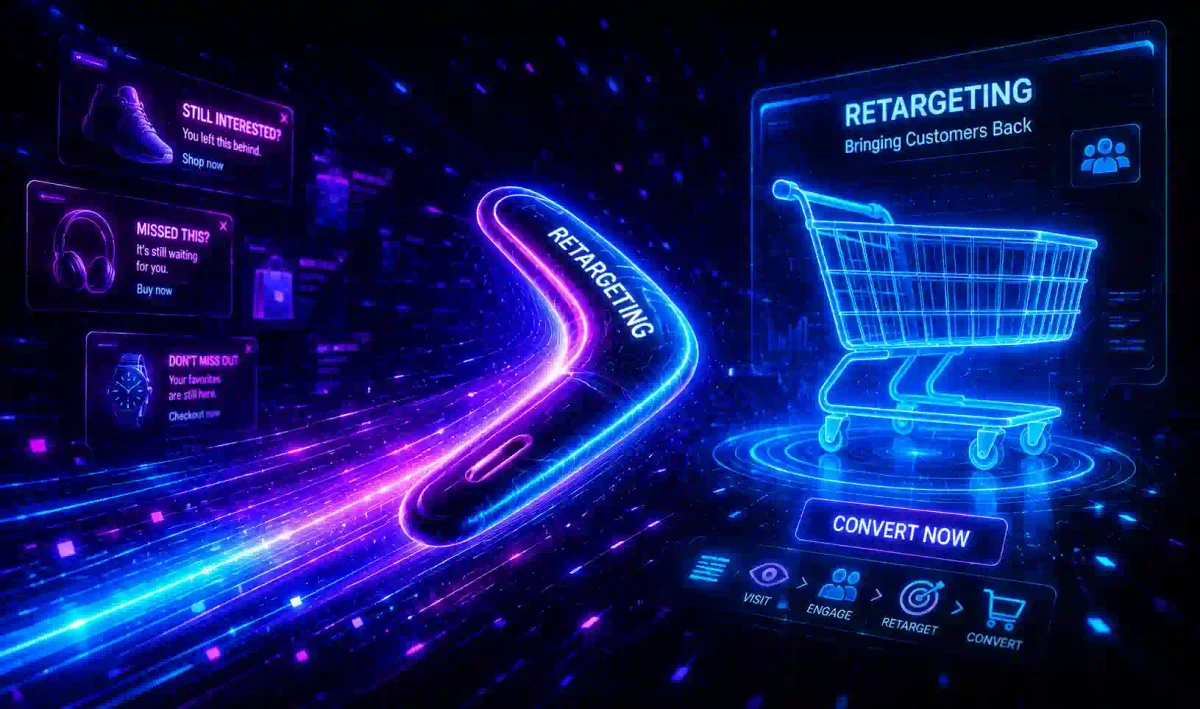
Imagine, for a moment, walking into a high-end physical retail store. You browse the aisles, look at a beautifully crafted leather jacket, check the price tag, try it on to see how it fits, and then ultimately decide to leave the store without buying it. You walk out the glass doors.
Now imagine that as you walk down the busy street toward your parked car, a salesperson from the store sprints out the door after you. They run alongside you, holding the exact leather jacket you tried on, shouting, “Hey! You forgot this! I know you liked it! I’ll give you a 10% discount and free shipping if you come back inside and buy it right now!”
In the physical, offline world, this aggressive behavior would be considered clinically insane and genuinely terrifying. In the digital world, however, it is called Retargeting, and it is unequivocally the single most profitable marketing strategy ever invented in the history of commerce.
If you are spending thousands of dollars running cold Facebook Ads, Google Ads, or a complex SEO Campaign to drive traffic to your website, and you are not running a dedicated retargeting campaign to capture the users who leave, you are literally setting large piles of cash on fire.
In this exhaustive guide, we will deeply explore the underlying technology of tracking pixels, the profound psychological difference between cold traffic and warm traffic, how to avoid terrifying your customers with ad fatigue, and the exact retargeting funnels used by multi-million dollar e-commerce empires.
1. Retargeting vs. Remarketing (Clearing the Industry Confusion)
Digital marketers frequently use these two terms interchangeably in meetings, but historically, they meant two very different things. It is important to know the difference to avoid confusion when discussing strategy with agencies.
- Retargeting (The Ad Focus): This refers specifically to serving paid Display Ads or Social Media Ads to people who have visited your website and left without buying. It relies entirely on browser cookies, tracking pixels, and ad network algorithms.
- Remarketing (The Email Focus): Historically, this referred to re-engaging customers via Email. It assumes you already successfully captured their email address, and you use an automated system to send them a message (e.g., “You left these items in your shopping cart!”).
The 2026 Reality: Today, the lines have blurred completely. Google Ads aggressively uses the word “Remarketing” to describe its display ad retargeting network. For the sake of your sanity and this guide, assume both words mean the exact same strategic concept: Marketing directly to someone who already knows exactly who you are.
2. The Psychology of the Lost Sale (Why 98% of People Leave)
Here is a brutal mathematical reality: The average e-commerce website conversion rate across all industries is roughly 2%. That means if you spend $1,000 to drive 1,000 highly targeted people to your website, 980 of them will leave without giving you a single dollar.
Why did 98% of them leave? Usually, it is not because they hated your product. It is due to specific, resolvable friction points:
- Contextual Timing: They were browsing your site on their mobile phone while waiting for a train. The train arrived, so they abruptly put their phone in their pocket.
- Lack of Trust: They have never heard of your brand before today. They don’t want to enter their credit card information on a site they don’t trust yet.
- Active Price Shopping: They are looking at your product in Tab A, and simultaneously looking at your direct competitor’s product in Tab B.
- Sticker Shock at Checkout: They were ready to buy, but they reached the final checkout screen, saw a massive $15 shipping fee added to the total, panicked, and abandoned the cart.
The Golden Rule: Cold Traffic vs. Warm Traffic Trying to convince a complete stranger (Cold Traffic) to buy a $150 product within 60 seconds of discovering your brand is incredibly difficult. It requires massive persuasion. Retargeting focuses exclusively on Warm Traffic. The user already knows your brand. They already expressed explicit interest in the product. Your retargeting ad simply needs to act as a gentle reminder, or resolve the specific friction point (like offering free shipping to overcome sticker shock) that made them leave in the first place.
3. The Underlying Technology: How Tracking Pixels Actually Work
You cannot retarget someone if you cannot track them. This seemingly magical process is achieved via a piece of code called a Tracking Pixel (like the Meta Pixel, Google Ads Tag, or TikTok Pixel).
The Step-by-Step Technical Journey:
- Installation: You install a tiny snippet of invisible JavaScript code (the Pixel) into the global
<head>section of your website’s HTML. - The Visit: A user visits your website while simultaneously logged into the Facebook app on their phone in the background.
- The Firing Event: The Pixel “fires” in their browser. It silently sends a data packet back to Facebook’s servers stating: “User #99834 just looked at the Red Running Shoes on Website X, but they did not trigger the purchase event.”
- The Departure: The user leaves your website without buying anything and opens the Instagram app to look at memes.
- The Algorithmic Match: Because Meta owns Instagram, their central database instantly cross-references the data. It realizes that User #99834, who just left your shoe store 10 seconds ago, is currently scrolling through their Instagram feed.
- The Delivery: The algorithm instantly enters a real-time auction, wins the bid using your budget, and injects an advertisement for your exact Red Running Shoes directly into their feed between pictures of their friends.
It feels like magic to the consumer. It is just basic database matching for the marketer.
4. The 3 Core Retargeting Audiences (Segmentation is Mandatory)
Amateur marketers make a fatal mistake: they put a tracking pixel on their site, create an audience of “Everyone who visited in the last 30 days,” and show them all the exact same generic advertisement. This is a massive waste of money. You must segment your retargeting based on the user’s specific level of intent.
Audience 1: Generic Site Visitors (Low Intent)
These people read a blog post or briefly glanced at your homepage, but did not look at a specific product page.
- Their Mindset: “I’m just browsing. I don’t really know what this company does.”
- The Ad Strategy: Do not push a hard sale; you will scare them away. Show them a brand awareness video, an educational article, a customer testimonial video to build trust, or offer a free Lead Magnet (like an eBook) to safely acquire their email address.
Audience 2: Specific Product Viewers (Medium Intent)
These users clicked on a specific product page (e.g., “The Blue Winter Coat”), spent 2 minutes reading the description, but didn’t add it to their cart.
- Their Mindset: “I like this coat, but I’m not sure if it’s high quality, or if I should buy it from Amazon instead.”
- The Ad Strategy: They lacked trust or urgency. Hit them heavily with Social Proof. Show them an ad featuring a 5-star review from a happy customer wearing the exact blue coat they were looking at. Alternatively, show an ad featuring an influencer unboxing the coat.
Audience 3: Cart Abandoners (Extremely High Intent)
They added the $150 coat to their cart, clicked “Checkout,” typed in their name and address, but abandoned the page when it asked for a credit card.
- Their Mindset: “I want this coat right now, but I just remembered I need to pay rent tomorrow, or I hate that shipping isn’t free.”
- The Ad Strategy: Extreme Urgency and Direct Incentives. Hit them immediately with an ad that says: “Forgot something? Your Blue Coat is selling out fast! Use code COMEBACK for 15% off and Free Shipping. Valid for the next 24 hours only.” This specific ad audience will generate the highest ROI of any advertisement you will ever run in your career.
5. Frequency Caps: The Fine Line Between Persistent and Creepy
Have you ever looked at a pair of shoes online, decided not to buy them, and then for the next three consecutive months, an ad for those exact shoes stalks you violently across the entire internet, popping up on every single website you visit?
That brand committed a cardinal sin: they did not set a Frequency Cap.
If a user sees your ad 3 times in a week, they are gently reminded of your brand. If a user sees your ad 45 times in a week, they rapidly develop what psychologists call “Brand Fatigue” or “Ad Blindness.” They become actively annoyed by your company. They feel stalked. They will consciously refuse to ever buy from you out of sheer spite.
The Golden Rule of Frequency: Always dive into the advanced settings of your ad platform and set a strict Frequency Cap. A standard best practice is to ensure a user sees your retargeting ad a maximum of 3 to 4 times per day, and for no longer than 14 to 30 days after their last website visit. If they haven’t bought the shoes after seeing the ad 40 times over a month, they are never going to buy the shoes. Stop wasting your money showing them the ad.
6. Dynamic Product Ads (DPA): The E-commerce Superweapon
If you run a small boutique store that sells exactly 3 products, you can easily manually design 3 different retargeting ads in Photoshop. However, if you run a massive e-commerce empire with 5,000 different SKUs across 50 different categories, it is mathematically impossible to manually design and launch 5,000 different retargeting ads.
Dynamic Product Ads (DPAs) completely automate this impossible task. You connect your website’s backend inventory catalog directly to the Google or Facebook ad platform via an XML feed.
When a user visits your site, the algorithm tracks exactly which specific SKU they viewed. When the user opens Facebook later, the algorithm automatically generates a custom advertisement in milliseconds. It pulls the specific image, the exact title, and the live price of that exact product directly from your catalog, formats it into a beautiful carousel ad, and shows it to the user.
- If User A looked at a blue hat and a red shirt, they see a carousel ad featuring exactly that blue hat and red shirt.
- If User B looked at hiking boots, they see an ad for hiking boots.
You do zero manual design work. The AI handles infinite personalization at scale.
7. The Burn Pixel (Exclusion Audiences): Stop Pitching Existing Buyers
The fastest way to infuriate a loyal customer, and simultaneously burn your own marketing budget, is to show a customer an ad offering a “20% New Customer Discount” on the exact product they just purchased from you yesterday at full price.
To prevent this disaster, you must aggressively utilize a Burn Pixel (technically known as an Exclusion Audience).
When a user successfully completes a purchase and lands on your final “Thank You for Your Order” page, the tracking pixel must trigger a “Purchase” event. You must configure your ad campaigns to exclude anyone who has triggered that Purchase event in the last 30 days from seeing your Cart Abandonment ads.
Once they buy, immediately pull them out of the aggressive sales funnel. Stop spending expensive ad budget trying to convince someone to buy a product they already own.
8. Cross-Selling and the Replenishment Funnel
While you should absolutely use a Burn Pixel to stop pitching the item they just bought, you should immediately retarget them with highly relevant, complementary items. This dramatically increases the Customer Lifetime Value (LTV).
- The Cross-Sell Campaign: If a user just bought a $1,000 professional camera body from your website, they do not need another camera body. However, they definitely need accessories. Put them in a specific “Recent Buyers” retargeting audience for the next 30 days that exclusively shows them ads for compatible camera lenses, tripods, SD cards, and carrying cases.
- The Consumable Replenishment Ad: If you sell a consumable product that runs out predictably—like a 30-day supply of protein powder, dog food, or skincare serum—you can use retargeting brilliantly. Exclude the buyer from all ads for 25 days so you don’t annoy them. On day 26 (right as they are running out of the product), trigger a highly specific retargeting ad: “Running low on your Vanilla Protein? Click here to reorder with 1-click and get 10% off your refill.”
9. Privacy Laws and the Cookieless Future (iOS 14.5 & GDPR)
It is impossible to write a definitive guide to retargeting in 2026 without discussing the massive, existential dark cloud hanging over the entire advertising industry: Privacy Legislation.
For a decade, retargeting relied entirely on “Third-Party Cookies”—trackers placed on your browser by ad networks. In 2021, Apple released the devastating iOS 14.5 update, which introduced App Tracking Transparency (ATT). It required apps to explicitly ask users if they wanted to be tracked across the internet. Unsurprisingly, over 80% of humans clicked “Ask App Not to Track.” Furthermore, strict European GDPR laws require users to manually accept cookies on your website before the pixel can legally fire.
When users block tracking, the Facebook and Google Pixels are severely blinded. They cannot seamlessly track that user from your website back to the app.
The Solution: First-Party Data and Server-Side Tracking (CAPI) Marketers can no longer rely entirely on third-party pixel data. You must shift your entire strategy.
- First-Party Data Capture: The primary goal of your website must be to capture the user’s email address or phone number as fast as physically possible (via a discount popup or lead magnet). If you own their email address, you can upload that encrypted email directly into Facebook (called a Custom Audience match). Facebook matches the email to the user’s profile, completely bypassing browser cookies to serve them retargeting ads.
- Conversions API (CAPI): Instead of relying on the user’s browser to send the pixel data to Facebook (which the browser can block), CAPI connects your website’s backend server directly to Facebook’s server. When a purchase happens, your secure server sends the data directly to Meta, vastly improving tracking accuracy in a privacy-first world.
10. Conclusion: The Invisible Sales Machine
Retargeting is not simply an advertising tactic; it represents a fundamental, philosophical shift in how a brand views its website traffic.
When you launch a marketing campaign today, you should not be aggressively trying to force a stranger to pull out their credit card and buy your product on the very first click. That is an archaic, expensive strategy.
Instead, you are simply trying to buy their attention long enough to get them to visit your website so you can Pixel them or capture their email. Once they are safely in your tracking ecosystem, you have the profound ability to gently, consistently, and cost-effectively remind them of your massive value until they are mathematically, psychologically ready to buy.
Ready to start driving traffic to your newly pixeled website? Dive deeply into our next guidees on traffic generation:
- The Complete Guide to Display Advertising
- Social Media Marketing (SMM) guide
- The Ultimate Guide to Web Analytics & Tracking
Frequently Asked Questions (FAQ)
What is the difference between retargeting and remarketing? Historically, retargeting referred to serving paid display or social media ads to previous website visitors, while remarketing focused on re-engaging captured emails. Today, the terms are often used interchangeably to mean marketing to people who already know your brand.
How do tracking pixels work for retargeting? A tracking pixel is a snippet of code on your website that fires when a user visits. It sends a data packet back to an ad network (like Facebook or Google) allowing the network to recognize the user and serve them your ads when they browse elsewhere.
What is ad fatigue, and how do I prevent it? Ad fatigue occurs when a user sees your ad too many times, leading to annoyance and “ad blindness.” You can prevent it by setting strict frequency caps—limiting ad exposure to 3-4 times per day over a maximum of 14-30 days.
What are Dynamic Product Ads (DPAs)? Dynamic Product Ads are automated ads that pull directly from your e-commerce catalog. Instead of manually designing ads, the algorithm automatically generates personalized ads showing the exact products a specific user viewed on your site.
How is the “cookieless future” affecting retargeting strategies? Privacy updates like iOS 14.5 and strict GDPR laws block third-party tracking cookies. To adapt, marketers must focus on capturing first-party data (like email addresses) and using server-side tracking (like Conversions API) to bypass browser restrictions.


Discussion
Loading comments...