

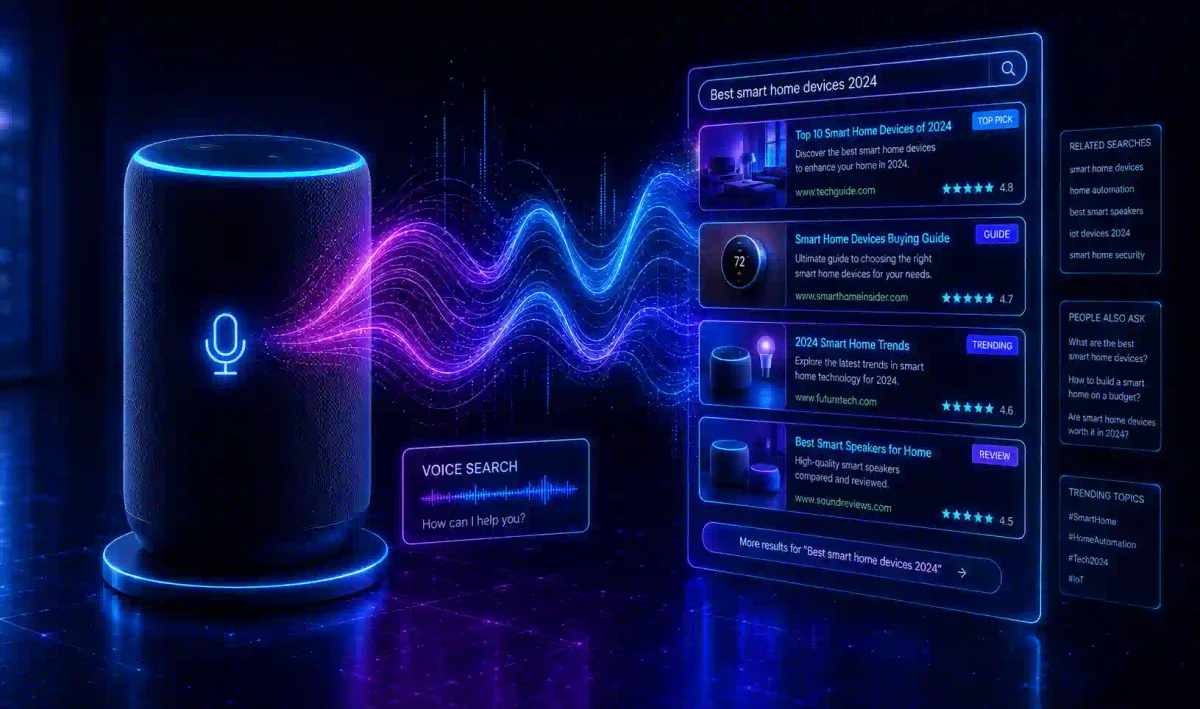
In the early 2010s, successfully searching the internet required physical effort. You had to sit down at a desktop computer keyboard, open a browser, and manually type out fragmented, robotic keywords like “weather Chicago weekend” or “best plumber New York.”
Today, the paradigm of human-computer interaction has shifted. You are more likely to be standing in your kitchen, chopping vegetables with both hands full, and asking the empty room: “Hey Alexa, what’s the weather going to be like in Chicago this weekend?”
The mainstream adoption of smart speakers (Amazon Echo, Google Home) and mobile virtual assistants (Siri, Google Assistant) has altered the digital landscape. By 2026, data suggests nearly half of all internet searches are initiated by voice commands rather than a keyboard.
However, many businesses make a mistake: they assume that standard Search Engine Optimization (SEO) applies to voice. Voice Search Optimization (VSO) is different from traditional Search Engine Optimization (SEO).
When a user types a standard query into Google on their laptop, they are given 10 blue links on page one to choose from. When a user asks Siri or Alexa a question while driving their car, the virtual assistant does not read 10 links aloud. It gives the user one answer.
If your website is not ranked as the #1 answer on the internet, you do not exist in the voice search ecosystem.
In this guide, we will explore the psychology of conversational search queries, how to structure your HTML content to capture “Position Zero,” and why optimizing your Local SEO is the backbone of modern voice marketing.
1. How Voice Search Differs from Text Search
To optimize your website for voice algorithms, you must first understand how human behavior changes when we speak aloud versus when we type. The differences are notable.
Search Query Length
- Typed Searches: These are short, typically averaging 1 to 3 words. Typing on a mobile keyboard is tedious and prone to typos, so humans condense their thoughts to save time.
- Voice Searches: These are longer, averaging 5 to 8 words, and often extending further. Speaking aloud is rapid and effortless. Instead of typing “shoes flat feet,” a user will speak the sentence floating in their head.
The Tone: Robotic vs. Conversational
- Typed Searches: Humans have been conditioned to speak to search engines like cavemen. We strip out grammar and stop words. We type “best running shoes flat feet.”
- Voice Searches: Because we are speaking to a virtual assistant that has a human voice (like Siri), we treat the machine like a human being. We use full, grammatically correct sentences. We ask: “What are the best running shoes for someone who has flat feet?”
The Underlying User Intent
- Typed Searches: Often broad, exploratory, and informational. The user might be researching a topic they plan to take action on next month.
- Voice Searches: Driven by urgent, immediate, and local intent. People use voice commands when their hands are full (driving a car, cooking, holding a baby) and they need an actionable answer right now.
2. The Psychology of Conversational Queries (NLP)
When optimizing for text SEO in the early days of the internet, marketers obsessed over “exact-match keywords.” If you wanted to rank for “cheap flights,” you jammed the phrase “cheap flights” into your paragraph 15 times.
This archaic strategy fails in voice search.
Google’s core Search AI (specifically the BERT and MUM algorithm updates) is now advanced at understanding Natural Language Processing (NLP). The AI does not look at individual words in a vacuum anymore; it understands the context, semantics, and nuances of a full sentence, just like a human brain does.
Your content must answer the conversational questions: “Who, What, Where, When, Why, and How.”
If you run an e-commerce store selling premium coffee beans, trying to rank for the broad word “Coffee” is irrelevant and impossible for voice search. You want to rank for the specific conversational query: “Hey Google, how do I brew a cup of French Press coffee at home?”
To win that search, your blog post cannot just be a list of coffee beans. It must be a structured, step-by-step tutorial answering the question the user asked the machine.
3. Position Zero: The Holy Grail of Voice Search
When you ask a smart speaker a question, where does it pull the answer from? Does it guess?
No. It reads aloud from Featured Snippets (also known in the SEO industry as “Position Zero”).
A Featured Snippet is that coveted, highlighted rectangular box of text that appears at the top of a Google search results page, sitting above the standard organic #1 ranking. Google’s algorithm has determined that the text inside that box is the best, most concise answer to the user’s question on the internet.
If you capture the Featured Snippet on desktop, you become the king of voice. You will be the only answer read aloud by Google Assistant.
The Formula for Capturing Featured Snippets
Securing Position Zero is a science. You must format your HTML to hand the answer to Google on a silver platter.
- The Question Header: Use an
<h2>or<h3>HTML tag that asks the question the user is speaking into their phone. (e.g.,<h2>How much does a brand new roof cost in 2026?</h2>). - The 45-Word Direct Answer: Immediately below that header tag, answer the question in a paragraph. Crucial Data Point: Industry studies show the optimal length for a voice search answer is between 40 and 50 words. Do not ramble. Give the machine the answer it needs to read aloud.
- The Deep Dive (For Standard SEO): Google still needs long-form content to justify ranking your page high enough to pull the snippet. After providing the concise 45-word answer, spend the remaining 1,500 words of the article explaining the topic in detail to satisfy standard algorithmic ranking factors.
4. Long-Tail Keywords and the Power of Question Phrases
Because voice searches are conversational, they rely on Long-Tail Keywords.
A long-tail keyword is a specific search phrase (usually 4+ words) that has a lower total search volume than a broad keyword, but possesses a high conversion intent because the user knows what they want.
How to find Voice Search Keywords: You cannot guess what people are asking. You must use data. Utilize tools like AnswerThePublic, Ahrefs Keyword Explorer, or look at the Google “People Also Ask” (PAA) box on the search results page.
If you are a local plumbing business, do not waste money trying to optimize for the keyword “Chicago Plumber.” Optimize for these high-intent voice queries:
- “Why is my kitchen sink draining so slowly?”
- “How do I temporarily fix a running toilet until a plumber arrives?”
- “Who is the cheapest 24-hour emergency plumber near me?”
Write a detailed blog post—or build out an FAQ section—dedicated to answering each one of those specific conversational questions.
5. Local SEO: The Engine of Mobile Voice Search
Here is the most important statistic in this guide: Over 50% of all voice searches possess Local Intent.
People are driving in their cars, walking down the street, or standing in a new city, asking their phones for directions, business hours, and nearby services. Voice search is tied to physical geography.
The “Near Me” Phenomenon
Searches containing the phrase “near me” have grown significantly over the last decade. If a user is driving and asks their Apple CarPlay, “Siri, where is a good Italian restaurant near me?” Siri does not read them a recipe blog post from a chef in Italy. It reads them a local business listing pulled directly from Apple Maps or Google Business Profile.
To dominate Local Voice Search, you must execute the following:
- Claim and Optimize GBP: Claim your Google Business Profile (GBP). Fill out every field. List your holiday hours, upload high-definition photos of your storefront, and accurately select your business categories.
- N.A.P. Consistency: Your Name, Address, and Phone Number (NAP) must be identical across the internet. If Yelp says you are located on “Main St.” and your website says “Main Street,” you will confuse the AI algorithm, and it will drop your ranking.
- Generate a Volume of 5-Star Reviews: This is critical. Siri and Google Assistant will often filter results by saying aloud, “Here are the top-rated Italian restaurants near you.” If your business is rated 3.5 stars, the algorithm will refuse to mention you, prioritizing the 4.8-star competitor across the street.
6. Website Speed and Mobile Optimization
As discussed in our Mobile Marketing Guide, Google operates on a “Mobile-First Indexing” protocol. It judges your website based on how it performs on a smartphone.
For voice search algorithms, Page Speed is the gatekeeper.
When a user asks a smart speaker a question, they expect an answer quickly. Data shows that the average voice search results page loads in 4.6 seconds—which is 52% faster than the average webpage on the internet.
If your website takes 10 seconds to load because it is bogged down by uncompressed images, bloated JavaScript animations, and cheap shared hosting, Google will refuse to use your content for a voice answer. The algorithm knows a slow site creates a terrible user experience, and it will give the Featured Snippet to a faster competitor, even if your written answer is slightly better.
7. Schema Markup (Structured Data) for Voice Algorithms
Search engine AI models are smart, but at the end of the day, they are still machines. They need help understanding the context of your data.
Schema Markup (JSON-LD) is specialized, hidden code you inject into your website’s HTML that translates your human-readable content into a structured language that search engines natively understand.
If you publish a blog post containing a recipe for chocolate chip cookies, you should not format it as regular text paragraphs. You must wrap the text in Recipe Schema Markup. This code tells Google’s AI which part of the text is the “Prep Time,” which part is the “Ingredients List,” and which part constitutes the “Cooking Instructions.”
When a user says, “Hey Google, walk me through the recipe for chocolate chip cookies,” Google Assistant does not read the whole page. It relies on your Schema Markup to logically read the instructions step-by-step, pausing when the user tells it to wait.
(Modern developers should research implementing Speakable Schema, which is code that tells the Google Assistant which paragraphs of text on a news article or blog post are designed to be read aloud).
8. Creating FAQ Pages for Voice Dominance
The fastest, highest-ROI strategy to start ranking for voice search queries in a matter of weeks is to build a structured FAQ (Frequently Asked Questions) page on your website.
The Actionable Strategy:
- Data Gathering: Talk to your Sales and Customer Support teams. Ask them: “What are the top 20 questions customers ask you on the phone every day?”
- HTML Structure: Write those 20 questions as
<h2>headers on your dedicated FAQ page. - The Concise Answer: Answer each question directly below the header in a 40-50 word paragraph. No fluff.
- Schema Injection: Apply the
FAQPageSchema Markup script to the entire page.
This strategy creates a concentrated cluster of natural language Q&A data that Google’s voice algorithm loves to index and read aloud. It is bait for virtual assistants.
9. The Impending Future of Voice Commerce (V-Commerce)
Currently, voice search is primarily used for information retrieval (weather, trivia, local directions). However, it is rapidly evolving into financial transactions. This industry is known as Voice Commerce (V-Commerce).
Consumers are already comfortable saying, “Alexa, reorder my brand of paper towels.” But as AI assistants (powered by Large Language Models) become more advanced, complex transactions are occurring natively through voice. “Siri, book me a window seat on the cheapest flight to Denver next Friday, and rent me an SUV at the airport.”
To prepare your business for the V-Commerce revolution, e-commerce brands must rewrite product descriptions to be conversational. Instead of listing a bulleted table of technical specs, product pages must answer conversational questions like, “Is this vacuum cleaner good for picking up dog hair on carpets?“
10. Frequently Asked Questions (FAQ)
Q: Do I need to build a different SEO strategy for Alexa, Siri, and Google Assistant? A: Largely, no. While it is true that Amazon’s Alexa relies on the Bing search engine, and Apple’s Siri pulls from Apple Maps and various proprietary sources, Google Assistant still holds the lion’s share of the global search market. If you optimize for Google’s Featured Snippets and Google Business Profile Local SEO, those foundational best practices will ensure you perform well across all three major voice assistants.
Q: Does voice search use different keywords than text search? A: The core topic remains the same, but the grammatical phrasing is different. A standard text search keyword might be “SEO software tools.” The equivalent voice search keyword is “What are the best SEO software tools for a small e-commerce business?” You must optimize for the question, not the fragment.
Q: How do I track Voice Search traffic in my Google Analytics dashboard? A: Currently, this is frustrating for marketers. Google Analytics does not provide a specific toggle to separate voice search traffic from standard desktop/mobile organic search traffic. You can only infer voice traffic by looking at your Google Search Console query data and filtering for long-tail search queries that begin with conversational modifiers like “Who,” “What,” “Where,” “Why,” and “How.”
Q: What percentage of searches are voice searches in 2026? A: It is estimated that over 50% of all online searches now involve some form of voice input, including smartphone voice assistants, smart speakers, and in-car voice systems. The trend continues to grow as natural language processing technology improves.
Q: Does page speed affect voice search rankings? A: Yes, significantly. Voice assistants prioritize fast-loading pages because users expect instant spoken responses. Google has confirmed that page speed is a ranking factor, and voice search results load 52% faster than the average web page.
11. Conclusion & Next Steps
Voice Search Optimization is not a passing tech fad; it is the result of human beings seeking the path of least resistance. Typing on a tiny glass keyboard is friction. Speaking aloud to a computer is frictionless.
By shifting your digital content strategy away from keyword stuffing and pivoting toward answering conversational human questions with clear, concise, and structured data, you will not only dominate the smart speaker ecosystem, but you will improve your overall SEO rankings on traditional desktop search.
Ready to explore the final frontier of Digital Marketing? Dive into our last guidees in this comprehensive series to complete your training:



Discussion
Loading comments...