

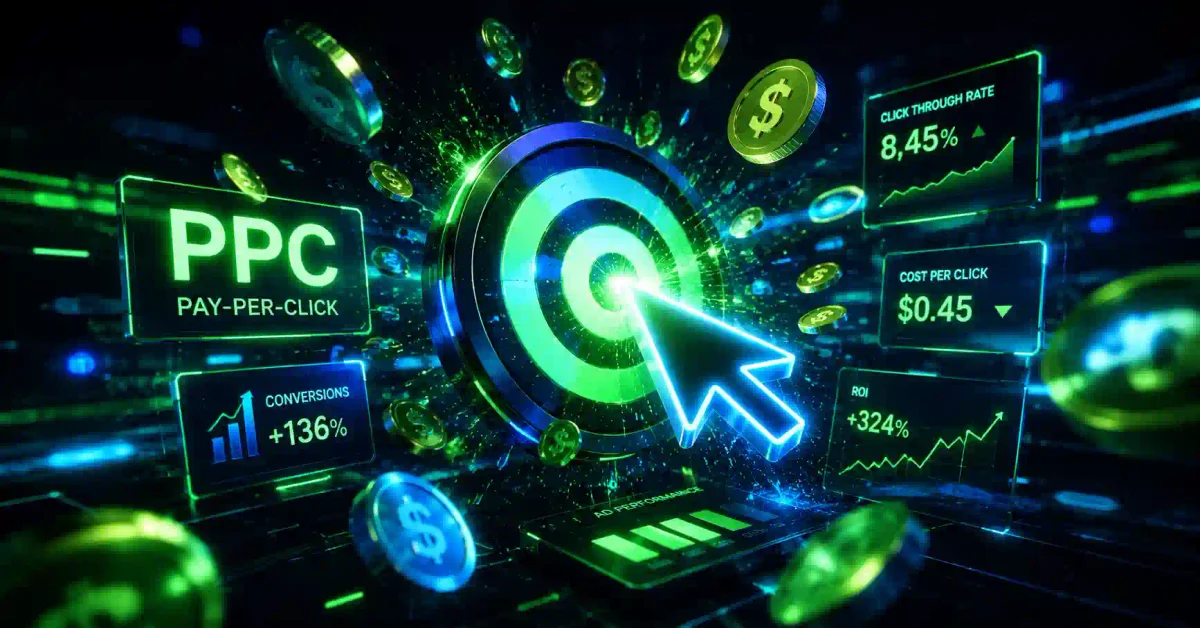
In the vast, rapidly evolving ecosystem of Digital Marketing, there is one specific advertising model that fundamentally restructured the global economy and birthed trillion-dollar tech conglomerates: Pay-Per-Click (PPC).
To understand the revolutionary power of PPC, you must understand how marketing worked before the internet. During the golden era of Madison Avenue advertising, running a campaign was an exercise in hoping, praying, and guessing. A company would spend $50,000 to place an advertisement on a highway billboard or a full-page spread in a national magazine.
The executives would pat themselves on the back, but they faced a terrifying reality: they had no idea how many people actually looked at the billboard, and worse, they had no mathematical way of proving if the people who saw the billboard actually drove to a store and bought the product. The legendary retailer John Wanamaker famously stated, “Half the money I spend on advertising is wasted; the trouble is I don’t know which half.”
PPC eliminated that guesswork. It introduced a precise new concept to the business world: You only pay when your advertisement actually works.
In this deep-dive guide, we will explore the mechanics of PPC bidding algorithms, the major platforms that dominate the digital space (from Google to TikTok), how to track your conversions with scientific accuracy, and how to avoid the common pitfalls that bankrupt inexperienced advertisers.
1. What is PPC?
Pay-Per-Click (PPC) is a digital advertising model used to drive targeted traffic to websites, in which an advertiser pays a publisher (typically a search engine like Google, or a social network like Meta) a specific fee only when the ad is clicked by a user.
PPC is the economic engine that drives Google’s global revenue. It is the reason Facebook and Instagram are free to use. It is the invisible backbone of the modern, free internet.
The Primary Benefits of PPC:
- Speed: If you want to launch a new business today, you do not need to wait six grueling months for organic SEO to slowly rank your website on page one. You can build a landing page at 9:00 AM, load a $500 budget into Google Ads at 10:00 AM, and have targeted customers visiting your website with their credit cards out by 10:15 AM.
- Financial Control: You control how much you spend per day down to the penny. If a campaign is generating profits, you can push a button to double the budget instantly. If a campaign is losing money, you can turn it off in two seconds.
- Targeting: You are not broadcasting a billboard to everyone driving on the highway. You are showing an ad specifically to a 35-year-old mother of two, living in a specific zip code, who has actively searched for “organic baby food” in the last 24 hours.
2. PPC vs. CPM vs. CPA: Decoding the Alphabet Soup
When you enter a digital advertising platform to buy ads, you are presented with several different mathematical pricing models depending on your business goal.
| Bidding Model | Stands For | How the Math Works | The Best Strategic Use Case |
|---|---|---|---|
| PPC / CPC | Pay / Cost Per Click | You pay a set dollar amount every time a user clicks your ad, regardless of how many times the ad was shown. | Driving direct traffic to a landing page and generating immediate sales. |
| CPM | Cost Per Mille (Thousand Impressions) | You pay a set dollar amount for every 1,000 times your ad is shown on a screen, even if nobody clicks it. | Top-of-funnel brand awareness campaigns (e.g., Coca-Cola reminding you they exist). |
| CPA / CPL | Cost Per Action / Lead | You pay a much higher dollar amount, but you only pay the platform when a user actually buys your product or fills out a lead form on your website. | Strict performance marketing and risk-averse e-commerce. |
Crucial Technical Note: Even when you choose “CPA” bidding, platforms like Google and Meta are not actually taking a financial risk on you. They are essentially just using their advanced AI algorithms to calculate the underlying CPC cost based on your historical conversion rate, mathematically guaranteeing the platform always makes its money.
3. The Major PPC Platforms You Need to Dominate
Not all digital clicks are created equal. The platform you choose to invest your budget into depends on the specific product you are selling and the intent of your target audience.
1. Google Ads (The Intent Machine)
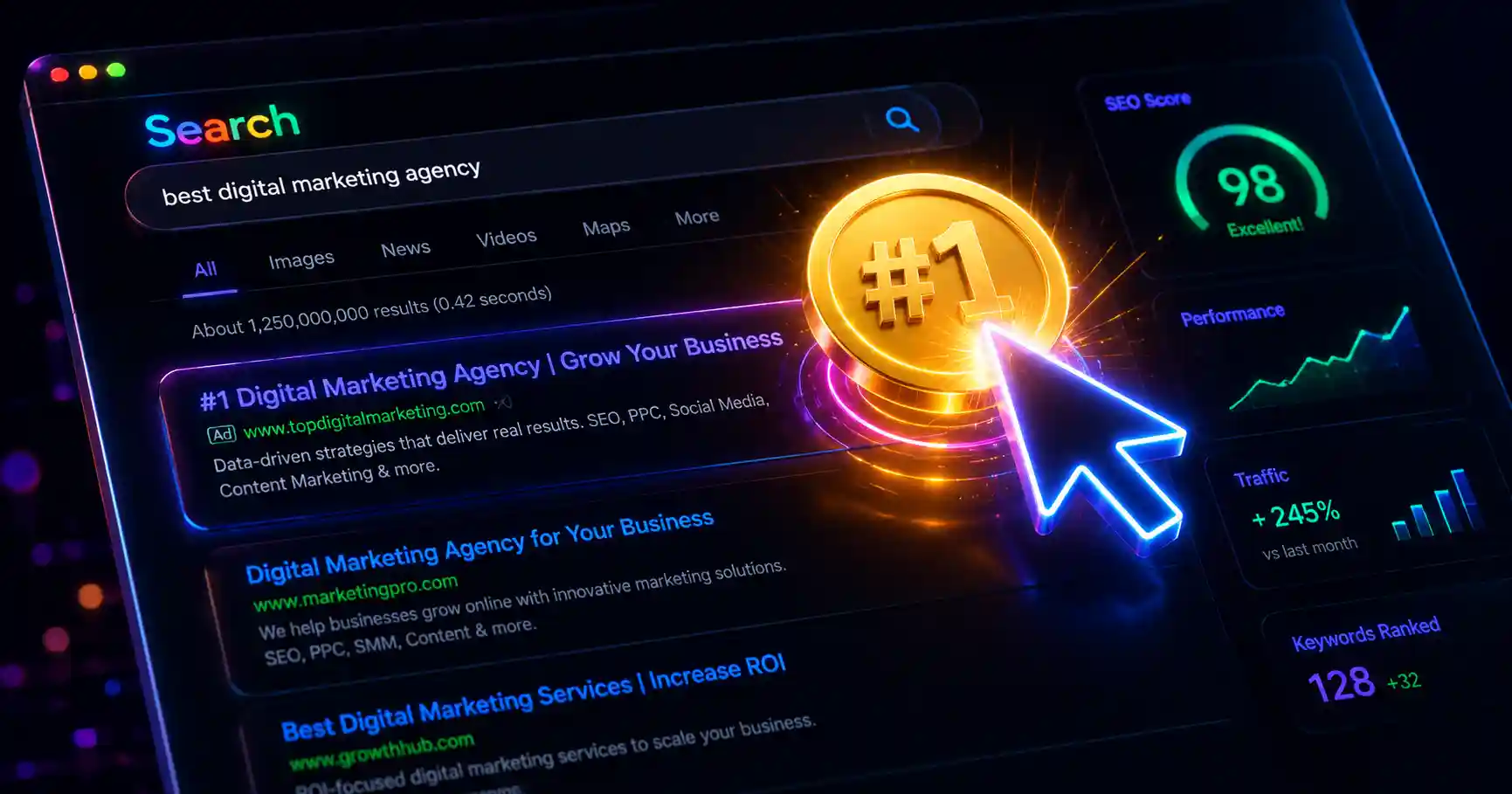
As covered in our SEM guide, Google Search Ads are the most powerful direct-response advertising tool in human history because they capture Active Intent. You are not interrupting someone; you are answering their direct question. If you bid on the keyword “emergency plumber near me,” the person typing that into Google currently has a flooded basement and a credit card in their hand. They are ready to buy right now. Google also operates the Google Display Network (GDN), which allows you to place visual banner ads on millions of third-party websites across the internet (ideal for retargeting).
2. Meta Ads (Facebook & Instagram - The Demographic Engine)
Unlike Google, people do not log onto Facebook or Instagram to actively search for products to buy. They go to scroll, look at photos of their friends, and be entertained. Therefore, Meta Ads are inherently Interruptive. However, Meta has the most advanced demographic and behavioral targeting algorithm on the planet. You can target users based on their age, their job title, major life events (e.g., “recently engaged” or “moving to a new city next week”), and specific interests. Meta remains arguably the best platform in the world for scaling B2C (Business-to-Consumer) e-commerce brands.
3. LinkedIn Ads (The B2B Enterprise Hub)
LinkedIn is significantly more expensive than Google or Meta (a single click can easily cost between $10 and $30). However, it is the only platform on earth where you can reliably target users by their verified professional data. If you are a B2B company selling a $100,000 enterprise software contract, paying $25 to ensure your ad is seen specifically by a “Chief Information Officer working at a Hospital with over 5,000 employees” is not expensive; it is a profitable bargain.
4. TikTok Ads (The Viral Commerce Engine)
The newest major player in the PPC space. TikTok ads rely on UGC (User Generated Content). If your ad looks like a polished, professional television commercial, TikTok users will scroll past it in milliseconds. To succeed on TikTok, your ad must look like an organic, vertical video shot on an iPhone by a regular person. It is highly effective for impulse-buy e-commerce products under $50.
4. The Anatomy of a High-Converting PPC Funnel
A click is worthless if it does not result in revenue. A successful PPC campaign is not just about writing a good ad; it requires a mathematically sound, friction-free “funnel”.
- The Ad Creative: The visual image, video, or text headline that stops the user from scrolling, grabs their attention, and promises a specific solution to their pain point.
- The Click: The user interacts with the ad. (This is the moment you pay the platform).
- The Landing Page (The Scent Match): The standalone web page the user lands on. Crucial Rule: The landing page must match the promise made in the ad (known as “Ad Scent”). If your ad promises “50% off Red Running Shoes,” the landing page must immediately show red running shoes at a 50% discount. If it drops them on your generic homepage to hunt for the shoes themselves, they will bounce immediately.
- The Offer: The irresistible, logical reason the user should pull out their credit card and buy your product right now, rather than waiting until tomorrow.
- The Conversion: The user completes the transaction.
If a single link in this fragile chain breaks, you lose your investment. A brilliant, award-winning ad pointing to a terrible, slow-loading landing page will result in thousands of dollars in wasted clicks.
5. The Necessity of Conversion Tracking
Running a PPC campaign without flawless conversion tracking is the equivalent of driving a Formula 1 racecar blindfolded at 200mph. You will crash, and you will lose all your money.
A Tracking Pixel (such as the Meta Pixel, Google Ads Tag, or TikTok Pixel) is an invisible snippet of JavaScript code that you must install into the <head> section of your website’s global code.
When a user clicks your Facebook ad and lands on your site, the Pixel tracks their every move. If they add an item to their cart, the Pixel records it. If they successfully buy the item, the Pixel reads the dollar amount of the receipt and reports that purchase value back to the Facebook Ads dashboard.
Why is this critical?
- Financial Attribution: You no longer guess what works. You look at your dashboard and know with mathematical certainty that “Ad Creative Variant B” spent $50 and generated $300 in sales, while “Ad Creative Variant A” spent $50 and generated $0. You turn off Ad A and put all your money into Ad B.
- Algorithmic AI Optimization: The ad platforms do not use humans to find customers; they use machine learning models. When the Pixel tells Facebook that “User A” just bought your product, Facebook’s AI analyzes hidden data points about User A (their age, what other pages they like, what their income bracket likely is). The AI then actively goes out into the network to find a million more people who share those hidden traits to show your ad to. Your ads get smarter and cheaper the more data the pixel feeds them.
6. Modern Audience Targeting Strategies
In the early days of PPC, marketers had to guess who their audience was and manually select rigid targeting options. Today, targeting is driven by machine learning.
- Detailed Interest Targeting: Manually telling the platform to show your ads to people who have liked specific pages or expressed interest in specific topics (e.g., targeting people interested in “Yoga” and “Lululemon” to sell your new yoga mat).
- Lookalike Audiences (LAL): The most powerful targeting tool ever created. You upload a CSV file containing the email addresses of your best, highest-spending past customers. The platform securely analyzes them, identifies the complex behavioral web that connects them, and generates a new audience of 2 million new people who “Look Like” your best customers.
- Broad Targeting (The Modern Approach): Because ad platform AI has become so intelligent, many top-tier media buyers now use “Broad Targeting.” They input zero interests and zero lookalikes. They simply target “United States, Ages 18-65,” and rely on the ad creative (the video or image) to naturally attract the right person. The AI quickly figures out who clicks the video and auto-optimizes the delivery.
7. Retargeting: The Most Profitable PPC Tactic
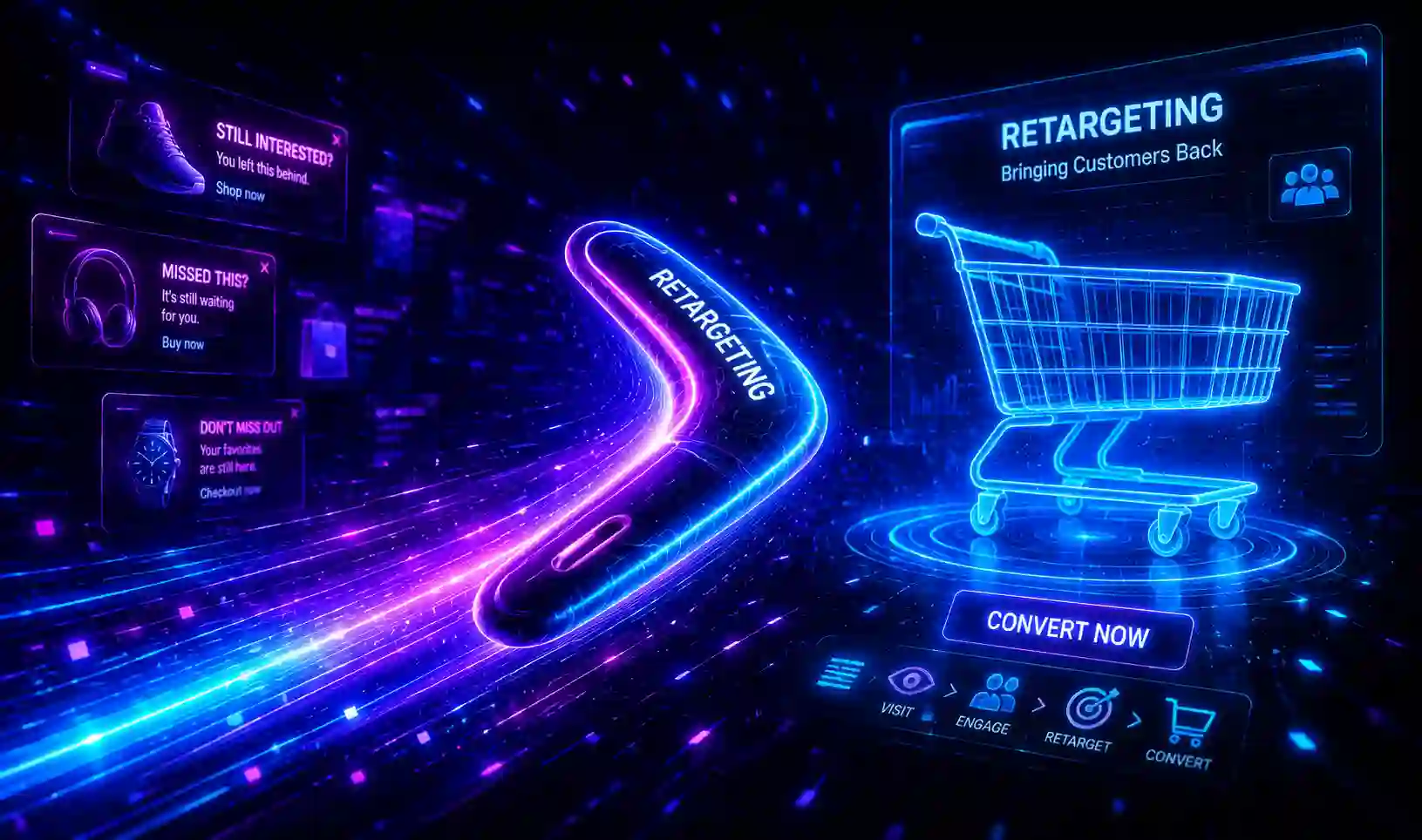
As we cover in our dedicated Retargeting guide, retargeting is the highest-ROI strategy in all of digital marketing.
On average, 97% of people who visit an e-commerce website leave without buying anything. Retargeting allows you to show highly specific ads only to those people who previously visited your site and left.
Because these users already know who you are (they are “warm” traffic), they are statistically much more likely to click the ad and complete the purchase. Retargeting clicks are almost always cheaper, and the conversion rates are exponentially higher than ads shown to strangers.
8. The Science of A/B Testing
In PPC advertising, you never assume you know what the customer wants; you let the data tell you.
A/B Testing (Split Testing) involves running two slightly different versions of an advertisement or a landing page simultaneously, splitting the traffic 50/50, to prove which one generates more revenue.
- The Golden Rule of Testing: You must only test ONE isolated variable at a time to achieve statistical significance.
- Correct Test: Running identical ads, but Ad A features an image of a smiling woman, and Ad B features an image of the product.
- Incorrect Test: Ad A features a smiling woman with a short headline and a red button. Ad B features a product image with a long headline and a blue button. If Ad B wins, you have no idea why it won. Was it the image, the headline, or the button? You learned nothing.
9. The 5 Crucial PPC Metrics to Monitor Daily
To run profitable campaigns and scale budgets, you must speak the mathematical language of the platform.
| The Metric | What it Stands For | What it Actually Tells You |
|---|---|---|
| CTR | Click-Through Rate | The % of people who clicked your ad after seeing it. If your CTR is below 1%, your ad creative is boring or your targeting is wrong. |
| CPC | Cost Per Click | How much you paid for one visitor. This dictates your total budget efficiency and how much traffic you can afford. |
| CVR | Conversion Rate | The % of clicks that successfully turned into a sale. If your CTR is high but your CVR is low, your ad is great but your landing page is terrible. |
| CPA | Cost Per Acquisition | Your total ad spend divided by total conversions. This tells you what it costs to acquire a single paying customer. |
| ROAS | Return on Ad Spend | Revenue divided by Ad Spend. The primary metric. A 4.0 ROAS means you generated $4 in revenue for every $1 you spent on ads. |
10. Fatal PPC Mistakes That Destroy Budgets
Avoid these critical, common errors that bankrupt new advertisers:
- Using Broad Match Keywords Carelessly (Google): Using the “Broad Match” setting without spending hours building an extensive “Negative Keyword” list will result in Google spending your money on irrelevant searches. (e.g., You bid on “glasses” to sell eyewear, and Google spends $500 showing your ad to people searching for “wine glasses”).
- Sending Paid Traffic to the Homepage: Never, ever send a paid click to your generic website homepage. The homepage has too many links and distractions. Always use dedicated, focused, distraction-free landing pages.
- Ignoring Mobile Load Speeds: Ensure your landing page loads in under 3 seconds on a standard 4G mobile network. If it takes 6 seconds to load your images, you will lose 60% of the traffic you just paid for before they even see the page.
- Failing to Verify Daily Budget Caps: Always quadruple-check your daily budget settings. A simple typo (typing $1000 instead of $10.00) will result in the platform gleefully spending $1,000 of your money while you sleep.
- Panicking During the Learning Phase: The AI algorithms take time (often 3 to 7 full days) to exit the “Learning Phase” and figure out who to show your ad to. Do not panic and turn off an ad on Day 1 just because it isn’t profitable yet. You must let the algorithm learn.
11. Conclusion
Pay-Per-Click advertising is not an art form; it is a ruthless, highly rewarding mathematical game. Once you find the correct, profitable combination of audience targeting, ad creative, and a high-converting landing page offer, PPC becomes a predictable, scalable engine for business growth.
The key to long-term success in PPC is rigorous conversion tracking, constant A/B testing, and a willingness to trust the data over your own personal assumptions and emotional biases.
Ready to expand your digital marketing knowledge? Dive into our next guidees:
- The Fundamentals of Content Marketing
- Social Media Marketing (SMM) Strategy
- The Ultimate Guide to Search Engine Optimization (SEO)
Frequently Asked Questions (FAQ)
Q: What is Pay-Per-Click (PPC) advertising? A: PPC is a digital advertising model where advertisers pay a fee only when their ad is clicked by a user, offering direct financial control and measurable results.
Q: What is the difference between PPC, CPM, and CPA? A: PPC charges per click, CPM charges per thousand impressions regardless of clicks, and CPA charges only when a user completes a specific action, such as a purchase or filling out a lead form.
Q: How does retargeting work in PPC? A: Retargeting allows advertisers to show ads specifically to users who have previously visited their website, resulting in higher conversion rates because the audience is already familiar with the brand.
Q: Why is conversion tracking essential in PPC? A: Conversion tracking uses tools like tracking pixels to measure exact sales from ads, enabling precise financial attribution and allowing machine learning algorithms to optimize ad delivery to high-converting users.
Q: What are common mistakes to avoid in PPC campaigns? A: Common mistakes include using broad match keywords without negative keywords, sending paid traffic to a generic homepage instead of a dedicated landing page, ignoring mobile page load speeds, and stopping campaigns too early before algorithms finish their learning phase.
Discussion
Loading comments...