

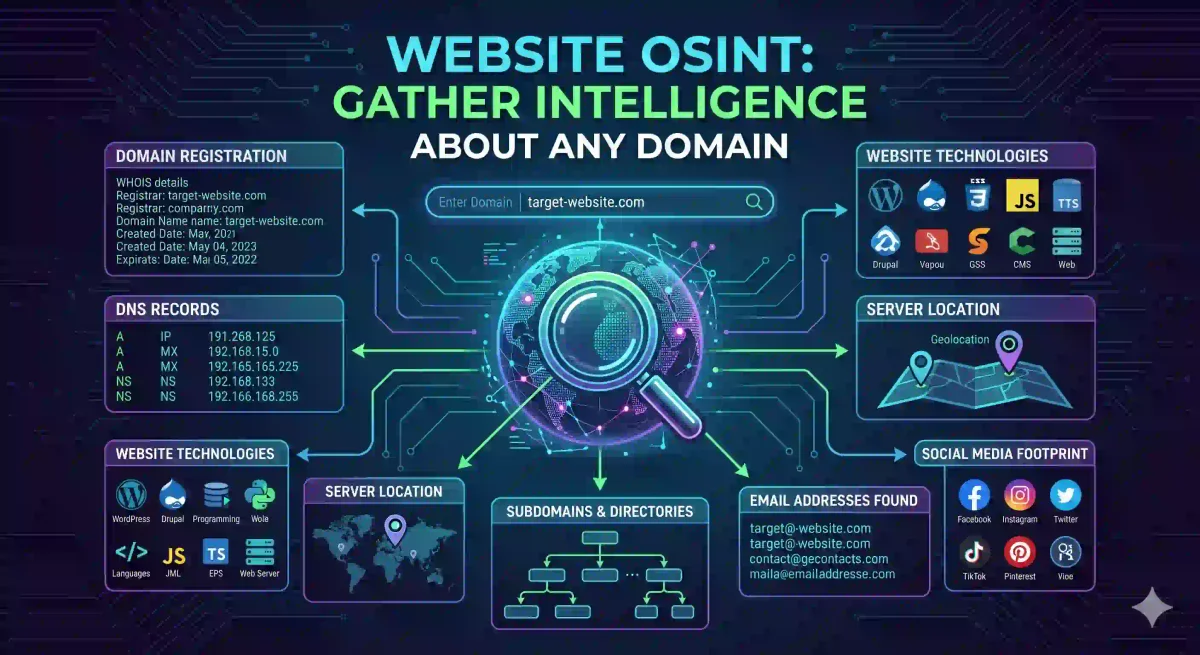
In the disciplines of Cyber Threat Intelligence (CTI) and Penetration Testing, a domain name is the foundational cornerstone of an organization’s digital footprint. Before a red team launches a simulated attack, or before a threat analyst can track a hostile adversary, they must thoroughly map the target’s infrastructure.
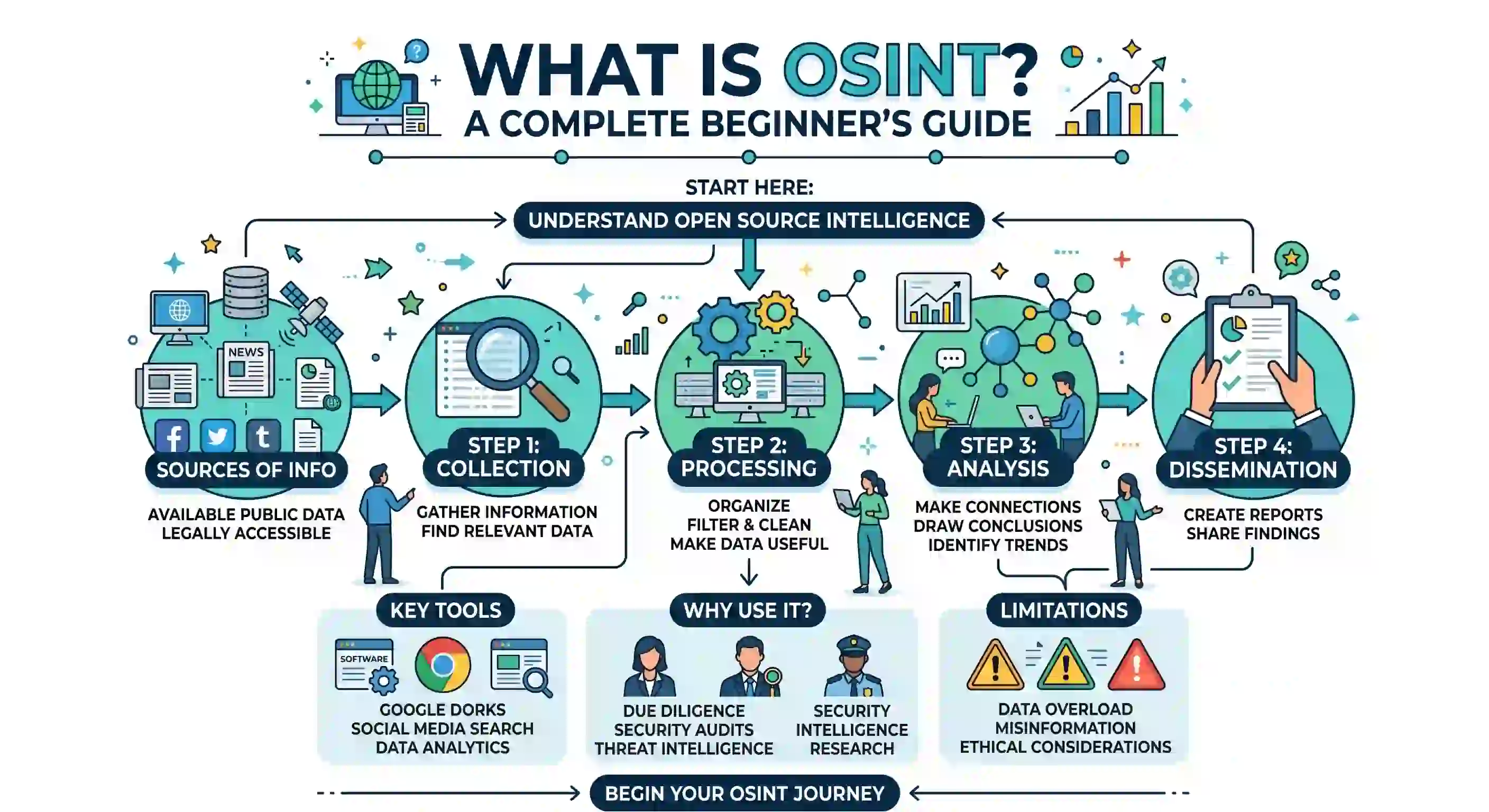
Website Open Source Intelligence (OSINT) is the process of passively gathering publicly available data about a specific domain to understand its architecture, uncover forgotten assets, and identify potential vulnerabilities—all without ever sending a single malicious packet to the target server.
In this guide, we will walk through a professional methodology for conducting comprehensive domain reconnaissance.
Step 1: WHOIS Lookups (The Registration Blueprint)
Every OSINT investigation against a domain begins with a WHOIS lookup. The WHOIS database is a public directory that stores the registration details of domain names.
What You Can Find
While privacy protection services (like Cloudflare Privacy or Domains By Proxy) often mask the owner’s true identity today, a WHOIS lookup can still provide critical metadata:
- Creation Date: Is this a newly registered domain (frequently used in phishing attacks), or an established corporate domain that has existed for a decade?
- Registrar: Which company was used to purchase the domain (e.g., Namecheap, GoDaddy, MarkMonitor)? Enterprise domains are often registered through specialized corporate registrars.
- Name Servers: Where is the DNS routing managed? This quickly reveals if the target uses Cloudflare, AWS Route53, or a self-hosted DNS solution.
Tools to use: whois (Linux command line), DomainTools, or WHOIS.domaintools.com.
Step 2: DNS Records Analysis (Mapping the Infrastructure)
The Domain Name System (DNS) is the phonebook of the internet. By aggressively querying a target’s DNS records, an analyst can map out exactly where specific services are hosted.
Key DNS Records to Analyze
- A & AAAA Records: Reveal the exact IPv4 and IPv6 addresses of the web servers.
- MX (Mail Exchange) Records: Reveal who handles the target’s email. If the MX records point to
google.comoroutlook.com, you instantly know their corporate email provider. - TXT (Text) Records: Often contain critical security configurations like SPF, DKIM, and DMARC policies. Misconfigured TXT records can indicate a vulnerability to email spoofing. They may also contain verification tokens for third-party services (e.g.,
google-site-verification). - CNAME (Canonical Name) Records: Alias one name to another. These are highly valuable for discovering third-party SaaS integrations (like Zendesk, HubSpot, or Shopify) tied to the main domain.
Tools to use: dig, nslookup, host, or web tools like DNSDumpster.
Step 3: Subdomain Enumeration (Finding the Hidden Doors)
Companies rarely host everything on their main www domain. They often have hundreds of subdomains for staging environments, employee portals, VPN gateways, and legacy applications. These subdomains are frequently forgotten by IT departments, left unpatched, and become prime targets for attackers.
Passive Subdomain Discovery
Passive discovery involves querying third-party databases without interacting with the target’s DNS servers directly:
- Search Engines: Using Google Dorks like
site:example.com -www.example.com. - Public Datasets: Querying massive databases like Rapid7’s Project Sonar or SecurityTrails.
Active Subdomain Enumeration
Active enumeration involves actively guessing subdomains by blasting the target’s DNS server with thousands of common prefixes (e.g., dev.example.com, vpn.example.com, api.example.com) and seeing which ones resolve to an IP address.
Tools to use: Sublist3r, Amass, GoBuster (in DNS mode), and crt.sh.
Step 4: SSL/TLS Certificate Reconnaissance
When a company requests a secure HTTPS certificate, that request is publicly logged in Certificate Transparency (CT) logs. These logs were designed to prevent certificate fraud, but they are an absolute goldmine for OSINT analysts.
By searching CT logs, you can instantly see every single subdomain that a company has requested an SSL certificate for, including internal subdomains that might not be discoverable through standard brute-forcing (e.g., secret-hr-portal.internal.example.com).
Tools to use: crt.sh is the standard web interface for querying Certificate Transparency logs.
Step 5: Historical Analysis (The Wayback Machine)
The internet never forgets. Even if a company realizes they accidentally published sensitive information and deletes it, the Internet Archive has likely already saved a copy.
What to Look For
- Old Directory Structures: Finding administrative login pages that were moved but not deleted.
- Leaked Documents: Discovering sensitive PDFs or configuration files that were briefly public.
- Personnel Changes: Reviewing old “About Us” pages to map the corporate hierarchy over time.
Tools to use: The Wayback Machine (archive.org/web) and the Waybackurls command-line tool.
Frequently Asked Questions (FAQ)
What is the difference between active and passive reconnaissance?
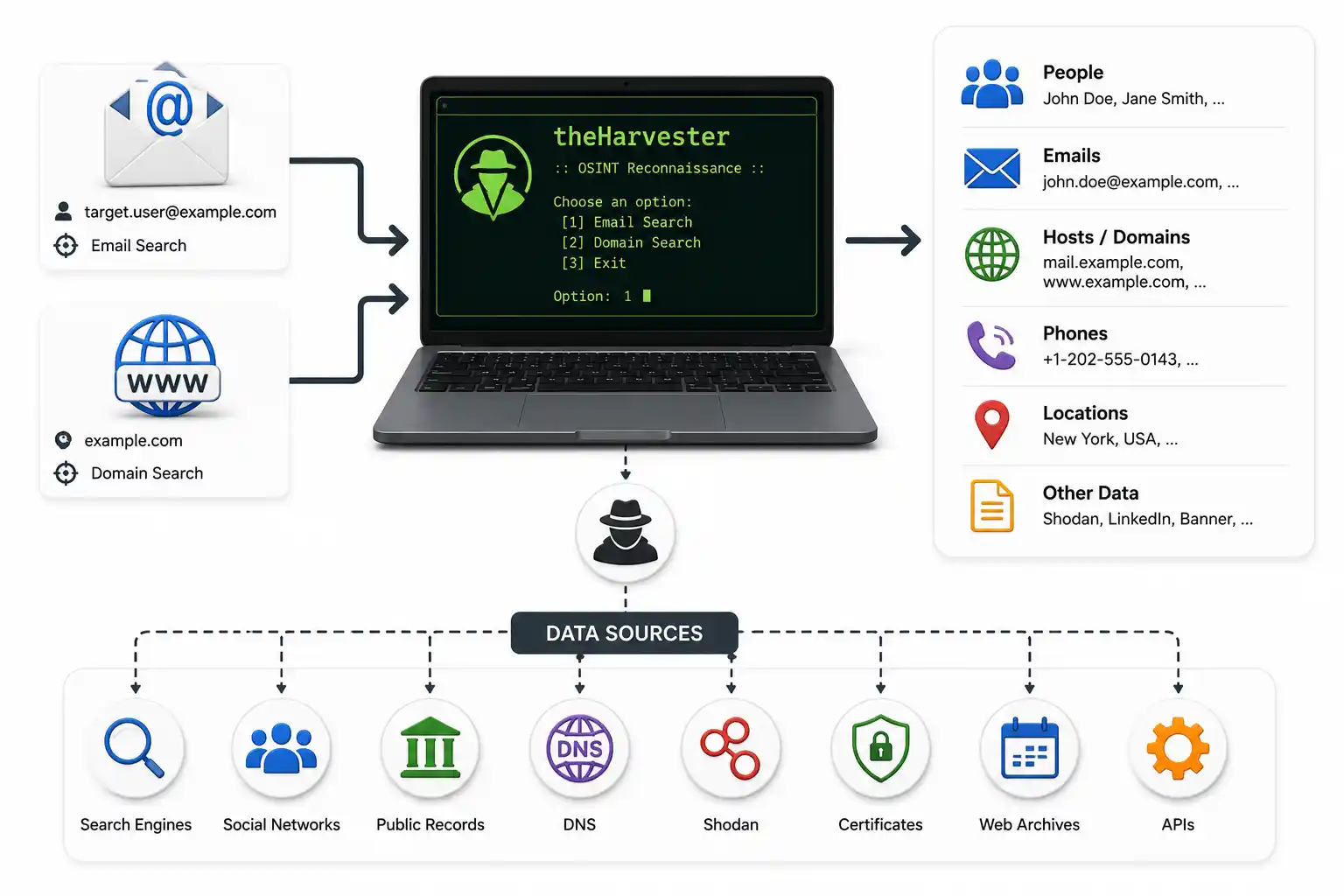
Passive reconnaissance involves gathering information from third-party sources (like Google, Shodan, or WHOIS databases) without ever directly interacting with the target’s servers. Active reconnaissance involves sending packets directly to the target (like port scanning or DNS brute-forcing), which leaves logs on their firewalls.
Is Website OSINT legal?
Yes. OSINT, by definition, relies entirely on publicly available information. Querying public DNS records, searching WHOIS databases, and reading the Wayback Machine are all completely legal activities.
How can I find the real IP address behind Cloudflare?
If a domain uses Cloudflare, its A records will point to Cloudflare’s servers, hiding the true origin IP. To bypass this, analysts often check historical DNS records (before Cloudflare was implemented), look for subdomains that aren’t routed through Cloudflare, or search Shodan for the website’s SSL certificate directly attached to an IP address.
What is a sub-domain takeover?
A subdomain takeover occurs when a company points a subdomain (e.g., blog.example.com) to a third-party service (like GitHub Pages or Heroku) via a CNAME record, but later deletes their account with that service without removing the DNS record. An attacker can then register that abandoned endpoint on the third-party service and effectively hijack the subdomain.
Why do hackers look at TXT records?
TXT records often contain SPF (Sender Policy Framework) configurations. If these are misconfigured or missing, attackers know they can easily spoof the company’s domain to send highly convincing phishing emails to employees or customers.
Conclusion: The Foundation of Threat Intelligence
Website OSINT is an incredibly powerful, entirely passive methodology for mapping the digital attack surface of an organization. By systematically analyzing WHOIS data, dismantling DNS records, discovering forgotten subdomains via Certificate Transparency logs, and dusting off historical archives, you can uncover critical vulnerabilities before a single port scan is ever launched.
Whether you are a defender conducting an audit of your own corporate perimeter, or an intelligence analyst tracking a hostile threat actor’s infrastructure, mastering domain reconnaissance is an essential skill in modern cybersecurity.
Discussion
Loading comments...