

In our highly interconnected digital age, every person and organization leaves behind a trail of data. Every time you post a photo on social media, register a website domain, or publish a corporate press release, you add to a permanent digital footprint scattered across the internet.
For cybersecurity professionals, threat actors, and investigators, this massive ocean of public data is an invaluable resource. The practice of systematically collecting and analyzing this data is known as Open Source Intelligence, or OSINT.
If you are just starting your journey into cybersecurity, penetration testing, or threat intelligence, understanding OSINT is an absolute requirement. In this beginner’s guide, we will break down exactly what OSINT is, how the intelligence cycle works, and how it is used in the real world.
What Exactly is Open Source Intelligence (OSINT)?
OSINT refers to the collection and analysis of information that is gathered from public, open sources to produce actionable intelligence.
It is critical to understand what OSINT is not. OSINT is not hacking. It does not involve bypassing passwords, exploiting software vulnerabilities, stealing private databases, or tricking employees into revealing confidential information (social engineering).
If you have to break a lock, steal a key, or deceive someone to get the information, it is no longer OSINT.
“Open source” means the data is freely available to anyone who knows where to look. This includes:
- The Surface Web: Public social media profiles, news articles, corporate websites, government records, and blogs.
- The Deep Web: Publicly accessible databases, unindexed websites, and public court records.
- The Dark Web: Forums and marketplaces accessible via the Tor network (as long as the specific pages are publicly viewable without hacking).
Active vs. Passive Reconnaissance
When gathering OSINT, analysts use two distinct approaches: Passive and Active. Understanding the difference is crucial for remaining undetected during an investigation.
Passive Reconnaissance
Passive reconnaissance means gathering information about a target without ever directly interacting with their systems. The target has absolutely no way of knowing you are investigating them.
- Example: Reading a company’s Wikipedia page, searching their domain on Google, or looking up their IP address on Shodan.
Active Reconnaissance
Active reconnaissance involves interacting directly with the target’s systems. While you are still using public tools, your IP address will be recorded in the target’s firewall or web server logs.
- Example: Using Nmap to scan a target’s web server for open ports, or aggressively navigating through their website to map its directory structure.
Professional OSINT investigators almost always prefer passive reconnaissance to maintain complete operational security (OPSEC).
The OSINT Intelligence Cycle
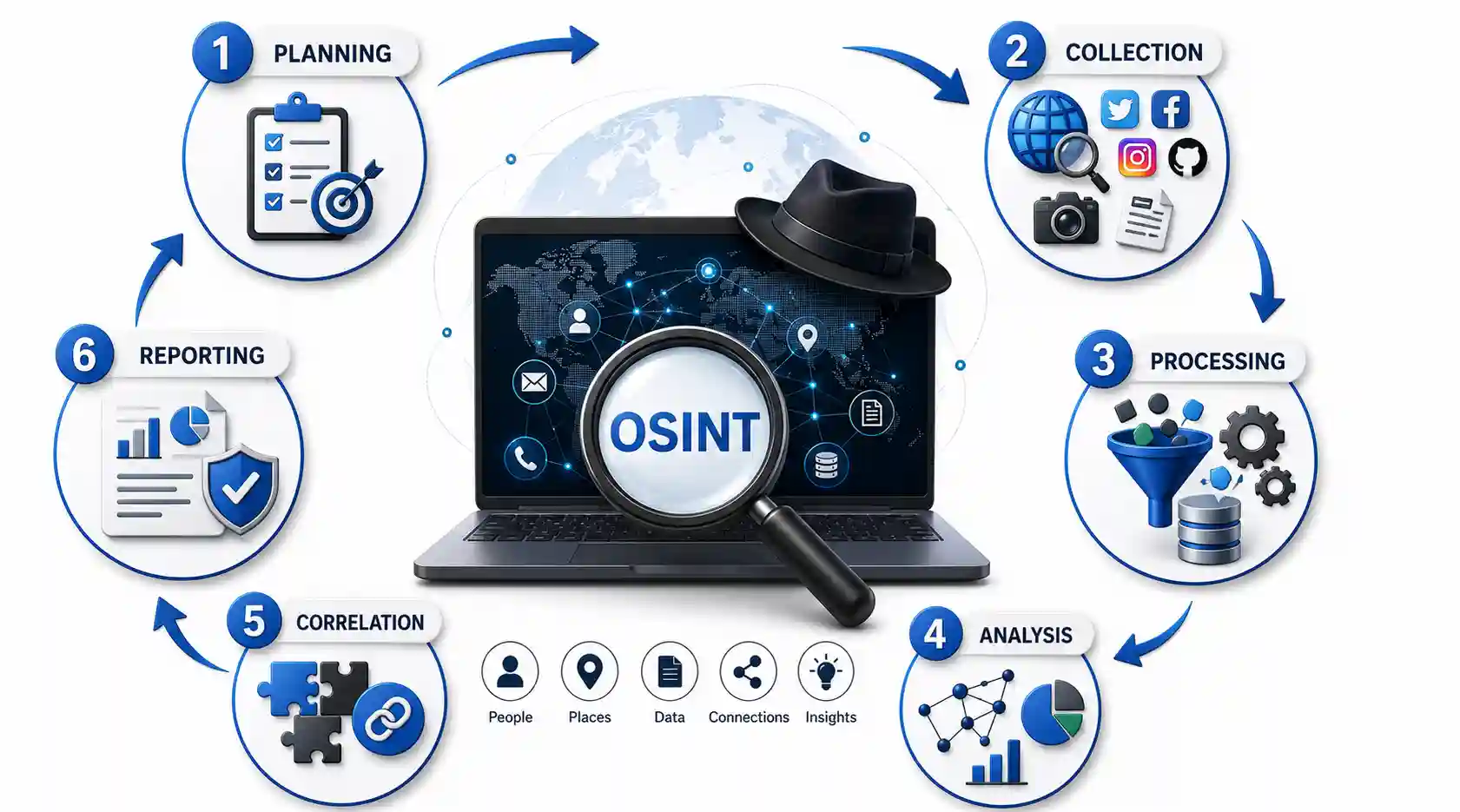
True OSINT is not just randomly Googling someone’s name. It is a highly structured, scientific process used by military and intelligence agencies worldwide, known as the Intelligence Cycle.
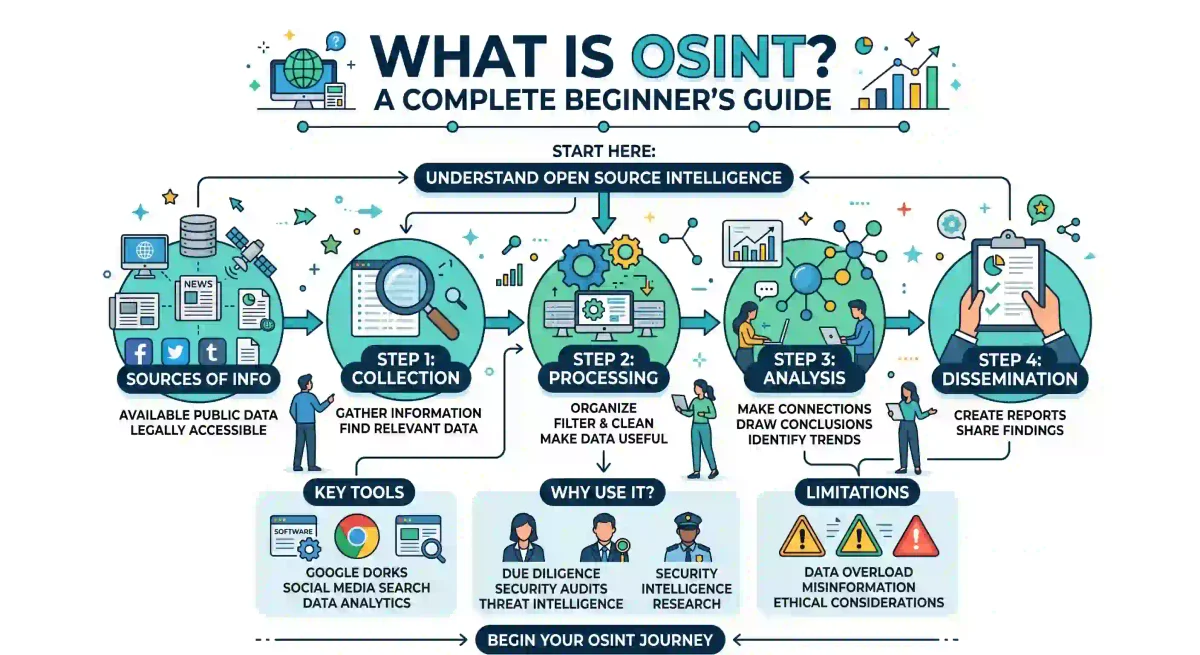
- Planning and Direction: Defining the exact objective. (e.g., “Find the true identity of the person operating this hostile Twitter account.”)
- Collection: Gathering raw data from search engines, social media, public records, and specialized OSINT tools.
- Processing: Organizing the chaotic raw data into a usable format, such as placing all gathered IP addresses into a spreadsheet or translating foreign documents.
- Analysis: The most important step. A human analyst connects the dots, filters out false positives, and turns the raw data into a cohesive narrative or conclusion.
- Dissemination: Delivering the final, polished intelligence report to the client or stakeholder who requested it.
Core OSINT Sub-Disciplines
As OSINT has evolved, it has fractured into several highly specialized sub-disciplines:
- SOCMINT (Social Media Intelligence): The collection and analysis of data from social media platforms like X, Facebook, LinkedIn, and TikTok. Used heavily to map relationships and track personal activities.
- GEOINT (Geospatial Intelligence): Analyzing satellite imagery, street-level photos, and metadata to physically locate where a picture was taken or track movement.
- IMINT (Imagery Intelligence): Closely related to GEOINT, focusing heavily on extracting data from photos and videos (e.g., reading a reflection in a window or analyzing shadows to determine the time of day).
- Domain/Infrastructure Reconnaissance: Mapping a target’s digital attack surface by analyzing DNS records, SSL certificates, and subdomains. (Learn more in our Website OSINT Guide).
Why Does OSINT Matter?
OSINT is a fundamental skill across the entire spectrum of cybersecurity and law enforcement:
- Penetration Testers (Red Teams): Use OSINT to map a company’s network, find forgotten subdomains, and identify employee emails to use in simulated phishing campaigns.
- Threat Intelligence (Blue Teams): Use OSINT to track the infrastructure of hacker groups, monitor dark web forums for leaked corporate credentials, and anticipate upcoming attacks.
- Law Enforcement & Journalists: Use OSINT to track down fugitives, verify the authenticity of viral videos, and expose criminal networks.
Frequently Asked Questions (FAQ)
What does OSINT stand for?
OSINT stands for Open Source Intelligence. It is the practice of collecting, evaluating, and analyzing publicly available information to answer a specific intelligence question.
Is OSINT the same as hacking?
No. OSINT strictly relies on publicly available information. It does not involve exploiting vulnerabilities, bypassing passwords, or accessing private systems. If you have to break into a system to get the data, it is hacking, not OSINT.
Is OSINT legal?
Yes, gathering OSINT is completely legal in most jurisdictions because the information is already public. However, using that gathered intelligence to harass, stalk, or blackmail individuals is illegal.
What are the best tools for OSINT?
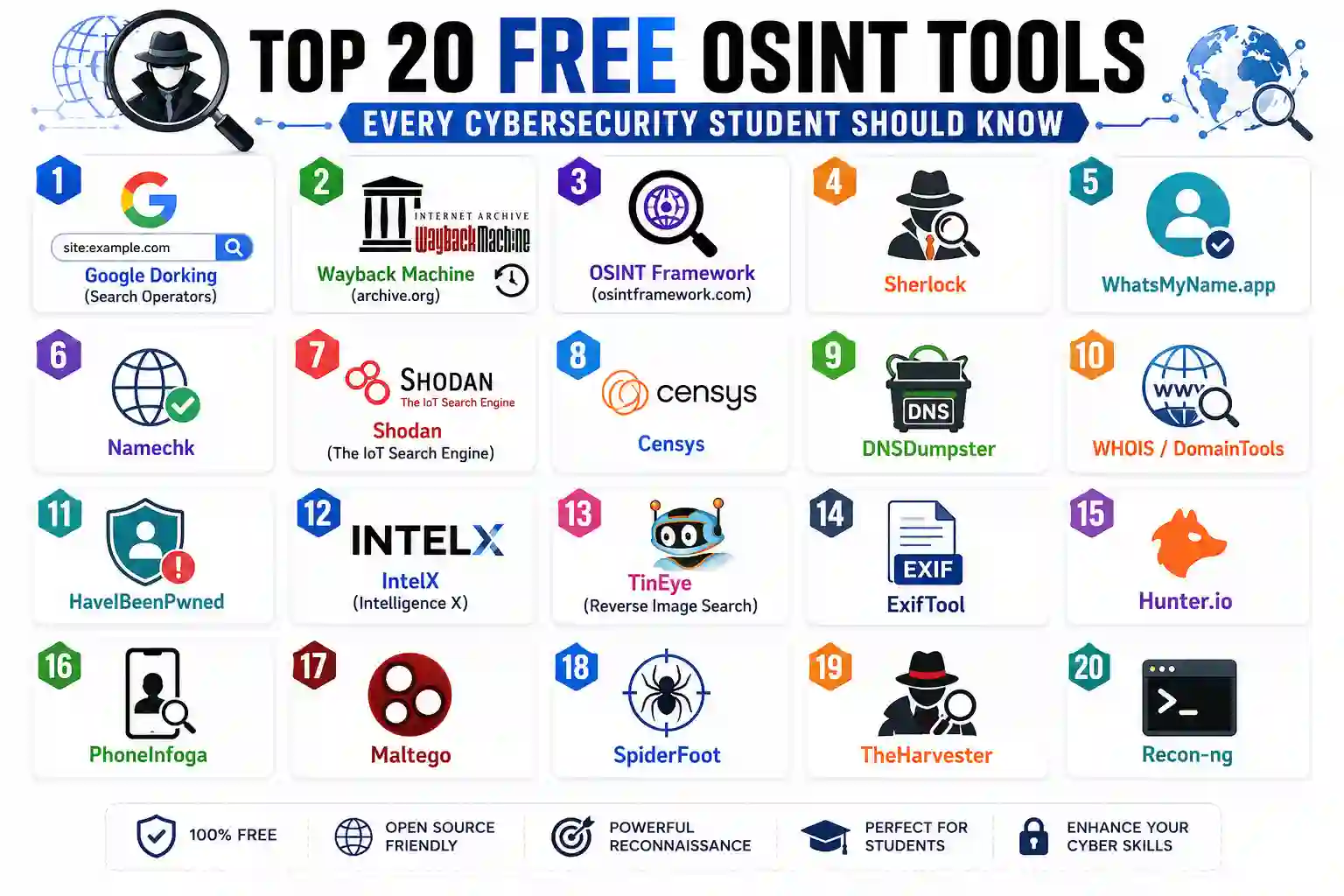
While Google is the most powerful OSINT tool, professionals also use specialized tools like Maltego (for link analysis), Shodan (for finding internet-connected devices), theHarvester (for email and domain discovery), and the Wayback Machine (for viewing deleted web pages).
Do I need to know how to code to do OSINT?
No. Beginners can perform highly effective OSINT investigations using just a web browser and analytical thinking. However, as you advance, learning Python is highly recommended for automating repetitive data collection tasks.
Conclusion: The Ultimate Investigation Skill
Open Source Intelligence is the ultimate equalizer in cybersecurity. It requires no expensive software, no illegal access, and no special clearance. With nothing more than a standard web browser, strict operational security, and a heavily disciplined analytical mindset, a skilled OSINT investigator can uncover secrets that organizations thought were perfectly hidden.
Whether you are looking to become an elite penetration tester, a threat intelligence analyst, or simply want to better protect your own privacy online, mastering OSINT is your first, vital step.
Discussion
Loading comments...