

In the early 2000s, the consumer retail landscape was simple: a customer bought products in one of two ways. They drove to a brick-and-mortar retail store, or they picked up the telephone and ordered from a mail-order catalog.
By 2010, the “Multi-channel” era had begun. An average company had a physical retail store, an e-commerce website, and perhaps an early mobile app.
However, there was a structural problem beneath the surface of this multi-channel approach: those digital and physical channels did not talk to each other. They were siloed. If a customer spent an hour putting a pair of shoes in their online shopping cart on Monday, but then walked into the brand’s retail store on Tuesday, the cashier had no idea who they were, what they had browsed, or what was in their cart. The customer was treated as two different, unrelated individuals depending on the channel they used to interact with the brand.
In 2026, the modern consumer demands a frictionless, unified experience. They expect to discover a product via an influencer on TikTok, research its specifications on their laptop, purchase it via a mobile app using Apple Pay, and pick it up at the retail store an hour later without repeating their name or order number.
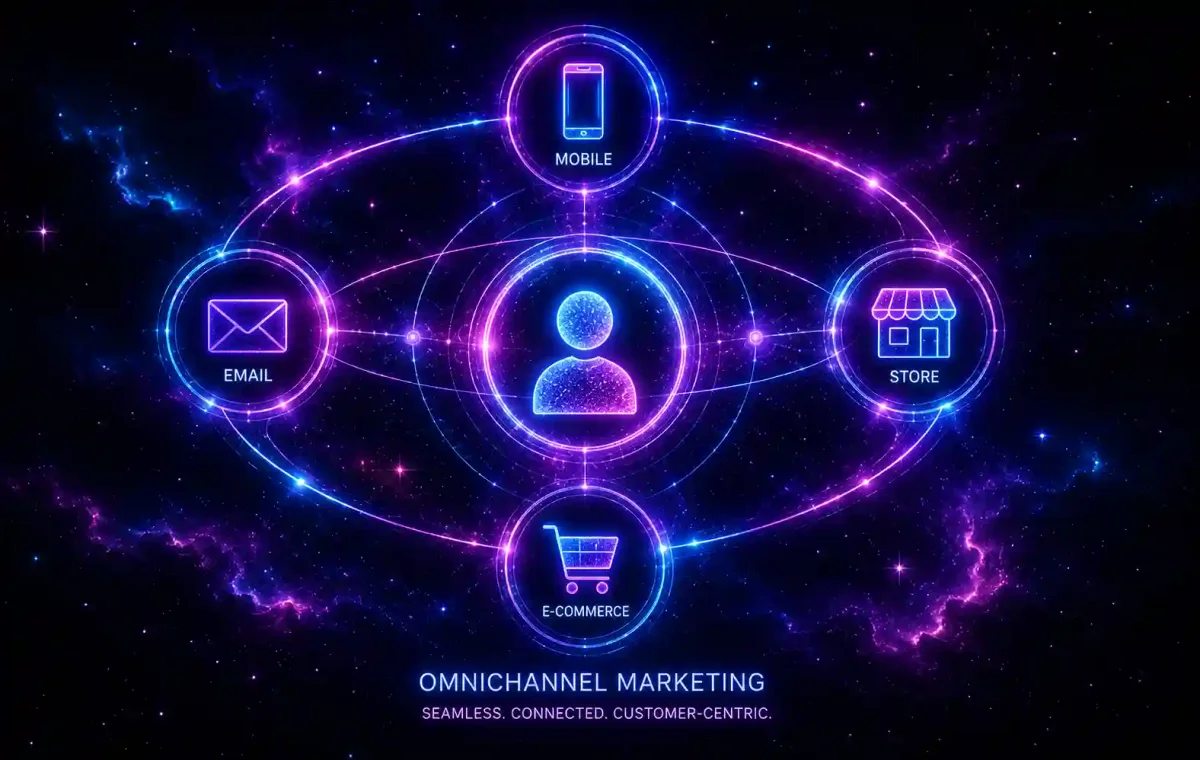
This unified, connected ecosystem is called Omnichannel Marketing.
In this guide, we will explore the philosophical difference between multi-channel and omnichannel, the enterprise technology required to pull it off, and how to build a unified customer experience that generates brand loyalty.
1. Multi-channel vs. Omnichannel: The Distinction
These two terms are frequently used interchangeably by marketers and PR teams. They mean structurally different things.
Multi-channel Marketing (The Old Paradigm)
In a multi-channel setup, a company exists and broadcasts on multiple channels (Facebook Ads, Email Newsletters, Physical Retail Stores, E-commerce Website). However, the backend databases of these channels are siloed and isolated.
- The Scenario: The Email Marketing team runs a “20% Off Spring Blowout” promotion and blasts it to 500,000 subscribers. However, they do not integrate this data with the physical Retail Store managers’ point-of-sale systems.
- The Result: A loyal customer receives the email, walks into the physical store, and asks the cashier to apply the 20% discount to their purchase. The cashier says, “I’m sorry, my register doesn’t recognize that code. That must be an online-only promotion. I cannot honor it here.” The customer leaves the store feeling frustrated and alienated by the brand.
Omnichannel Marketing (The Modern Paradigm)
In an omnichannel setup, the company exists on multiple channels, but every channel is interconnected, syncing data in real-time, and pulling from one unified database.
- The Scenario: A customer adds a $150 blue sweater to their cart on the brand’s mobile app while riding the train to work, but doesn’t buy it. Later that day, they walk into the retail store.
- The Result: The store’s entrance beacon detects the customer’s phone via Bluetooth. It pings the cashier’s tablet. As the customer walks up to the counter, the cashier smiles and says, “Welcome back, Sarah! I see you were looking at the blue cashmere sweater online this morning. We have one left in a size Medium right behind me. Would you like me to grab it so you can try it on?” That is a great customer experience. That is Omnichannel.
2. The Core Philosophy: The Customer is the Center
The shift from multi-channel to omnichannel requires a psychological shift in how a marketing department views its relationship with the public.
In multi-channel marketing, the Brand is at the center. The brand sits in the middle and broadcasts its messages outward to the various channels (email, social, web), hoping the customer intercepts one of them.
In true omnichannel marketing, the Customer is placed at the center. The brand’s channels orbit the customer, monitoring their behavior and adapting to their preferences in real-time.
If the central intelligence of the omnichannel system notices that a specific customer historically ignores emails, but responds within minutes to WhatsApp messages, the system adapts to the customer. It stops sending that user emails and routes future shipping updates, receipts, and promotional discounts through WhatsApp instead.
The technology adapts to the human, not the other way around.
3. The Anatomy of an Omnichannel Customer Journey
To grasp the power of this strategy, let’s look at a hypothetical omnichannel journey for an outdoor clothing brand. Notice how the customer moves seamlessly between the digital and physical realms.
- Discovery (Social Media): Sarah sees a targeted Native Ad for a winter coat while scrolling Instagram on her phone. She clicks the ad, views the coat on the mobile website, but leaves without buying because she is heading into a meeting.
- Nurture (Marketing Automation): Because Sarah had previously created an account on the website months ago, the brand’s Marketing Automation software recognizes her browser session. It triggers a workflow. Two days later, it sends her an email featuring a styling guide focusing on winter coats.
- Intent (Desktop Web): Sarah clicks the link in the email while sitting at her computer at work. The website’s database remembers her profile and knows she is a size Medium. The product page dynamically updates to show her that there are two Medium coats left in stock at her local downtown retail store.
- Conversion (Mobile App): Worried they will sell out, Sarah opens the brand’s mobile app on her phone. She uses Apple Pay to reserve and purchase the coat, selecting the “Pick Up In-Store” option.
- Fulfillment (Physical Retail): Sarah drives to the store. The retail associate uses an iPad Point-of-Sale (POS) system to pull up Sarah’s unified profile. The associate sees that Sarah bought a blue winter scarf online 6 months ago. As he hands her the coat, he says, “By the way, we just got a new shipment of hats that match the blue scarf you bought in October.” Sarah tries on the hat and buys it.
- Retention (SMS Marketing): The next morning, Sarah receives an automated SMS text message: “Thanks for visiting the downtown store yesterday, Sarah! We hope you love the coat and hat. Here’s a 10% coupon for your next app purchase.”
Notice how the journey crossed Instagram, Mobile Web, Desktop Web, Email, Physical Retail, and SMS flawlessly, without the customer ever feeling friction or repeating themselves.
4. The Technology Stack Required for Omnichannel
You cannot achieve omnichannel marketing by connecting a patchwork of basic plugins. It requires robust data architecture.
The Customer Data Platform (CDP)
A standard CRM (Customer Relationship Management) tool is designed to manage sales pipelines and phone calls. A CDP (Customer Data Platform) is a more powerful engine designed to manage data points across digital touchpoints simultaneously.
The CDP is the brain of the omnichannel operation. It ingests streams of data from the physical cash registers, the mobile app, the website browsing history, and the email marketing software.
The CDP utilizes Identity Resolution. It uses AI to realize that the anonymous user browsing on an iPhone (device_ID_994), the person who clicked an email ([email protected]), and the person who swiped a Visa card at the retail store yesterday are all the same person. It merges that fragmented data into a single unified profile of Sarah.
Headless Commerce Architecture
Historically, in traditional e-commerce platforms (like early Magento or WooCommerce), the “frontend” (what the website visually looks like) and the “backend” (the inventory and pricing database) were tightly connected.
In a modern Headless Commerce architecture, the backend database is decoupled from the frontend presentation layer. The database exists in the cloud, serving data via APIs (Application Programming Interfaces).
This means that one centralized inventory database can power the desktop website, the mobile app, a smartwatch app, an interactive kiosk, and the physical cash registers. If someone buys the last medium sweater in the physical store in London, the website in New York updates the inventory to “Out of Stock” immediately.
5. Integrating the Physical and Digital Worlds (The “Phygital” Experience)
A decade ago, experts predicted the death of brick-and-mortar retail. The death of retail was exaggerated. However, the purpose of the physical retail store has changed.
Modern stores no longer act merely as places to warehouse inventory. They act as experiential showrooms and localized fulfillment centers.
- BOPIS (Buy Online, Pick Up In-Store): This fulfillment method grew in popularity during the 2020 pandemic and is now an expectation for modern consumers. It saves the customer shipping time, and it saves the brand shipping and logistics costs. Most importantly for marketers, data shows that roughly 40% of all BOPIS customers end up purchasing an additional item when they arrive at the store to pick up their order.
- The Endless Aisle: In the past, if a customer was in a store but their size or desired color was out of stock, the store lost the sale. The customer walked out. In an omnichannel “Endless Aisle” setup, the cashier pulls out a tablet, locates the item in the online warehouse database, accepts the payment in the store, and has the item shipped directly to the customer’s house. You avoid losing sales due to local inventory limits.
6. The Unique Role of SMS Marketing in Omnichannel
While email marketing is powerful for long-form storytelling and visual product showcases, it sits passively in an inbox waiting to be opened. SMS (Text Message) Marketing, however, reaches the customer directly.
- High Open Rates: SMS boasts a documented 98% open rate, with nearly 90% of all text messages being read within the first few minutes of receipt.
- The Omnichannel Rule: Do not use SMS to send long newsletters. Use SMS for time-sensitive offers and high-value utility.
- High Utility: “Your order #884 is ready for pickup at the 5th Avenue store.”
- Urgency: “Our 50% off Black Friday VIP sale ends in 3 hours. Click here to shop before inventory runs out.”
A Legal Warning: SMS is a personal channel. If you abuse it by sending messages too frequently, customers will reply “STOP” and revoke your access. Furthermore, violating TCPA (Telephone Consumer Protection Act) consent laws in the US carries financial penalties. Treat the phone number with respect.
7. The Importance of Consistent Branding
Omnichannel is not purely about syncing databases and routing data; it is equally about brand consistency.
If your brand’s Instagram account is professional, featuring minimalist photography and sophisticated language, but your automated emails are chaotic, filled with neon colors, and packed with emojis, the customer experiences cognitive dissonance. Subconsciously, they feel like they are interacting with two different companies. This affects trust.
Your tone of voice, your typography, your color palette, your customer service scripts, and your return policies must be identical whether the customer is reading a tweet, reading an email on their laptop, or talking face-to-face with a cashier. The brand must feel like a cohesive entity.
8. Common Pitfalls in Omnichannel Execution
Omnichannel transformations sometimes fail. But they rarely fail because the software was inadequate. They often fail because of organizational issues.
- Organizational Silos & Corporate Politics: A major barrier to omnichannel success is internal corporate politics. If the “VP of E-commerce” and the “VP of Retail Stores” view each other as rivals, and refuse to share customer data because they want their departments to look better on the quarterly earnings report, omnichannel is impossible. Leadership must encourage departmental integration.
- Over-Personalization: There is a fine line between “helpful” and “intrusive.” Suggesting a hat to match a scarf a customer bought is helpful. Sending an automated email saying, “We tracked your phone’s GPS and noticed you paused outside our physical store yesterday at 4:30 PM for 4 minutes” is intrusive. It will cause the customer to delete your app.
- Ignoring the Customer Support Loop: Marketing is only half the omnichannel equation. If a customer tweets a complaint to your brand on Sunday night, the customer support representative answering the phone call on Monday morning must have a record of that tweet on their screen. If the customer has to repeat their complaint to three different people on three different channels, the omnichannel experience is broken.
9. Conclusion: The Future of Commerce
Omnichannel marketing represents the future of modern digital and physical commerce. It is difficult to build, requires dismantling organizational silos, and demands financial investments in data infrastructure.
However, the companies that are willing to put in the work to successfully execute it achieve a competitive advantage in their market.
By utilizing technology to treat the customer as a single, unified individual rather than a fragmented collection of browser cookies and anonymous receipts, you build a shopping experience so frictionless and helpful that the customer will prefer shopping with you over alternatives.
The Digital Marketing Ecosystem is Complete. This guide brings together every concept we have covered in our digital marketing series. The SEO brings the organic traffic. The Interactive Content captures the lead data. The Marketing Automation orchestrates the emails. And the Omnichannel CDP unifies it all into scalable revenue.
Frequently Asked Questions (FAQ)
1. What is the difference between multi-channel and omnichannel marketing?
Multi-channel marketing involves being present on multiple platforms, but the channels operate in silos with disconnected databases. Omnichannel marketing connects every channel to a centralized database, creating a seamless, unified, and personalized experience for the customer across all touchpoints.
2. What is a Customer Data Platform (CDP)?
A Customer Data Platform (CDP) is the central software engine of an omnichannel strategy. It ingests data from various sources (website, mobile app, physical store) and uses identity resolution to merge fragmented interactions into a single, unified profile for each customer.
3. How does Headless Commerce support omnichannel marketing?
Headless Commerce decouples the backend database (inventory and pricing) from the frontend presentation layers (website, mobile app, store kiosks). This allows a single, centralized backend to instantly update inventory and data across all customer-facing platforms simultaneously.
4. What role does the physical store play in an omnichannel strategy?
In an omnichannel ecosystem, the physical store evolves into an experiential showroom and a local fulfillment center. It supports connected features like BOPIS (Buy Online, Pick Up In-Store) and “Endless Aisle,” allowing customers to purchase online inventory directly from the retail location.
5. How should SMS marketing be used in an omnichannel approach?
Because SMS is a highly personal channel with excellent open rates, it should not be used for long promotional newsletters. Instead, it should be reserved for high-value utility messages (such as order updates) and time-sensitive urgency offers.
Discussion
Loading comments...