

The most common trap for beginner Open Source Intelligence (OSINT) investigators is an obsession with automated tools. It is easy and seductive to simply download a Python script from GitHub, run it against a target username in a terminal, and watch thousands of lines of raw data scroll across your monitor like a hacker movie.
However, you must realize a fundamental truth: A pile of raw data is not actionable intelligence.
If you hand a corporate client, a legal team, or a law enforcement agency an unreadable, 500-page flat text file containing raw scraped IP addresses, obscure forum posts, and DNS records, you have not solved their problem. You have only created a new one. Without a structured OSINT Methodology, you will inevitably suffer from information overload, miss critical connections, or worse, succumb to cognitive bias and falsely accuse an innocent person of a cybercrime.
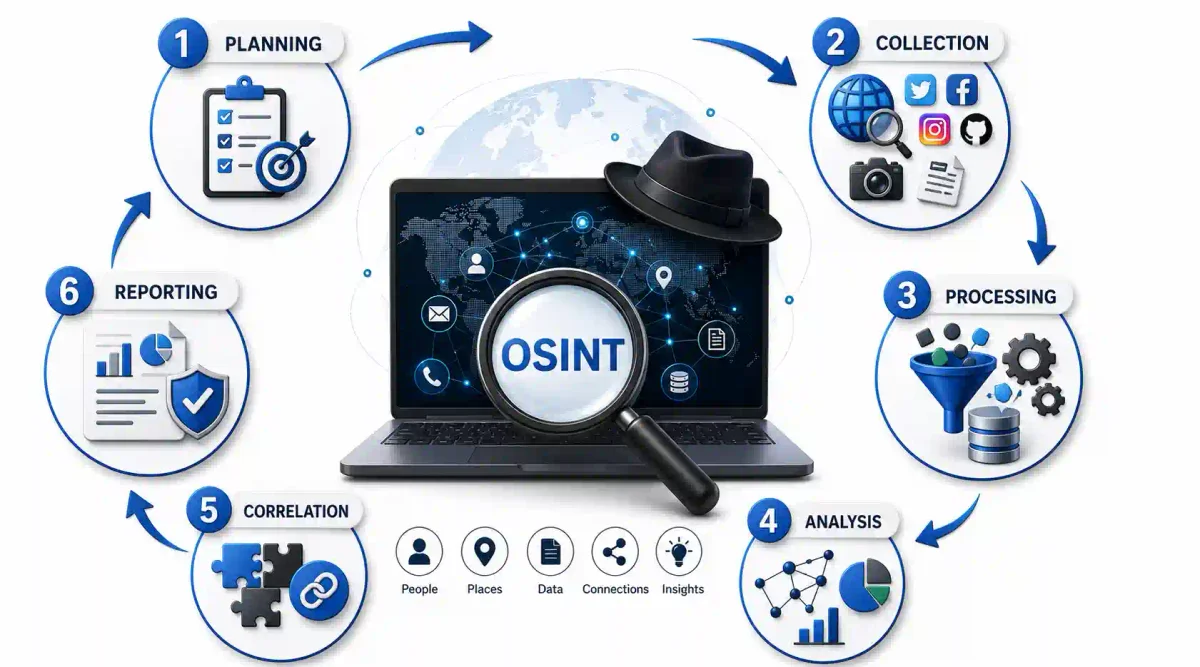
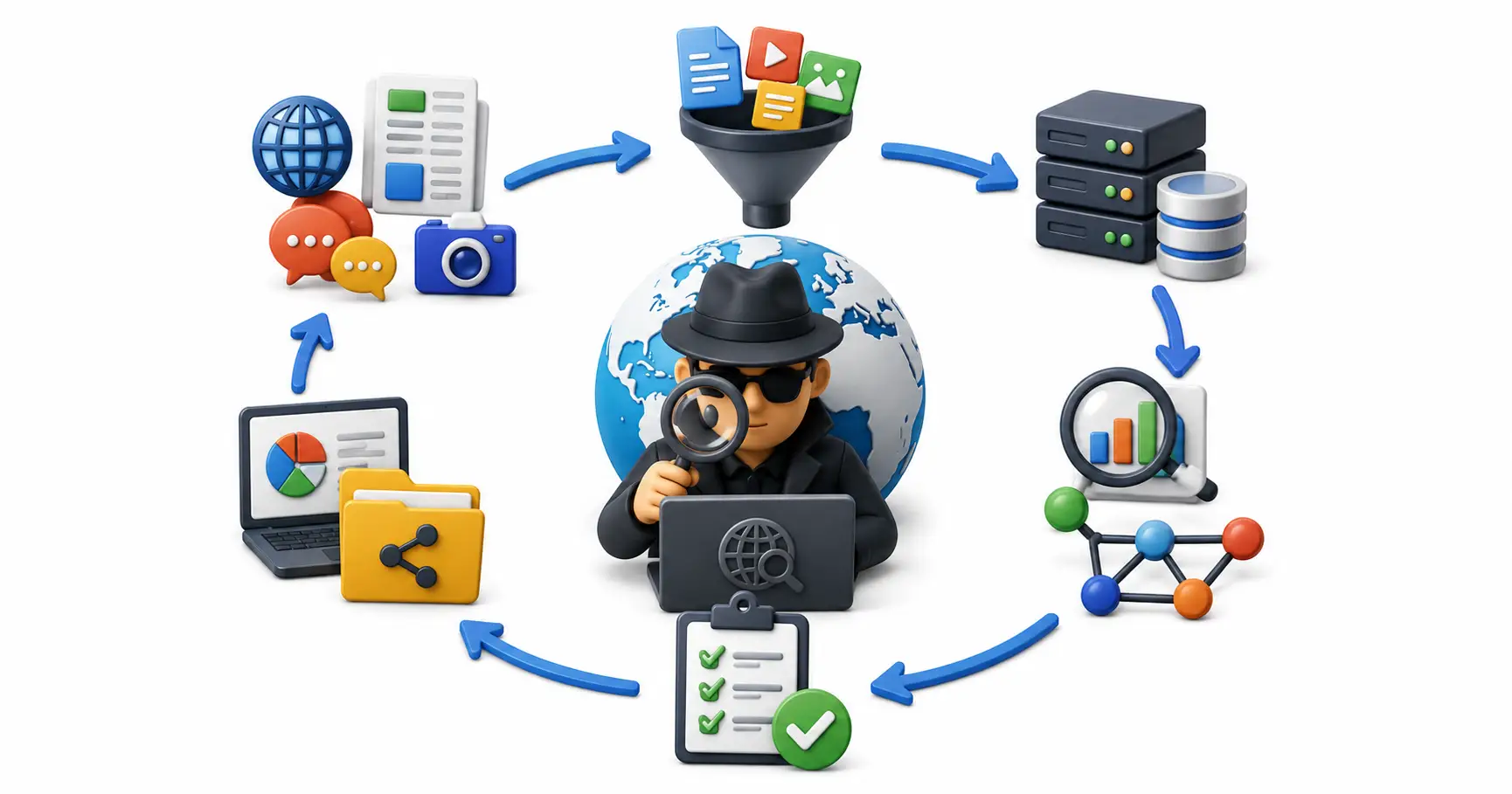
Professional intelligence agencies and corporate threat hunters do not just “Google things.” They adhere to a rigorous, cyclical methodology designed to transform noisy raw data into structured, actionable, verified intelligence.
In this comprehensive guide for 2026, we will break down the methodology utilized by professional OSINT analysts to move from the initial collection phase directly into structured analysis.
1. Phase 1: Direction and Meticulous Planning
The biggest mistake you can make is opening a web browser and typing a target’s name without a plan. Before you collect a single byte of data, you must define the scope of the investigation.
Defining the Priority Intelligence Requirement (PIR)
In military intelligence and corporate threat hunting, this foundational concept is known as defining the PIR (Priority Intelligence Requirement). What is the specific question you are trying to answer?
- The Bad PIR: “Find out everything possible about the hacker John Doe.” (This vague directive leads to unproductive rabbit holes and burnout).
- The Structured PIR: “Identify the geographical location and server infrastructure currently utilized by the threat actor operating the Twitter handle @CryptoScam2026.”
Operational Security (OPSEC)
Before you even think about investigating, you must threat-model yourself. If you carelessly visit a target’s website, your true physical home IP address is permanently logged in their firewall. If you view their professional LinkedIn profile using your true account, they receive a push notification containing your real name and current employer.
You must configure an isolated, ephemeral virtual machine (as discussed in our guide on Building an OSINT Toolkit), utilize a non-logging VPN, and create convincing, untraceable “sock puppet” (fake) social media accounts to conduct your research safely.
2. Phase 2: Collection Strategies
Once your isolated environment is secure, you begin gathering raw data. Professional collection is categorized into three distinct strategies based on the level of physical interaction with the target’s infrastructure.
Passive Collection (The Gold Standard)
This is the safest, most recommended method for all OSINT investigations. You do not touch the target’s physical infrastructure at all. You rely on third-party data aggregators and global search engines.
- WHOIS Records: Querying global Domain Name registries to see who purchased a malicious website.
- Search Engine Dorking: Using advanced Google/Bing operators (e.g.,
site:target.com filetype:pdf "Confidential") to coerce search engines to reveal hidden, sensitive corporate files. - Public Breaches: Searching dark web databases like HaveIBeenPwned to see if the target’s email address was exposed in a historical data breach, which often reveals their password creation patterns.
- The Global Wayback Machine: Viewing historical, deleted versions of the target’s website via the Internet Archive, finding content they tried to erase.
Semi-Active Collection (The Gray Area)
You physically interact with the target’s actual server, but in a way that looks like normal internet traffic.
- Fetching Cryptographic SSL Certificates: Asking the server to present its cryptographic certificate, which often leaks the internal hostnames of other servers the target owns.
- Advanced DNS Interrogation: Querying the target’s global DNS records (as explained in our DNS Deep Dive) to map out their hidden subdomains and mail servers.
Active Collection (The Danger Zone)
Warning: This crosses the line from passive OSINT directly into hostile Active Reconnaissance and physical Penetration Testing. This involves noisy actions like port scanning the target’s IP address with Nmap. The target’s firewalls will log your IP address and block you. In strict, legally bound OSINT engagements, active collection is heavily restricted or banned.
Evidence Preservation
As you collect raw data, you must preserve it immediately. A paranoid target might delete their Twitter account halfway through your investigation. Analysts use tools like Hunchly to automatically archive every webpage they visit, complete with cryptographic hashes and precise timestamps, ensuring the raw evidence is legally admissible in a court of law.
3. Phase 3: Processing and Exploitation
You have finished collecting data. You now possess a folder containing 50 screenshots, a 10,000-line CSV file of raw IP addresses, and 20 encrypted downloaded PDF documents. You are now in the Processing Phase.
Cleaning the Noise
Raw outputs from automated tools contain large amounts of useless, irrelevant data. Processing cleans this up:
- Deduplication: You must run Python scripts to remove duplicate IP addresses, dead links, or irrelevant usernames from your spreadsheets.
- Metadata Extraction: This is an OSINT goldmine. When a careless target uploads a PDF or a high-resolution JPEG image, it often contains hidden EXIF metadata. You must extract this hidden metadata to reveal the GPS coordinates of where the photo was taken, or the name of the software used to create the document.
Correlating Identifiers
If you found a specific target username on a gaming forum, and the identical username on a GitHub repository, you cannot blindly assume they are the same human being. You must process the raw data to find bridging identifiers: Do both profiles list the same geographic home city? Do they use the identical custom profile picture avatar?
4. Phase 4: Structured Analysis
This is the most critical phase of the methodology. Analysis is the cognitive process of extracting meaning from your processed data and connecting the disparate dots. Analysts rely on frameworks to visually and mathematically represent these connections.
Link Analysis
Link Analysis involves creating a visual map of complex relationships (often using graph-database tools like Maltego or Gephi). You represent entities (people, encrypted emails, domains) as “Nodes,” and their relationships as physical “Edges” (lines).
For example, your finished graph might show:
- Node A (Username: DarkHacker99) connects to Node B (Email: [email protected]).
- Node C (Malicious Domain: scam-website.com) was registered by Node B (Email: [email protected]).
- Node C is hosted on Node D (IP Address: 104.21.55.10).
By graphing this flow, you prove that the user on the gaming forum is responsible for registering the scam infrastructure.
Pattern of Life (Chronological Timeline) Analysis
You take every raw timestamp from your data collection (the time of a forum post, the timestamp of an EXIF photo, the creation date of a domain) and arrange them chronologically on a timeline.
- Timezone Deduction: If the target exclusively posts on Reddit forums between 02:00 UTC and 16:00 UTC, and is silent for 8 solid hours, you have mapped their sleep schedule, indicating they live in an Asian or Australian geographical timezone.
- Causality: Did the target register the malicious domain 12 hours after a vulnerability was officially announced on Twitter?
Analysis of Competing Hypotheses (ACH)
If you have a working theory (“The target is an insider threat working at the target company”), you must write it down alongside alternative theories (“The target is a skilled foreign hacker,” “The target is an automated botnet”). You then measure every piece of collected evidence against all possible hypotheses to see which theory the raw evidence most strongly supports. This prevents you from falling in love with your first idea.
5. Reporting: The Final Intelligence Product
If you do not communicate your findings clearly to the decision-makers, the investigation was useless.
OSINT reports are not rambling essays. They are concise, structured intelligence products.
- The BLUF (Bottom Line Up Front): The first paragraph of the report states the most important finding. (e.g., “We assess with high confidence that John Doe is the owner of the malicious domain.”)
- The Narrative: A clear, chronological explanation of how you moved from the initial starting indicator to the final conclusion, referencing the visual link analysis charts.
- The Raw Evidence Appendices: All raw IP addresses, hashes, and timestamps are placed at the back of the report, keeping the main narrative clean and readable for non-technical executives.
6. Mitigating Cognitive Bias
Humans are flawed, irrational analytical machines. In professional OSINT, the most dangerous enemy is not the target; it is your own Confirmation Bias. This is the psychological tendency to search only for data that supports your pre-existing, favored theory, while subconsciously ignoring or discrediting valid data that proves you wrong.
To prevent this failure, intelligence analysts adhere to strict validation rules:
- The Rule of Two: Never report a critical finding as a verified “fact” unless it is corroborated by at least two independent, unrelated sources. (e.g., An obscure forum post claims the target lives in London, but you must verify this with a secondary source, like a corporate business registry or a geotagged photo).
- The Source Reliability Matrix: You must grade your data sources. An official government corporate registry is graded “A” (Highly Reliable). An anonymous post on a 4chan imageboard is graded “F” (Unknown Reliability).
- Rigid Confidence Levels: When writing the final intelligence report, analysts never deal in absolutes. Findings are presented with specific confidence levels:
- High Confidence: Strongly supported by multiple strong, corroborated sources.
- Moderate Confidence: Plausible, but relies on some analytical assumptions or single-source data.
- Low Confidence: A fragile working theory based on fragmented or unverified raw data.
Frequently Asked Questions (FAQ)
What are the 5 phases of the OSINT cycle?
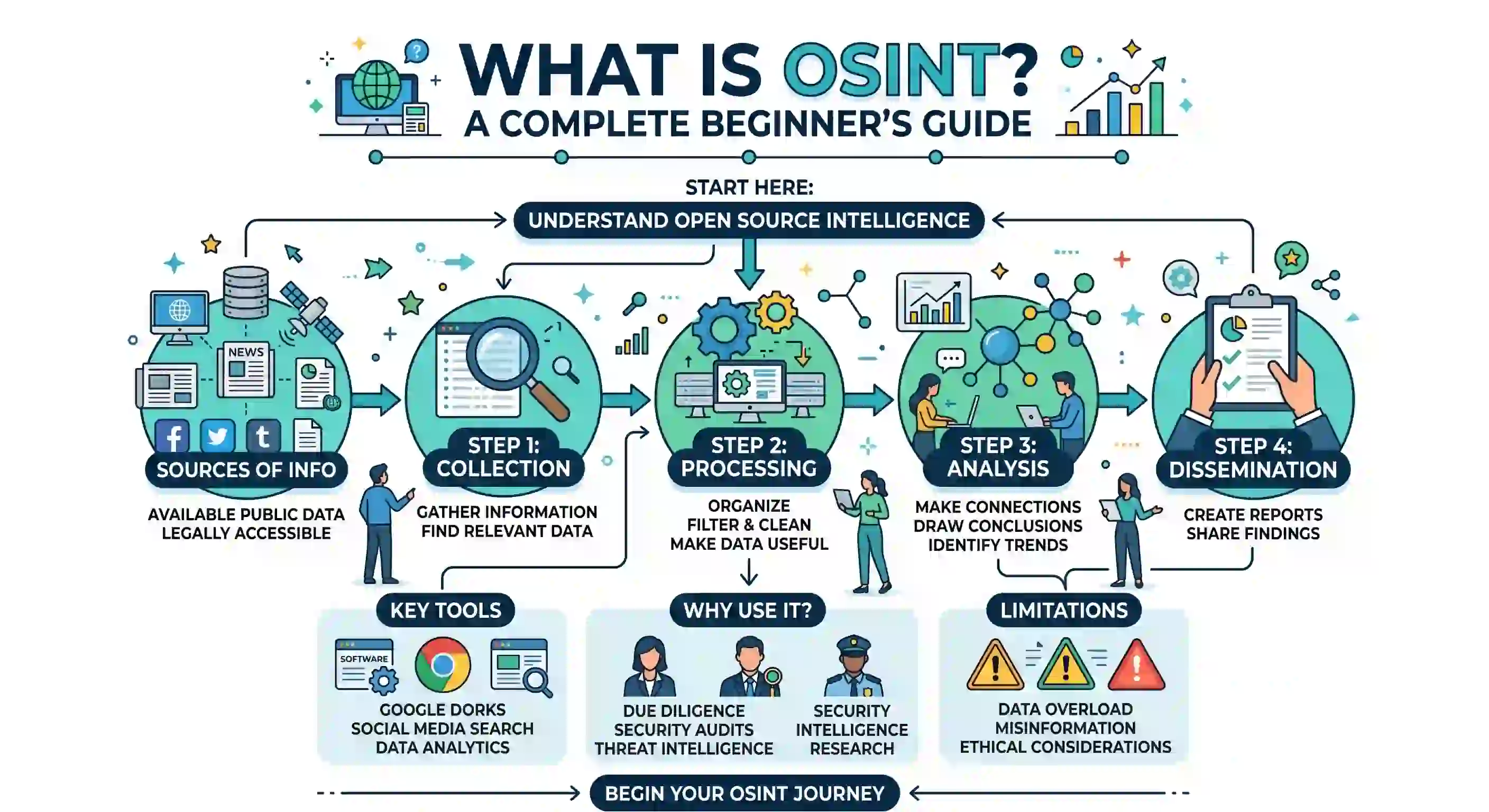
The 5 phases of the OSINT cycle are: 1) Planning and Direction, 2) Collection, 3) Processing, 4) Analysis and Production, and 5) Dissemination and Integration. These phases ensure investigations are structured, legal, and focused on specific intelligence requirements.
Why is an OSINT methodology important?
Without a methodology, investigators risk collecting large amounts of irrelevant data (data overload), violating legal or ethical boundaries, and falling victim to confirmation bias. A methodology ensures a repeatable, defensible, and accurate intelligence product.
What is the difference between data collection and analysis?
Data collection is the raw gathering of public information (like saving tweets or logging IP addresses). Analysis is the process of evaluating that raw data, identifying patterns, verifying facts, and drawing actionable conclusions that answer the initial intelligence requirement.
How do OSINT analysts avoid confirmation bias?
Analysts avoid confirmation bias by using structured analytical techniques, such as the Analysis of Competing Hypotheses (ACH). This requires them to actively look for evidence that disproves their theory, rather than only collecting data that supports it.
What makes a good OSINT intelligence report?
A good OSINT report uses the BLUF (Bottom Line Up Front) methodology, clearly states the intelligence requirement, separates verified facts from analytical assessments, and provides a clear chain of evidence (like archived links and timestamped screenshots) for every claim.
Conclusion: The Professional Cycle
The difference between an amateur and an intelligence professional is strict methodology.
Anyone can run an automated, open-source tool to indiscriminately scrape a website. But transitioning that pile of raw data through a rigorous pipeline of processing, link analysis, timeline deduction, and bias-mitigation is what produces actual, actionable intelligence. By adhering to this intelligence cycle, your OSINT investigations will become faster, more accurate, and legally defensible in any environment.
Discussion
Loading comments...