

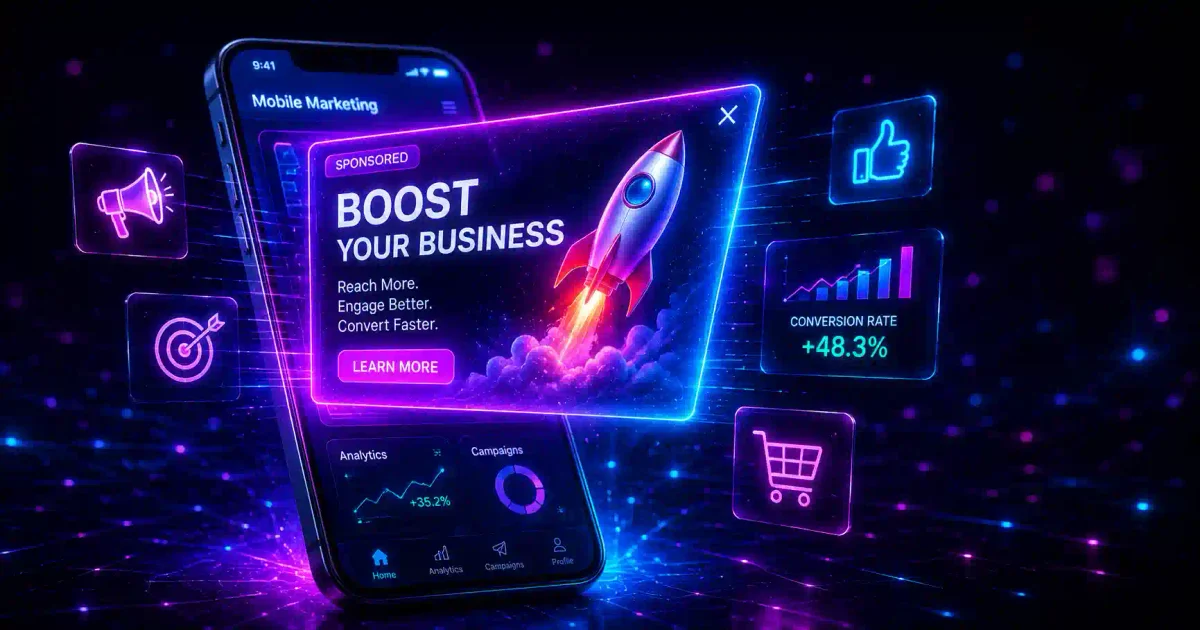
In 2015, Google published an internal data report that altered the landscape of the internet: for the first time, mobile web searches surpassed desktop searches on a global scale.
Fast forward to 2026, and the traditional desktop computer is increasingly becoming a specialized tool reserved for office work. The smartphone, conversely, has become the primary lens through which humanity experiences the world, consumes media, and conducts commerce. Global mobile traffic now accounts for over 60% of all internet usage, and in rapidly developing markets across Asia and Africa, that number is closer to 90%.
Therefore, if your company’s marketing strategy treats mobile as a secondary “afterthought,” or simply attempts to shrink down a desktop website to fit on a smaller screen, you are losing money and alienating your customer base.
Welcome to the definitive guide on Mobile Marketing. In this guide, we will explore the psychology of the mobile consumer. We will teach you how to master the algorithms of the App Store, how to harness the power of push notifications without getting deleted, and how to execute local Geofencing campaigns to attract customers directly from your competitors’ retail stores.
1. Redefining Mobile Marketing
Mobile Marketing is a multi-channel digital marketing strategy aimed at reaching a target audience on their smartphones, tablets, and other mobile devices via websites, email, SMS messaging, social media, and native applications.
However, viewing mobile marketing as simply another “screen size” is a strategic error. True mobile marketing is not just about the device; it is about the context of the user.
When someone is sitting at a desktop computer, they are usually in a stable environment (an office cubicle or a home desk). They have time to read longer articles, navigate multi-tiered dropdown menus, and fill out 10-field checkout forms.
When someone is using a smartphone, the context is different. They are often standing on a crowded train, walking down a busy street, or waiting in line for coffee. They are easily distracted, they are rushed, their attention span is limited, and they are operating the interface with only one thumb.
Mobile marketing, therefore, requires a focus on simplicity, urgency, and location awareness. You must remove unnecessary friction.
2. Mobile-First Indexing: The SEO Reality
If you read our foundational SEO guide, you know that Google determines how high your website ranks in organic search results.
Ten years ago, Google’s algorithms looked primarily at the desktop version of your website to determine its quality and relevance. This is no longer true.
Today, Google operates on a system called Mobile-First Indexing. This means Google’s crawling bots simulate a smartphone screen when analyzing your site. It does not matter if your desktop site is well-designed. If your website is broken on a smartphone, if the text is too small to read without pinching and zooming, or if the images take 10 seconds to load on a 4G connection, Google will penalize your domain. You will drop off the first page of search results for both mobile and desktop users.
The Mobile-First Optimization Checklist:
- True Responsive Design: Your site must not just “shrink”; it must rearrange its layout to fit any screen. Multi-column desktop grids must stack into single-column mobile layouts.
- Thumb-Friendly Tap Targets: Buttons and links must be large enough to tap with a thumb without hitting an adjacent link. Google’s developer guidelines mandate that clickable tap targets be at least 48x48 pixels, with sufficient blank space between them.
- The Death of Intrusive Interstitials: If a large popup (asking for an email address) covers the mobile screen the moment the page loads, forcing the user to hunt for a small “X” to close it, Google will penalize your site. Popups on mobile must be delayed, unobtrusive, and easily dismissible.
3. The Psychology of the Mobile User: Mastering the Micro-Moment
To succeed in mobile marketing, you must design your funnel around what Google defines as the “Micro-Moment.”
Micro-Moments are intent-rich moments when decisions are made and preferences are shaped. They occur when people turn to a device to act on a need. They fall into four distinct categories:
- I-Want-to-Know Moments: A user sees an unfamiliar word or historical event mentioned on a television show. They pull out their phone to quickly google it. They are not looking to buy; they want immediate information.
- I-Want-to-Go Moments: A user is walking downtown and searches “Best Thai food near me.” They are moving and looking for a local destination. Your Google My Business profile must be optimized to capture this traffic.
- I-Want-to-Do Moments: A user is standing in their kitchen, phone propped against the sink, watching a YouTube tutorial on how to fix a leaky pipe. They need step-by-step visual instruction.
- I-Want-to-Buy Moments: A user is standing in the aisle of a Best Buy retail store looking at a television. They pull out their phone, search the model number, and check if Amazon has it cheaper. They have their credit card in hand.
If your mobile marketing strategy provides a relevant, formatted answer to those specific micro-moments in under 3 seconds, you win the customer. If your site takes 5 seconds to load, they will hit the back button and go to your competitor.
4. App Store Optimization (ASO): The SEO of the App World
If you spend $50,000 to build a native mobile app, it will be listed in the Apple App Store or Google Play Store alongside roughly 5 million other applications. How does anyone actually find it?
Through ASO (App Store Optimization). ASO is the data-driven process of optimizing mobile apps to rank higher in an app store’s internal search results. It is the equivalent of SEO, but restricted to the walled garden of the App Store.
Keyword Strategy for the App Store
App Store search algorithms are less sophisticated than Google’s web search algorithm. The physical title of your app is the strongest ranking factor.
- A Poor Title:
FitLife(Nobody searching the store knows what this means. It provides no context). - An Optimized Title:
FitLife - Calorie Tracker, Diet Planner & Gym Routine(This title naturally integrates the high-volume keywords users are typing into the search bar).
The Power of App Screenshots and Visuals
Unlike web SEO, where large blocks of text are used, ASO is a visual discipline. When a user searches for an app, they don’t read the description first. They look at the App Icon and the first three screenshots.
- The App Icon: Must be simple, recognizable, and stand out against both dark mode and light mode phone backgrounds.
- The Screenshots: Avoid uploading raw, unedited screenshots of your user interface. The UI is often confusing out of context. Instead, treat the screenshot slots as miniature billboards. Place the actual screenshot inside an image of a phone bezel, and place bold text at the top of the image explaining the core benefit (e.g., “Track Your Macros Instantly!” or “Syncs with Apple Watch!“).
5. In-App Advertising vs. Mobile Web Advertising
When buying mobile advertisements (via Google Ads, Meta Ads, or programmatic platforms), you must understand the critical difference in user behavior based on where the ad is actually displaying.
Mobile Web Ads
These are the standard display ads shown while a user is reading a blog or news site on a mobile browser (like Chrome or Safari).
- The Problem: These ads suffer from ad-blocker usage. More importantly, they suffer from the “Fat-Finger” phenomenon. A percentage of clicks on mobile web banner ads are accidental—a user was trying to scroll past the ad and tapped it. You pay for that worthless click.
In-App Ads
These are ads shown natively inside a downloaded application (like a banner at the bottom of a weather app, or a video inside a mobile game).
- The Rewarded Video Ad (The Gold Standard): This is arguably the most effective form of mobile advertising. A user is playing a free mobile game, and they run out of “lives.” The game pauses and offers them a choice: wait 30 minutes to play again, or watch a 30-second video advertisement from a sponsor to get an extra life immediately. Because the user explicitly chooses to watch the ad and is rewarded for their attention, engagement rates and positive brand sentiment are higher than forced, unskippable pop-up ads.
6. The Ethics and Strategy of Push Notifications
Push notifications are a direct form of marketing. You are vibrating a user’s phone in their pocket, requesting their attention.
If you abuse this channel, the user will become annoyed, revoke your notification permissions, or delete your app from their phone.
The Golden Rules of Push Notifications:
- Never Send “Just Because”: A push notification must contain utility, news, or value. “Check out our new blog post” is a poor push notification. “Flash Sale: The shoes you favorited are 50% off for the next 2 hours” is an effective push notification.
- Personalization is Important: Sending a generic “Sale today!” to every user is spam. Sending a notification that says, “Hey John, your favorite band just announced a concert in Chicago, tickets go on sale in 10 minutes,” feels personalized.
- Timing is Everything: Do not send a push notification at 3:00 AM local time. Use “Intelligent Delivery” algorithms built into modern marketing software. These tools analyze the user’s historical opening habits and hold the notification until the time the user usually picks up their phone.
7. SMS Marketing: The Power of the 98% Open Rate
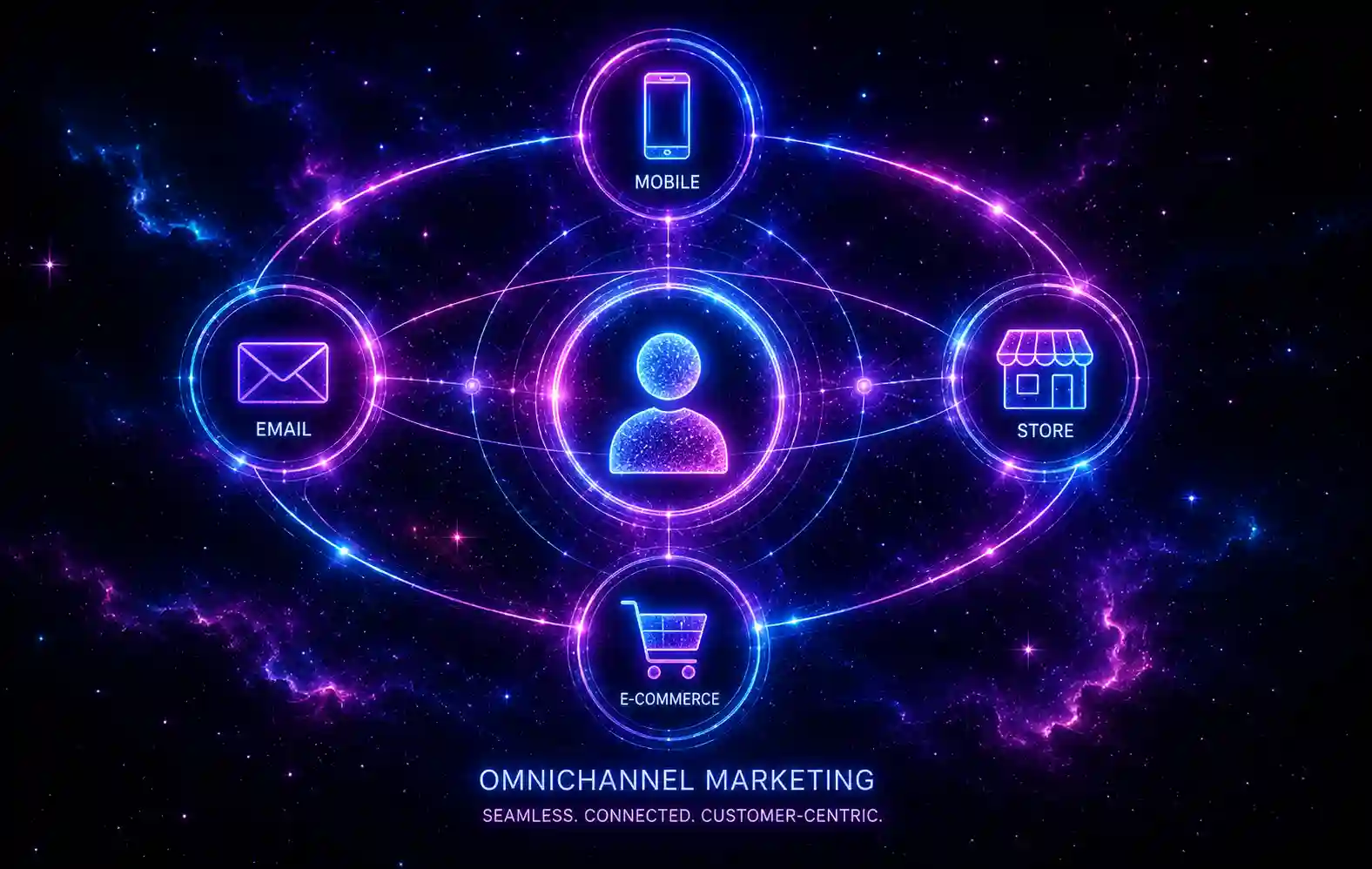
As discussed in our broader Omnichannel guide, SMS (Text Message) Marketing is currently the most powerful direct-response channel in the world.
While a promotional email might sit unread in a Gmail “Promotions” folder for three days and achieve a 20% open rate, an SMS message is often read within 3 minutes of receipt, boasting a 98% open rate.
Best Practices for SMS Marketing:
- Strict Legal Compliance: In the United States, the Telephone Consumer Protection Act (TCPA) levies significant fines for texting consumers without their explicit, written, opt-in consent. Never buy lists of phone numbers. You must earn them via lead magnets.
- Keep it Short: You have 160 characters before the message breaks. Do not use corporate jargon. Get straight to the offer and include a clear, shortened tracking link.
- The Golden Ratio (3:1): If every text you send asks the user for money, they will reply “STOP.” For every 1 promotional text you send (“Buy this new product”), you must send 3 utility texts that provide value (“Your order just shipped,” “Here is a free tip on how to use your product,” “Your appointment is confirmed for tomorrow”).
8. Location-Based Marketing and Geofencing
Smartphones are GPS-enabled devices. Marketers can use this hardware to trigger specific campaigns based on where the user is located.
Geofencing involves drawing a virtual “fence” around a specific physical geographic location (such as drawing a 1-mile radius around your physical retail store on a digital map). When a user who has your app installed (and has granted location permissions) walks inside that virtual fence, the app detects their location and triggers an automated action. It might send a push notification: “Hey! You are only 2 blocks away from our cafe. Come in right now and show this notification for a half-price coffee.”
The Strategy: Competitor Conquesting Many brands will draw geofences around their direct competitors’ physical stores. Imagine a user walks into a Ford car dealership. Because they have the Chevrolet app on their phone, the app detects they are inside a competitor’s lot. It triggers a push notification offering them a $1,000 cash-back discount on a new truck if they leave the Ford lot and drive three miles down the road to the Chevrolet dealership instead. It is an effective strategy.
9. Mobile Payment Integrations (Fixing the Checkout Bottleneck)
The Conversion Rate Optimization (CRO) hack for mobile e-commerce has little to do with button colors or copywriting. It is about integrating mobile wallets.
Typing out a 16-digit credit card number, finding the expiration date, typing the CVV code, and entering a full billing address using only your thumbs while riding on a bumpy commuter train is a frustrating user experience. It results in high cart abandonment rates on mobile devices.
If your mobile checkout page features native “Apple Pay” and “Google Wallet” integration buttons, the user can bypass the form. They can purchase a $500 item simply by looking at their phone (FaceID biometric scanning) or double-clicking the side button. Reducing the checkout process from 3 minutes of typing down to 3 seconds of biometric scanning will increase your mobile revenue.
10. Conclusion
Mobile marketing requires a paradigm shift. You can no longer think of the smartphone as merely a smaller desktop computer; you must think of it as a remote control for the consumer’s life.
It is a device they look at first thing in the morning and last thing before they sleep. By designing for the micro-moment, leveraging the direct nature of SMS and push notifications ethically, and removing friction from the mobile checkout process, you align your brand with the way modern humans actually live and operate.
Ready to explore the rest of the Digital Marketing ecosystem? Dive into our next guidees:
- The Complete Guide to Display Advertising
- The Ultimate Guide to Native Advertising
- Omnichannel Marketing Strategy
Frequently Asked Questions (FAQ)
Q1: What is Mobile-First Indexing in SEO? A: Mobile-First Indexing means Google primarily uses the mobile version of a website’s content for indexing and ranking. If your site is broken on a smartphone or loads too slowly, it will drop in search rankings across all devices, including desktop.
Q2: How is App Store Optimization (ASO) different from SEO? A: While SEO focuses on ranking websites in search engines like Google, ASO is the process of optimizing mobile apps to rank higher within the Apple App Store or Google Play Store. ASO relies heavily on app titles, keywords, and strong visual elements like icons and screenshots.
Q3: What are Google’s “Micro-Moments” in mobile marketing? A: Micro-Moments are intent-rich moments when users turn to their smartphones to act on a need. They are categorized into four types: I-Want-to-Know, I-Want-to-Go, I-Want-to-Do, and I-Want-to-Buy.
Q4: How does geofencing work in mobile marketing? A: Geofencing involves drawing a virtual boundary around a physical location (like a retail store) using GPS. When a user with your app enters that area, the app can trigger location-based automated actions, such as sending a promotional push notification.
Q5: Why is SMS marketing considered so effective? A: SMS marketing is incredibly effective because text messages boast an average open rate of 98%, with most messages read within three minutes. It is a powerful direct-response channel when used ethically and with proper user consent.

Discussion
Loading comments...