

For the last twenty years, the internet has primarily been an entirely passive experience.
A brand writes a massive, 2,000-word blog post. A user sits down, stares at their screen, and reads it. A brand uploads a 10-minute video to YouTube. A user sits back and watches it. It is the exact same psychological dynamic as watching television, listening to the radio, or reading a physical newspaper. The brand broadcasts a message, and the user is merely a passive recipient of that information.
In 2026, passive consumption is dying. Attention spans are shorter than ever, the internet is flooded with generic AI-generated articles, and modern consumers are demanding to be active participants in the digital experience. They don’t just want to read about a product; they want to engage with it, manipulate it, and see how it specifically applies to their unique situation.
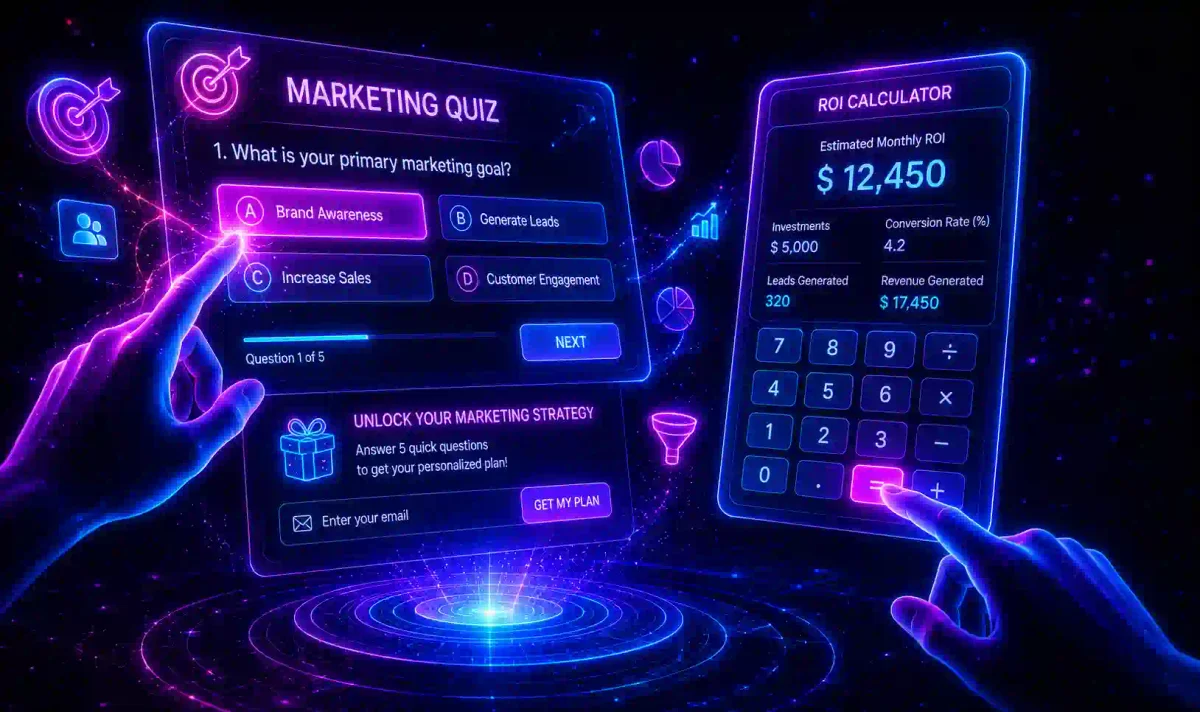
Interactive Content Marketing is the ultimate antidote to the boring, static blog post. It requires the user to click, swipe, answer complex questions, and input personal data to receive a highly personalized, mathematically accurate result.
In this comprehensive guide—the final installment of our digital marketing series—we will explore exactly why interactive content generates double the conversions of static content, deconstruct the deep psychological triggers that make quizzes mathematically irresistible, explain how to survive the death of third-party cookies using Zero-Party Data, and reveal how to build interactive tools that generate massive B2B and B2C revenue.
1. Defining Interactive Content vs. Static Content
Interactive Content is any type of digital material that requires active, physical engagement from its consumers. Instead of simply scrolling and reading text or passively watching a video, the user must input data, answer specific questions, or make binary choices to interact with the content and receive an outcome.
To understand the difference, consider a user trying to figure out if they can afford to buy a house.
- Static Content: They find an article titled “How to Calculate Your Mortgage.” The article is 1,500 words long and explains the complex algebraic formula for amortizing a 30-year loan with a 6% interest rate. The user has to pull out a physical calculator and try to do the math themselves. They get frustrated and leave.
- Interactive Content: They find an actual Mortgage Calculator built into the webpage. The calculator simply asks for their down payment amount, interest rate, and zip code. They type in three numbers, hit “Calculate,” and the tool instantly generates a beautiful graph showing their exact monthly payment.
The interactive calculator provides ten times more value, in one-tenth of the time, and completely eliminates the user’s cognitive load.
2. The Deep Psychology of Participation
Why does interactive content boast an average conversion rate of 70%, compared to the dismal 36% conversion rate of traditional static landing pages? It exploits three massive psychological phenomena.
1. The Ego-Bait Principle
Humans are inherently narcissistic. We love learning about ourselves, categorizing ourselves, and comparing ourselves to others. The entire reason media companies like Buzzfeed built multi-million dollar empires off of ridiculous quizzes like “Which Harry Potter Character Are You Based on Your Breakfast Choices?” is because people crave personalized categorization. If you build a quiz that promises to reveal something new about the user’s personality, their business, or their health, they will click it.
2. The Sunk Cost Fallacy
This is the primary driver of interactive lead generation. If a user spends 3 minutes carefully answering 10 questions on a complex assessment, they have heavily invested their time and mental energy into the process. When the quiz stops at the very end and asks for their email address to reveal the final results, they are highly likely to hand the email over. Why? Because of the Sunk Cost Fallacy. They do not want to feel like they just wasted 3 minutes of effort for nothing. They need to see the result to justify the time spent.
3. Immediate, Frictionless Utility
An interactive ROI calculator solves a complex math problem instantly. A product recommender filters through 5,000 items to find the perfect gift in 10 seconds. Interactive content is not just a marketing message; it is a genuine, helpful utility. Users are willing to exchange their contact information for tools that make their lives easier.
3. The 5 Most Profitable Types of Interactive Content
Not all interactive content is created equal. Depending on whether you are in B2B SaaS, e-commerce, or consulting, you must choose the specific format that aligns with your sales funnel.
1. Assessments and Personality Quizzes
The absolute king of B2C (Business-to-Consumer) marketing and top-of-funnel lead generation.
- The Execution: A high-end skincare brand runs a Facebook ad for a “Free 60-Second Skin Type Assessment.” The user clicks and answers questions about their diet, acne frequency, climate, and age. At the end, the brand captures their email and gives them a highly personalized, 3-step daily skincare routine (which conveniently features the brand’s exact products as the solution).
2. Interactive Calculators
The undisputed king of Finance, Real Estate, and SaaS marketing.
- The Execution: A solar panel installation company builds a “Solar Savings Calculator.” The user inputs their zip code, roof size, and average monthly electric bill. The calculator instantly runs the math and tells them exactly how many thousands of dollars they will save over 20 years by switching to solar. Below the massive savings number is a button: “Book a call with an engineer to lock in these savings.”
3. Interactive Infographics
Standard infographics are often massive, unreadable, towering image files that look terrible on mobile phones. Interactive infographics are built in HTML5. They allow the user to hover over data points to see extra text, click on specific regions of a global map to reveal localized statistics, and filter the data to only see what they specifically care about.
4. Product Recommenders (The E-commerce Savior)
If an e-commerce store has 5,000 products, the user experiences “Decision Paralysis.” They get overwhelmed by choice and leave without buying anything.
- The Execution: A Product Recommender asks them 3 simple questions (e.g., “Are you looking for a gift for someone else?”, “What is their gender?”, “Is your budget under $50 or over $50?”). The software instantly filters the 5,000 products down to the 3 absolute perfect recommendations, dramatically increasing the likelihood of a sale.
5. Interactive E-Books and Whitepapers
B2B Whitepapers are notoriously boring, text-heavy 40-page PDFs that executives download but never actually read. An interactive whitepaper is built like a dynamic webpage. It features embedded calculators, pop-up video interviews with industry experts, and mini-quizzes checking the reader’s knowledge at the end of each chapter to ensure they are actually digesting the data.
4. Zero-Party Data: Surviving the Privacy Apocalypse
As discussed extensively in our Web Analytics Guide, Apple and Google are actively killing third-party tracking cookies. Marketers can no longer silently spy on users as they browse the web to figure out what they want to buy.
Interactive content solves the cookie apocalypse by collecting Zero-Party Data.
Zero-Party Data is data that a customer intentionally, explicitly, and proactively shares with a brand. It is the holy grail of modern marketing because it is 100% accurate and fully legally compliant.
If a user takes your SaaS assessment quiz and explicitly selects the answer: “My company’s biggest marketing struggle right now is generating qualified B2B leads,” you do not have to guess what they want. You do not have to track their IP address. They explicitly told you their pain point.
You can now use your Marketing Automation Software to tag their profile in your CRM as “Struggles with Leads.” Your software then instantly sends them a highly targeted, automated email containing a case study on exactly how your software generates B2B leads. The conversion rate on this personalized follow-up is astronomical.
5. The Architecture of a High-Converting Quiz
If you build a quiz poorly, users will abandon it halfway through. Building a quiz is an exercise in user experience (UX) design. You must follow this strict architecture:
- The Hook (The Title): The title must promise a highly desirable, personalized outcome. Do not call it “Our Marketing Quiz.” Call it “Find Your Perfect Running Shoe in 60 Seconds” or “Discover Your True Leadership Style.”
- The Length (The Sweet Spot): 5 to 8 questions is the absolute sweet spot for completion rates. Any shorter, and the user won’t believe the final results are mathematically accurate. Any longer (15+ questions), and they will experience quiz fatigue and abandon the page.
- The Visuals: Do not use boring, text-only answers. Humans process images faster than text. Every answer option should have a beautiful, clickable image or icon representing the choice.
- The Lead Capture (The Gate): This is the most crucial step. Put the email capture form after the final question is answered, but before the results are revealed. Make it optional to avoid angering users, but highly incentivized (e.g., “Enter your email to permanently save your results to your inbox and instantly unlock a 10% discount on your recommended shoe.”)
- The Results Page: Do not just lazily say “You got Product A.” You must explain the logic. Explain why they got Product A based on the specific answers they provided in questions 2 and 4. Showing the math builds massive trust.
6. Interactive Content in B2B Enterprise Marketing
Interactive content is not just for Buzzfeed personality quizzes and direct-to-consumer beauty brands. It is a devastatingly effective weapon for complex B2B Enterprise sales.
The “Maturity Assessment” Strategy: Imagine a B2B software company that sells highly complex, $100,000/year cybersecurity software to hospitals. Selling this via a cold email is impossible.
Instead, the company builds an interactive “Hospital Cybersecurity Maturity Assessment.” The Chief Information Security Officer (CISO) at a hospital sees the ad and takes the rigorous, 15-question assessment.
At the end, the assessment gives the hospital a score of 40/100. It highlights massive, specific security vulnerabilities in their current tech stack based on their answers. The final page says: “Your score is 30% below the national average for hospitals. Click here to book a free 15-minute consultation with our security engineers to discuss fixing these 3 specific vulnerabilities before a breach occurs.”
The sales team now has an incredible, highly-qualified lead. More importantly, the sales team already knows exactly what the prospect’s specific weaknesses are before they even pick up the phone, allowing them to tailor a perfect pitch.
7. The No-Code Revolution: Tools to Build Interactive Content
Five years ago, building an interactive ROI calculator or a dynamic branching quiz required hiring a $150/hour software engineer to write custom JavaScript.
In 2026, the market is flooded with powerful “No-Code” platforms that allow marketers to drag-and-drop complex logic, design beautiful interfaces, and embed the final product directly onto their website in an afternoon.
- Typeform: The undisputed king of beautiful, highly engaging, mobile-first quizzes and assessments. They pioneered the “one question at a time” interface that drastically improves completion rates.
- Outgrow: A highly specialized, mathematically powerful software specifically designed for building complex ROI calculators, cost estimators, and e-commerce product recommenders.
- Ceros: An enterprise-level platform used by Fortune 500 companies for turning boring PDFs into highly interactive, fully animated whitepapers and immersive digital magazines.
- Interact: Focused heavily on simple lead generation quizzes and boasts incredible native integrations with massive email marketing platforms like Mailchimp, Klaviyo, and HubSpot.
8. The Metrics of Interactive Marketing
You cannot judge the success of an interactive calculator using standard, passive metrics like “Pageviews.” You must track deep engagement and funnel metrics.
- Starts vs. Completions (The Drop-off Rate): If 1,000 people click “Start Quiz,” but only 200 people actually finish it, your quiz is broken. It is either too long, or one specific question is too confusing. You must look at the analytics for each individual question to see exactly where people are abandoning the process.
- Lead Conversion Rate: Of the people who successfully completed the quiz and reached the final gate, what percentage actually gave you their email address? If this number is below 40%, your incentive is not strong enough.
- The Virality Coefficient (Share Rate): Personality quizzes are highly viral. If you tell an executive they have the precise leadership style of Steve Jobs, their ego will compel them to share that result on LinkedIn. You must meticulously track how many completions came directly from the social sharing buttons embedded on the final results page.
9. Conclusion: The End of Our Journey
Interactive content is the ultimate expression of modern digital marketing. It inherently respects the consumer’s time, provides immediate and frictionless utility, and replaces annoying, aggressive sales pitches with personalized, data-driven recommendations.
The Digital Marketing Ecosystem is Now Complete.
This concludes our massive, 20-part guide series on Digital Marketing.
From the foundational, highly technical bedrock of Search Engine Optimization (SEO), to the psychological warfare of Conversion Rate Optimization, to the massive scale of Omnichannel Marketing and the mathematical rigor of Web Analytics, you now possess the complete blueprint to build a digital empire.
You understand that digital marketing is not a collection of isolated, random tactics. It is a highly interconnected symphony. The SEO brings the organic traffic. The Interactive Content captures the zero-party data lead. The Marketing Automation safely nurtures the relationship via email. The Display Advertising retargets the lost carts. And the CRO ensures every single step is mathematically optimized for profit.
Stop reading. Start building.
Review the core pillars of the guide:
- The Search Engine Optimization (SEO) guide
- The Complete Guide to Content Marketing
- The Ultimate Guide to Email Marketing & Automation
Frequently Asked Questions (FAQ)
Q: What is interactive content marketing? A: Interactive content marketing uses digital materials like quizzes, calculators, and assessments that require active user participation, leading to significantly higher engagement and conversion rates.
Q: Why does interactive content convert better than static content? A: Interactive content converts better because it provides immediate personalized utility, taps into the ego-bait principle, and leverages the sunk cost fallacy after a user invests time into participating.
Q: What is zero-party data in digital marketing? A: Zero-party data is information that a customer intentionally and explicitly shares with a brand, often collected through interactive quizzes or assessments, making it highly accurate and privacy-compliant.
Q: How can B2B companies use interactive content effectively? A: B2B companies can use interactive tools like maturity assessments and ROI calculators to provide immediate value while collecting highly qualified leads with specific data on their prospects’ pain points.
Q: Do I need to know how to code to build interactive marketing content? A: No, modern no-code platforms like Typeform, Outgrow, and Interact allow marketers to easily drag-and-drop complex logic and design beautiful interactive experiences without writing any custom code.

Discussion
Loading comments...